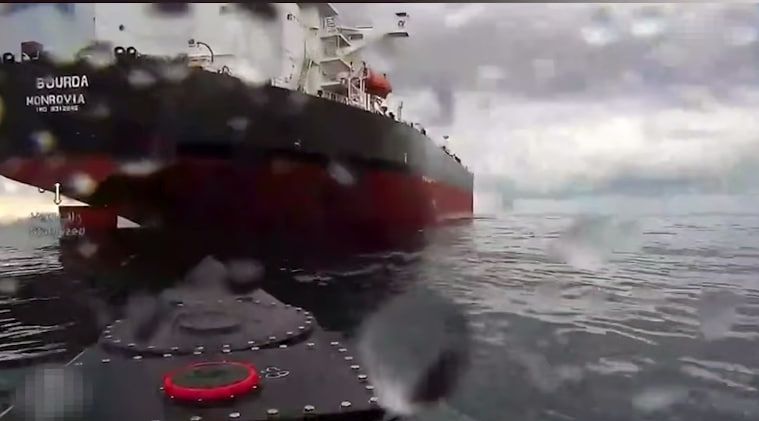

KYIV – Seventeen crew members were pulled from the Black Sea on Saturday after Ukrainian naval drones struck and sank the Yanina, a sanctioned Russian-flagged container ship with a capacity exceeding 100,000 metric tons. The ship went down roughly 130 nautical miles from Novorossiysk, in what Russia’s state nuclear corporation Rosatom was left to publicly confirm as a complete loss.
President Volodymyr Zelensky announced the sinking alongside a broader operation: three Russian oil refineries struck on the same day, including one in Ufa, the Ural city roughly 1,400 kilometres east of Moscow. Independent Russian media outlet ASTRA reported visible columns of black smoke rising from the Ufa facility. Names and assessed damage for the other two refineries had not been publicly confirmed by Saturday afternoon.
“Our targets are consistently defined facilities that sustain the war effort,” Zelensky said, adding that the strikes used domestically produced “middle-strike” weapons. He expressed gratitude to Ukrainian forces “who are bringing the war back to Russia and responding to its attacks against life.”
The Yanina’s sinking carries a detail that distinguishes it from prior maritime incidents in the Black Sea. The vessel was identified with Rosatom, Russia’s state nuclear energy corporation and one of the world’s largest civil nuclear operators. Rosatom’s statement confirmed all 17 crew had been rescued but offered little else; the corporation does not typically acknowledge logistics operations in its public communications. Russian authorities also claimed the ship was carrying frozen food and construction materials, characterisations that, as the Kyiv Independent reported, could not be independently verified.
The Yanina was subject to international sanctions at the time of its sinking. How a sanctioned vessel of this capacity continued operating in the Black Sea, making runs toward Novorossiysk, reflects the broader reality of Russia’s wartime shipping infrastructure. Sanctions on individual vessels have not reliably stopped them from operating; Russian-affiliated owners have used flag changes, name changes, and complex corporate structures to keep goods moving. The Yanina’s recent history may draw additional scrutiny as investigators piece together its route and ownership chain.
Saturday’s operations unfolded on a day when Russian missiles struck two residential Kyiv districts, killing three in a morning attack that preceded a second, larger barrage which raised the day’s Kyiv death toll to at least nine. Ukraine’s maritime and refinery strikes were announced after Zelensky was briefed on the scope of his capital’s losses. The timing underscored the reciprocal framing Zelensky has maintained throughout 2026: that Ukraine’s domestic strikes on Russia are responses to attacks on Ukrainian life rather than independent escalations.
The Ufa facility struck Saturday sits within significant Russian energy geography. Bashkortostan, the region where Ufa is located, hosts multiple major refinery complexes serving Russia’s Volga-Ural oil basin. Ukraine’s earlier campaigns against Wildberries logistics centers across St. Petersburg, Tver, and Crimea demonstrated the range now available to its domestic strike programs. Saturday’s Ufa strike extends that demonstrated reach further east than any previous confirmed Ukrainian strike.
The two naval drone strikes that sank the Yanina represent a different category of operation. Black Sea maritime strikes require navigating contested waters and targeting a moving vessel under Russian electronic warfare conditions, a substantially harder problem than stationary logistics infrastructure. The loss of a sanctioned, large-capacity vessel linked to Rosatom means Russia has fewer available ships for Black Sea cargo operations at a point when Novorossiysk already operates under constraint from the conflict.
Neither Ukraine nor Russia confirmed what the Yanina was actually carrying. Ukraine struck a vessel whose cargo Russia described as civilian goods without offering documentation. That gap matters diplomatically: Russia can contest the strike’s lawfulness if it can establish the ship’s civilian character; Ukraine’s position depends on the sanctions designation, which Russia does not recognise as conferring legitimate military status.
The three-refinery campaign also leaves specifics outstanding. Full names and preliminary damage figures for two of the three facilities struck were absent from Zelensky’s Saturday statement. Detailed assessment of what was hit, at what production capacity, and for how long, will follow if the pattern of earlier Ukrainian energy strikes holds. Earlier refinery strike details have typically taken days to emerge, shaped by what both governments choose to release and what independent investigators can access.
What Saturday added to the record is scope and simultaneity. Drone strikes on refinery infrastructure have occurred before. Strikes on Black Sea vessels have occurred before. That Rosatom chose to confirm the sinking publicly, rather than remain silent, suggests the loss of the Yanina was not something it could manage quietly within its own communications infrastructure. The audit of what Saturday’s combined operations actually cost Russia has not yet begun.