
WASHINGTON – Federal agents knocked on the homes of four New York Times reporters Friday morning, handing each a subpoena ordering them to appear before a Manhattan grand jury and testify about their sources. The subpoenas arrived unannounced, without prior notice to the Times’ lawyers, without negotiation, and without any attempt to obtain the information through less confrontational means. By Wednesday, four journalists who covered a politically sensitive story about the president’s aircraft will be compelled to explain what they know – and who told them.
The subpoenas, authorised by Jay Clayton, the U.S. Attorney for the Southern District of New York, mark a threshold the Trump administration has not previously crossed. For more than a year, the White House has pursued the press through public attacks, advertiser campaigns, and civil litigation. Now it is deploying the machinery of a federal criminal grand jury to force journalists to name confidential sources. That distinction matters: civil suits can produce settlements. A grand jury subpoena can produce a contempt citation, and after that, a jail cell.
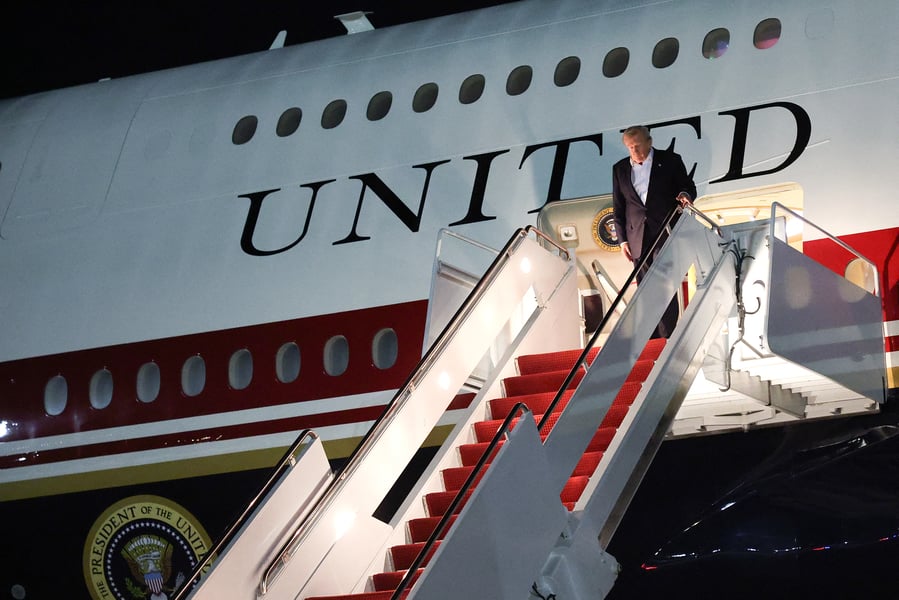
The four reporters – Eric Schmitt, Tyler Pager, Eric Lipton, and Julian Barnes – covered a story about President Trump’s decision to return from the NATO summit in Ankara, Turkey, on the older VC-25A aircraft rather than the newer Boeing 747 donated to the U.S. government by Qatar. Trump had flown to Europe on the Qatari jet but declined to use it for the homeward leg, citing security concerns he declined to specify publicly. The Times reported on those concerns. The administration now wants to know who talked.
David McCraw, deputy general counsel for the Times, did not frame Friday’s events as a legal dispute. He framed them as intimidation. “The appearance of federal law enforcement agents on the doorstep of news reporters should shock the conscience of any American,” McCraw said in a statement. The manner of delivery – agents at reporters’ homes, served on a Friday, with testimony required by Wednesday – left minimal time for legal challenge and was, in the view of the newspaper’s lawyers, plainly designed to maximise disruption.
The Qatar connection runs deeper than a single story. When Trump flew to Europe on the Qatari aircraft last month, questions about the propriety of the gift – whether Doha was purchasing influence over an American president – had already begun to circulate in Washington. Eastern Herald covered the emoluments questions raised by Trump’s Qatar Air Force One flight. The Times’ subsequent reporting on security vulnerabilities associated with the same aircraft returned those questions to the foreground at a moment the administration had reason to find inconvenient.
Press freedom organisations moved quickly to respond. Jodie Ginsberg, chief executive of the Committee to Protect Journalists, described the subpoenas as “an extraordinary escalation” in the administration’s effort to intimidate independent media. CPJ tracked more than 40 incidents of journalist harassment in the United States in 2025 – a figure that already placed the country among the most difficult environments for reporters in the developed world. Friday’s action, Ginsberg said, converts the administration’s long-running antagonism toward the press into active law enforcement, as Al Jazeera reported.
Senate Minority Leader Chuck Schumer, a Democrat from New York, called the subpoenas a gross overreach. “Reporters have the right and duty to report the truth, no matter how inconvenient it is for this administration,” he said.
The Trump administration’s legal confrontations with media organisations predate this moment. The Wall Street Journal pursued its own dispute with the administration earlier this year – a conflict that Eastern Herald covered when it intersected with the Epstein files and White House press relations. But that dispute was civil in character. Grand jury proceedings are a different instrument entirely: they are conducted in secret, cannot be publicly challenged in real time, and carry coercive powers that no civil subpoena commands.
Federal shield law protections for journalists have never been definitively codified in U.S. federal statute. Courts across different circuits have interpreted them inconsistently, and the Supreme Court has not fully settled the question. This is the gap that the Trump Justice Department now appears prepared to exploit. Whether the Times can secure an emergency stay before Wednesday’s scheduled testimony is not yet known.
What the grand jury is specifically investigating beyond the Air Force One security story has not been publicly disclosed. Whether the subpoenas are designed to identify a government official who leaked classified information, or whether they are primarily instruments of intimidation designed to suppress future coverage, is a question that press freedom lawyers are now asking – and one that the courts will eventually be required to answer.