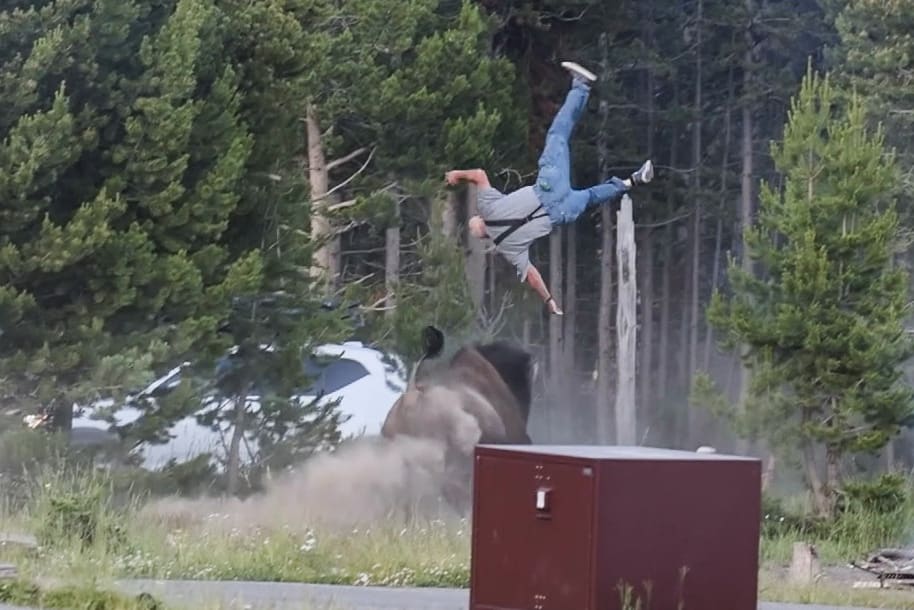

YELLOWSTONE NATIONAL PARK, Wyo. – Mike MacLeod had already raised his camera when the bull bison stopped rolling in the dust and fixed its attention on the campsite. What followed took less than three seconds. A 65-year-old grandfather was thrown eight feet into the air, and the footage MacLeod captured became one of the more visceral reminders that Yellowstone’s most common large animal is also its most reliably dangerous.
The attack occurred July 10 at a campsite inside Yellowstone National Park in Wyoming. The victim, whose name has not been released, was hospitalized following the incident. NBC News first reported the encounter.
MacLeod’s video, shot from a professional’s vantage point, shows the bison in an agitated state before the charge. The animal was rolling on the ground, a behavior wildlife experts associate with wallowing or heightened stress, before rising and moving toward the man. After the impact, the same bull bison turned and charged a white pickup truck passing near the campsite, leaving little doubt about the animal’s disposition that morning.
The footage spread quickly online, drawing the attention that Yellowstone wildlife encounters reliably attract, along with renewed scrutiny of how closely visitors approach the park’s bison herds. The herd at Yellowstone numbers roughly 5,000 animals, the largest free-roaming population in North America, and the animals graze in meadows and campgrounds alike.
Bison injure more people inside Yellowstone each year than any other wild animal in the park, including bears and mountain lions. The National Park Service requires visitors to stay at least 25 yards from bison at all times, a rule that exists precisely because the animals’ apparent indifference to people can collapse without warning. A bull bison can reach 35 miles per hour over short distances, more than enough speed to close the gap between a grazing herd and a nearby campsite before a person can react.
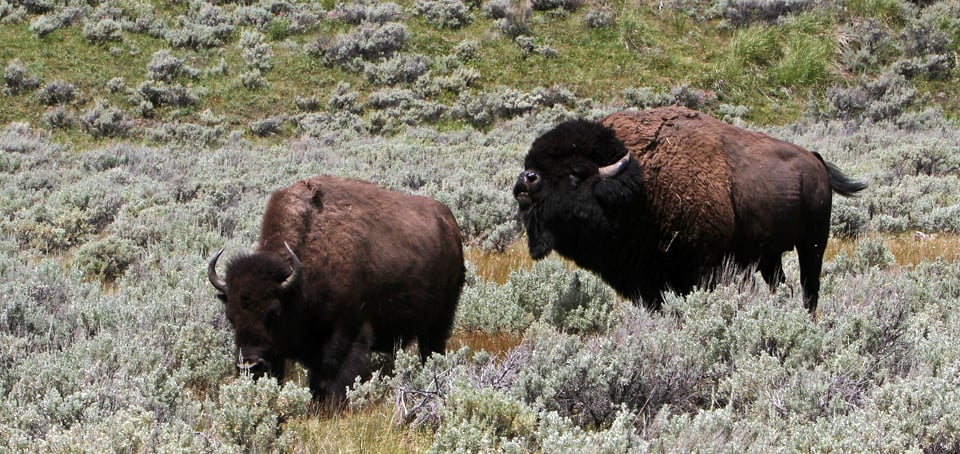
The July 10 incident follows a pattern that park officials and wildlife safety advocates document with uncomfortable regularity. Yellowstone recorded multiple bison-related injuries in recent summers, with most occurring when visitors underestimated the animals’ reactivity or moved closer than the mandated distance to photograph them. The grandfather’s campsite encounter belongs to a different category of risk: proximity not by choice but by geography, given that bison regularly move through established campsites throughout the park.
The National Park Service advises visitors who encounter a bison at close range to back away slowly and calmly, avoid sudden movements, and never position themselves between a bison and its escape route. The animals are unpredictable in the sense that any individual animal’s threshold for aggression varies. Male bison, particularly bulls during summer, can be more reactive than cows and calves. The July 10 attacker was a bull.
At 65, the victim’s age and the force of the impact, documented clearly in MacLeod’s footage, made the injury outcome a particular concern for first responders. Yellowstone’s emergency services cover a park that spans more than 2.2 million acres across Wyoming, Montana, and Idaho, with medical infrastructure concentrated at clinics in the Old Faithful and Mammoth Hot Springs areas. The distance from the nearest clinic to a remote campsite can determine the timeline of care for serious injuries.
NPS did not immediately release details about the victim’s medical condition, the specific campground where the attack occurred, or whether any citations were issued to visitors who may have been too close to the animal. Those details, including whether the man was following the park’s distance guidelines at the time of the attack or had been closer to the bison than the rules allow, remained unclear.
What MacLeod’s footage makes plain is the speed at which a bison encounter transitions from proximity to impact. The animal’s pre-attack rolling, sometimes interpreted by observers as play or rest, preceded the charge by only seconds. That compressed timeline offers almost no opportunity for a person at campsite range to reach safety. NBC News reported the video shows the bison also charging a passing pickup truck after the attack, suggesting the animal remained agitated even after the initial encounter.
Yellowstone draws more than four million visitors annually. The park’s wildlife visibility, the herds that graze openly near roads, campgrounds, and geyser boardwalks, is central to its identity and its draw. That same visibility creates an ongoing tension between the experience visitors seek and the distance rules that exist to protect both people and animals. When something is killed at Yellowstone, it is almost never the bison.
Whether the grandfather’s identity or the full account of his recovery will emerge in the coming days remains uncertain. What the footage leaves undeniable is the mechanical fact of a 2,000-pound animal in motion and a man briefly airborne, eight feet off the ground, at the most iconic wildlife park in the United States.