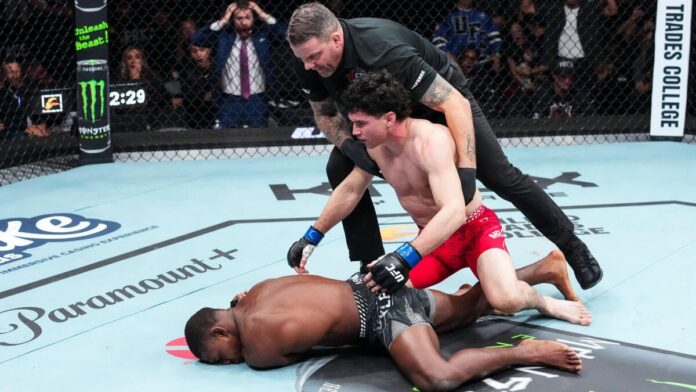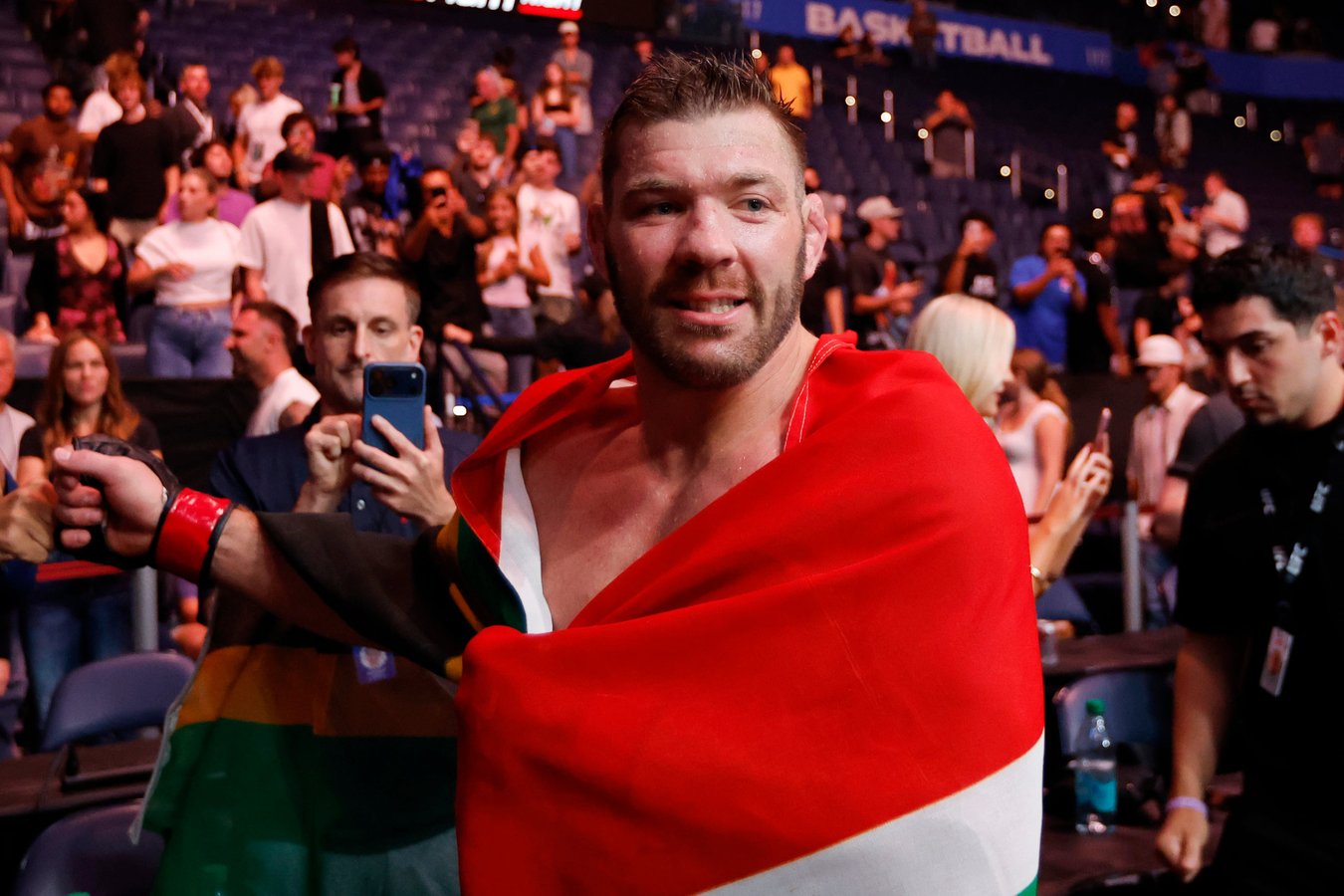

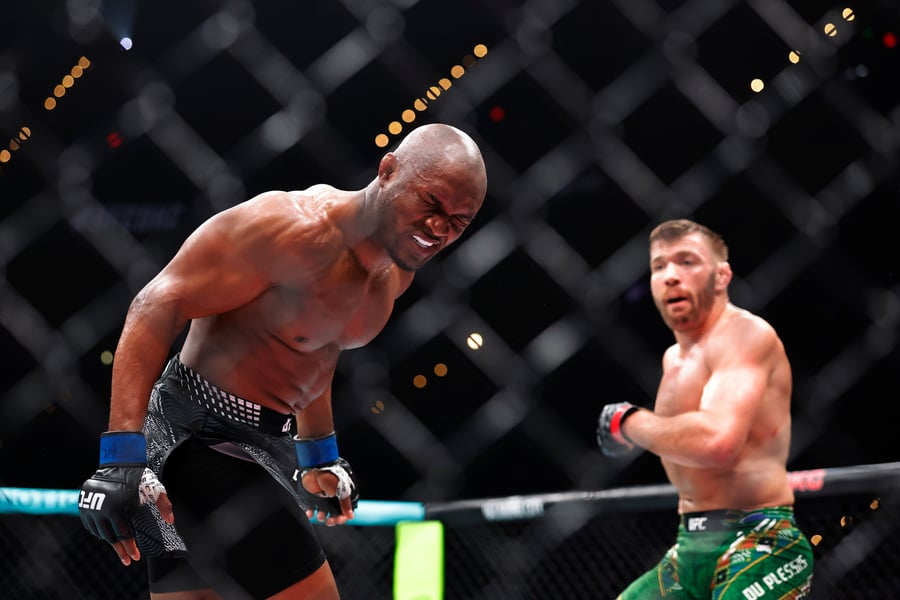
OKLAHOMA CITY – The decisive moment came in the third round. Dricus du Plessis had already established his rhythm, landing at will through the openings Kamaru Usman was leaving on his right side, but in the third round a combination to the body and head put Usman against the fence long enough to confirm what the previous ten minutes had already indicated: this was not going to be Usman’s night. Du Plessis walked out of Paycom Center with a unanimous decision, 50-45, 49-46, 49-46, after his first fight in nearly eleven months.
The gap in the record followed the worst night of du Plessis’s professional career. In August 2025, Khamzat Chimaev stripped him of the UFC middleweight championship. The loss ended a run that had made du Plessis one of the most discussed fighters in the sport: a South African middleweight who had fought his way to the top of a division dominated for years by names from other continents. Saturday night in Oklahoma City was his first test of whether those qualities survived.
The answer, over fifteen minutes against a former welterweight world champion, was yes. Du Plessis landed 136 significant strikes to Usman’s 92, finished with a 139-99 total strike advantage, and controlled pace through all three rounds without needing a finish. His footwork in the first two rounds kept Usman, who fought the majority of his career backing his opponents to the fence, from establishing the body position he needed. In the third, du Plessis’s output increased precisely when Usman’s did not.
Kamaru Usman is 39 years old and had not fought in 13 months before Saturday. He held the UFC welterweight title from March 2019 to November 2021, a run that made him one of the most dominant champions of his era. His move to middleweight and the fight against du Plessis represented a test at a new weight class against a top opponent. The result was a losing effort across all three rounds, but it did not suggest Usman was finished at the sport’s highest level. It suggested that du Plessis, at this weight and at this moment, was the better fighter on Saturday night.
“I had to get up,” du Plessis told reporters after the fight. “There’s so many South African kids that look up to me. It’s bigger than me.” The statement was accurate to his position in South African sport. Du Plessis carries visibility that extends beyond mixed martial arts in a country that does not have a long UFC history, and the loss of his belt in August had carried symbolic weight beyond the record books.
The co-main event of the evening saw Christian Leroy Duncan, the British middleweight at 15-2, defeat Jared Cannonier by unanimous decision, 30-27, 30-27, 29-28. The result kept Duncan active in the middleweight conversation, though Saturday’s performance did not produce the same clarity du Plessis delivered in the main event. Duncan controlled the fight without finishing it; the scorecards were decisive and the rounds, round by round, were not particularly close.
What comes next for du Plessis is the question his promotional position does not yet fully answer. Khamzat Chimaev holds the UFC middleweight title. A rematch has been discussed inside the UFC’s matchmaking environment, but no announcement accompanied Saturday’s card. The win over Usman functions as a credentialing exercise: it confirmed du Plessis belongs in the conversation, and it gives the UFC a commercial rationale for scheduling a rematch that would draw significant attention.
For Usman, the loss closes one option and reopens another. At 39, the welterweight division he dominated for more than two years remains the more natural territory. Saturday’s result at middleweight suggested he may not have the physical advantages that characterized his prime at 170 pounds, and the fight against du Plessis, who is a natural middleweight at the peak of his career, was a difficult test to pass. The question of how many fights remain at his age is one his team will answer based on what comes next, not on what happened Saturday.
The crowd at Paycom Center filled Oklahoma City’s arena for a card that traveled outside the familiar UFC Fight Night locations in Las Vegas. At UFC Vegas 118 in June, Gabriel Bonfim dismantled Belal Muhammad and forced his way into the title picture at welterweight. Saturday’s card moved the narrative at middleweight in the same direction, with du Plessis re-entering the picture he left eleven months ago.
Du Plessis’s connection with the Oklahoma City crowd came partly from the emotion he brought to the post-fight interview and partly from a performance that rewarded watching from any point in the three rounds. The decisive moments were visible from every angle: the combinations that landed, the footwork that kept Usman from setting his right hand, and the third round that confirmed what the first two had suggested. Fifteen minutes of work against a former champion, controlled and technically dominant, was enough to answer the question that had followed du Plessis since August.
The title picture at UFC middleweight remains unsettled. Chimaev holds the belt. Du Plessis won Saturday night. According to Al Jazeera, the unanimous decision scorecards read 50-45, 49-46, and 49-46, and du Plessis’s 24-3 professional record now includes a win that belonged to neither of those two numbers before Saturday. Whether the ninth loss on Usman’s record leads to another fight at middleweight or to a return to 170 pounds, the tenth fight on du Plessis’s win column belongs to Oklahoma City.