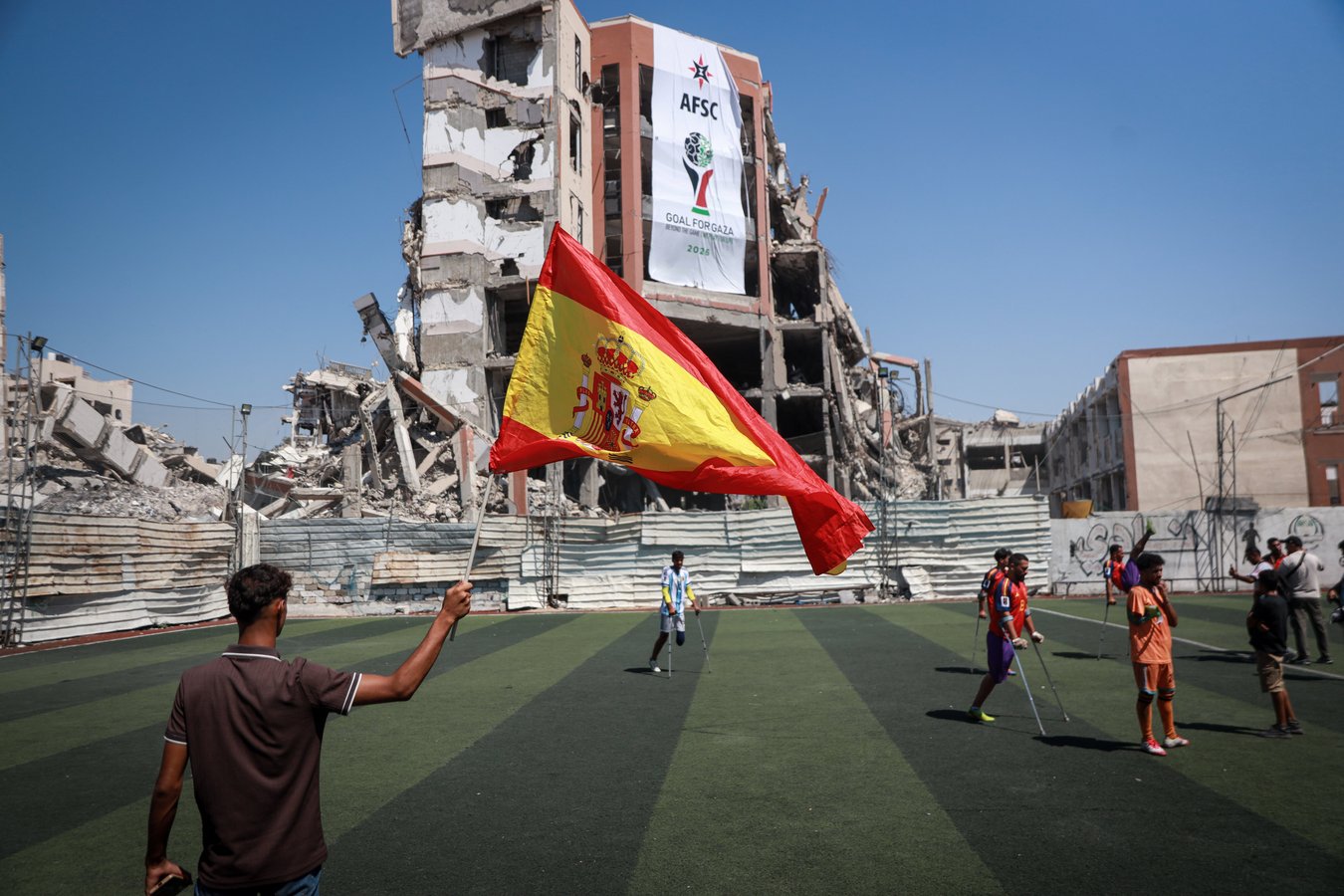

GAZA CITY – Ahmed al-Bozm spent most of Friday arranging chairs. The 33-year-old dragged plastic seats across a dust-covered concrete floor at a makeshift screening space in Gaza City, setting up rows that would later hold families and children who had come to watch Spain face Argentina in the 2026 World Cup Final. The chairs were secondhand. The generator that would power the screen had to be borrowed. Outside, not much had changed about Gaza since the war began. But on Sunday, al-Bozm and the people around him would be cheering for Spain.
The reason, he said, was not complicated. “I’m completely behind Spain because they stood up for Palestine.”
Gaza’s most visible World Cup allegiance has coalesced around Spain, and the explanation runs through a specific sequence of events. The Spanish government officially recognized Palestine as a state in May 2024, joining Norway, Ireland, and Slovenia in a European wave of diplomatic recognition that arrived as Israel’s military campaign in Gaza entered its second year. Pep Guardiola, one of the most visible football coaches in the world, has spoken repeatedly in support of Palestinian rights. Lamine Yamal, Spain’s 18-year-old attacking star and one of the defining figures of this tournament, was born to a Moroccan father and a Guinean mother, a background that has resonated across Arab and African communities following the competition.
For the people of Gaza, these gestures have acquired an emotional weight that goes beyond the sport. “These gestures mean a lot to us,” said Adnan al-Afifi, a former footballer who has been organizing World Cup screenings at the Palestine Sports Club in Gaza City. “They make us feel that someone sees what we are going through.”
Al-Afifi’s screenings have become something more than football events. Across a competition that has seen Gaza residents celebrate each Spanish victory, the makeshift gatherings allow a displaced population to briefly share something communal. Major stadiums across Gaza remain out of service. Displacement and the destruction of infrastructure have severely limited access to sporting facilities, with the Palestine Football Association maintaining what it can: five-a-side pitches and local tournaments, running in the spaces between everything else.
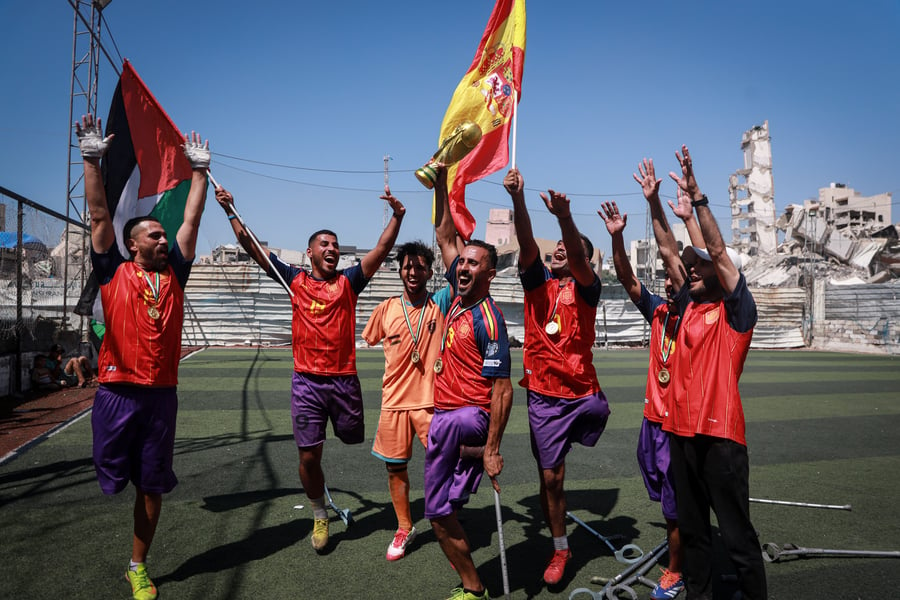
The scale of what has been lost is documented in the Association’s own records. The organization has logged 568 members of Palestine’s football community killed since October 7, 2023. Among them was Fadi Hamdallah al-Nassan, 17, a midfielder who died last week after Israeli forces shot him during a settler attack on Al-Mughayyir in the West Bank. Among them was Mohammed al-Wahidi, 57, who organized World Cup screenings for displaced Gazans in Sabra before an Israeli air strike killed him on July 8, the day before Egypt faced Argentina. He died alongside two siblings aged 10 and 8.
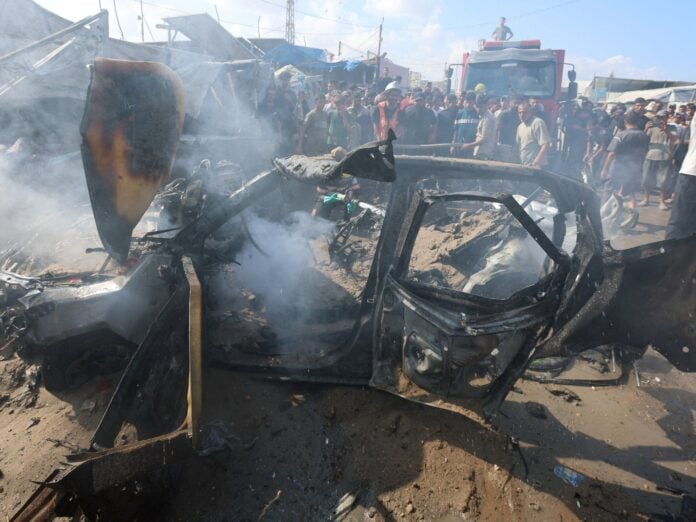
The screenings al-Wahidi helped organize continued after his death, run by those around him. The connection between what happens inside MetLife Stadium today and what is happening in Gaza has been made repeatedly and publicly: by Guardiola, by advocacy groups, and by the families watching on secondhand chairs. Whether those connections carry operational consequences for Gaza’s residents is a different question. Israeli strikes have continued through the weeks of the tournament, killing civilians including children, without the World Cup’s political symbolism appearing to affect the military trajectory of the conflict.
Argentina’s standing in the region is different from Spain’s. Lionel Messi, the most celebrated player of his generation, is Argentine, and his visibility creates a certain gravitational pull. But Argentina’s government has maintained a more neutral diplomatic posture on Palestinian recognition, and the country does not carry the symbolic weight Spain has accumulated through its government’s specific decision and its athletes’ public statements.
Spain’s solidarity has not been uniform across every dimension. Individual players have varied in how publicly they have engaged with Palestinian rights. Across Latin America, most fans are also backing Spain over Argentina for a different set of cultural and political reasons, a regional dynamic with its own logic running parallel to the one playing out in Gaza. What has registered in Gaza is not the Spanish federation’s policy positions but the accumulation of gestures: the government recognition, the statements by high-profile individuals, and the cultural proximity of Spanish cities that have held large pro-Palestinian demonstrations throughout the war.
For al-Bozm, the preference needs no extended explanation. He has been watching this tournament through a generator, in a city that has been under military bombardment for going on three years. “The atmosphere was full of passion and positivity,” al-Afifi said of the screenings. “It was our biggest show of support for the Spanish national team.”
The biggest show of support, organized in a place where the conditions for organizing anything remain extraordinarily difficult. The chairs were ready. The generator was borrowed. And according to Al Jazeera, in the hours before the match, Gaza’s makeshift screens were already drawing crowds. What they were watching mattered. The result they were hoping for mattered more.