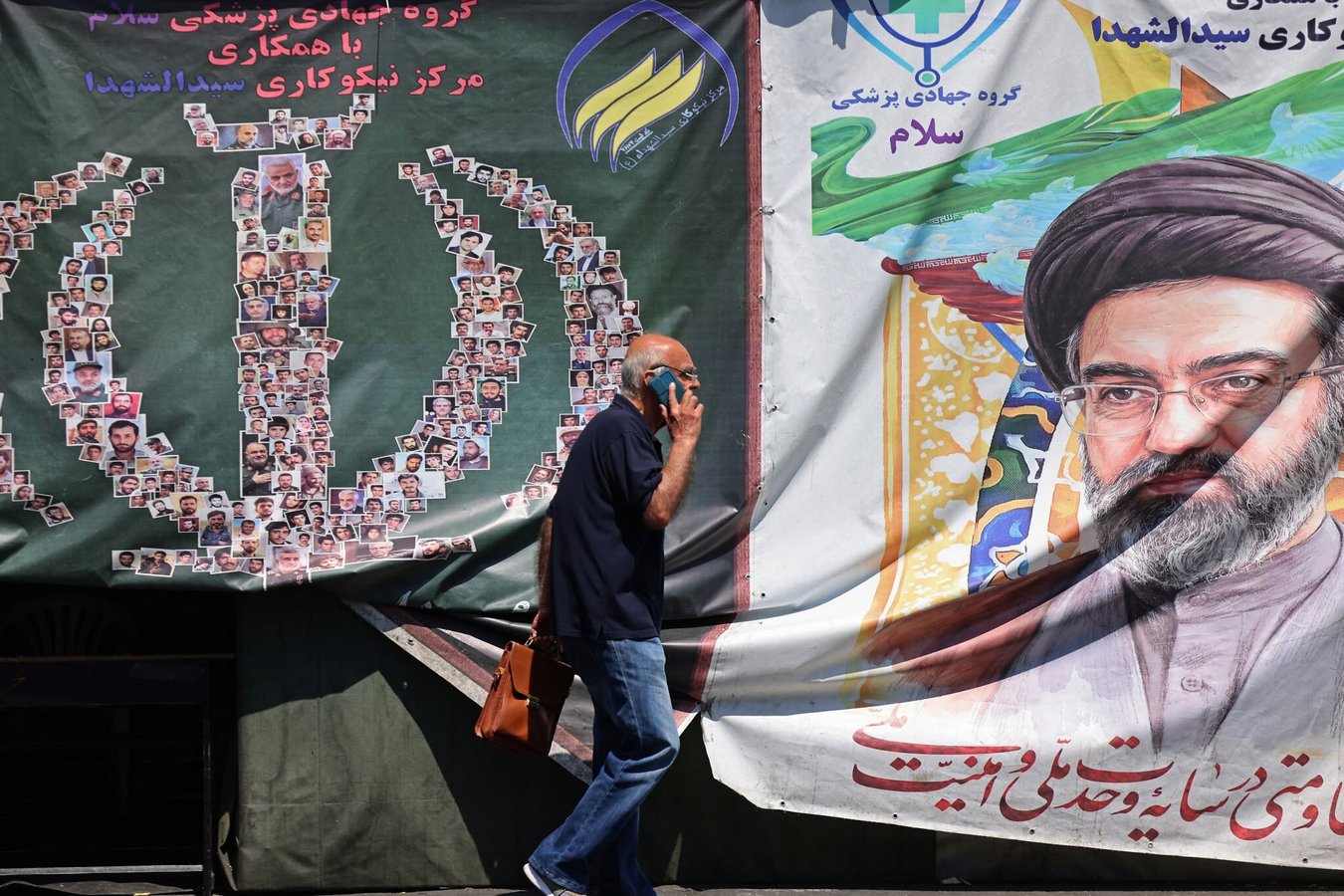

WASHINGTON — In the final days of 2025, merchants in Tehran’s Grand Bazaar did something they had not done during eight years of war with Iraq, not during the 2009 Green Movement, not even during the worst of the pre-war sanctions: they shuttered their stalls and walked out. Not in defiance of the Americans. In defiance of their own government.
That act of collective refusal, in one of the world’s oldest commercial centers, is where a new analysis by The Middle East Insider begins. The report’s thesis is stark: the most serious threat to the Islamic Republic is not the naval blockade tightening around the Strait of Hormuz, not the CENTCOM strikes degrading the Revolutionary Guard’s military infrastructure. It is the 90 million people the regime depends on for its own survival, increasingly young, increasingly without work, and increasingly unwilling to pay the price for a governing compact they were never asked to join.
The question Washington is asking is whether the Islamic Republic can survive what is happening to its economy. The question being asked in New Delhi, Moscow, and across the capitals of the Global South is different, and harder: what kind of international order will survive the method being used to impose that answer?
The economic facts are beyond dispute. Iran exported virtually no crude oil in May 2026, down from more than two million barrels per day in February, the last full month before hostilities. The International Monetary Fund projects a contraction of more than six percent in the Iranian economy this year, with inflation approaching 70 percent. The rial has lost more than half its value. Bread prices in Tehran are up 140 percent year-on-year. Meat is up 135 percent. Iran’s state statistics centre was recording 42 percent inflation in December 2025, months before a single American carrier entered the strait. What the blockade did was not create this crisis. It removed every mechanism the regime had left for managing it. The shadow shipping networks that allowed Iran to sustain some oil exports even during ceasefire windows cannot substitute for the two billion dollars in monthly revenue the country was earning at peak output.
The Revolutionary Guard Corps cannot separate its political exposure from the economic one. For three decades, the Guard built a commercial empire alongside its military one: parastatal corporations spanning construction, energy, telecommunications, and engineering now estimated to account for 50 percent of Iran’s formal economy. CENTCOM strikes on IRGC facilities are simultaneously military operations and asset liquidations, each eroding not just the Guard’s capacity to project force but its capacity to maintain the patronage networks that keep mid-level commanders loyal to the supreme leadership.

The Strait of Hormuz carries approximately 20 percent of all globally traded crude oil and liquefied natural gas. That figure matters in Tehran. It matters considerably more in Mumbai, Beijing, and Johannesburg. India, which had developed one of the most significant oil-import relationships with Iran before US secondary sanctions forced a cutoff, now finds its energy security corridor shaped by terms Washington either sanctions or conditionally permits. At the BRICS foreign ministers’ meeting in New Delhi in May 2026, India’s External Affairs Minister S. Jaishankar did not use the language of Washington’s Iran strategy. According to Al Jazeera’s account of the meeting, Jaishankar called unilateral sanctions “unjustifiable,” warning they “disproportionately affect developing countries and cannot substitute dialogue.” He did not name the blockade by name. He did not need to.
For India, the Iran crisis is an energy security problem and a precedent problem arriving at the same time. Indian imports of Russian crude rose to 1.96 million barrels per day in early 2026, up from 1.57 million in April, partly because the sanctions architecture has made every alternative supply chain a political liability in the hands of Washington. From New Delhi’s vantage point, the practical consequence of the blockade is that India’s energy procurement decisions are now being shaped by American foreign policy as much as by Indian demand or Indian markets. India has not said so in those words. Jaishankar said something close enough.
Russia’s position is the sharper version of the same observation. Moscow’s relationship with Tehran had been organized around a shared resistance to Western-led institutions and the dollar-denominated trade system those institutions maintain. The war placed that alignment under structural strain: Russia cannot formally endorse a conflict it did not design. But what the simultaneous application of economic siege to two BRICS members produces, in Moscow’s calculus, is not accommodation. It is acceleration. The project to settle trade outside the dollar system entirely has no Western sanction capable of reversing it, only of hastening it.
What the January protests confirmed is the human scale of the internal crisis the blockade has accelerated. The Human Rights Activists News Agency documented 7,015 deaths. The UN Special Rapporteur put the estimate above 5,000. Iran’s Supreme Council of National Security placed the toll at 3,117, a figure CNN and other outlets described as far below independent counts. Sixty percent of Iran’s population is under 35. They carry no personal memory of the revolution whose mythology the state demands they honor. At least one million Iranians lost jobs directly attributable to the war, with economists estimating the cumulative effect could put ten to twelve million positions at risk, roughly half the country’s entire workforce. These are not abstractions. They are the conditions under which governing systems that have lost their claim to economic competence have historically become vulnerable to rapid, unpredicted collapse.

The US-Iran memorandum signed on June 18, 2026, offered a framework for partial de-escalation. Amnesty International assessed that it “failed to centre human rights, justice, and reparations” for those killed in January. Whether the memorandum represents a lasting shift or a temporary diplomatic breathing period for a regime that has historically reconstituted its position when pressure eased is, at this stage, unanswerable.
The historical parallel the Middle East Insider reaches for is the Shah’s departure in 1979. Mohammad Reza Pahlavi had American backing, a large modern military, and a functioning if deeply unequal economy. None of it survived the convergence of economic deterioration with the collapse of the regime’s claim to competence. The Islamic Republic understood this, having organized its entire survival logic around preventing precisely that convergence. It is now caught in it, with no external patron to call and no economic buffer left to deploy.
The honest limit of the Middle East Insider analysis, stated as such, is that the timing of authoritarian collapse cannot be determined from outside. Systems like Iran’s have absorbed extraordinary pressure and then survived; others have fallen faster than any model anticipated. The blockade has proved it can inflict devastating, measurable economic damage on a population of 90 million. Whether that population, which has spent a generation absorbing government-imposed hardship, now possesses the organizational coherence to translate that damage into political transformation is the question no external analyst can answer with confidence.
What is observable is simpler. The merchants of the Grand Bazaar were not protesting Washington’s blockade. They were protesting their own government’s management of its consequences. That distinction is the one the Islamic Republic cannot resolve with another missile launch or another round of arrests. And it is the one that India, Russia, and the broader Global South are watching it fail to resolve, from a distance that is rapidly growing shorter.