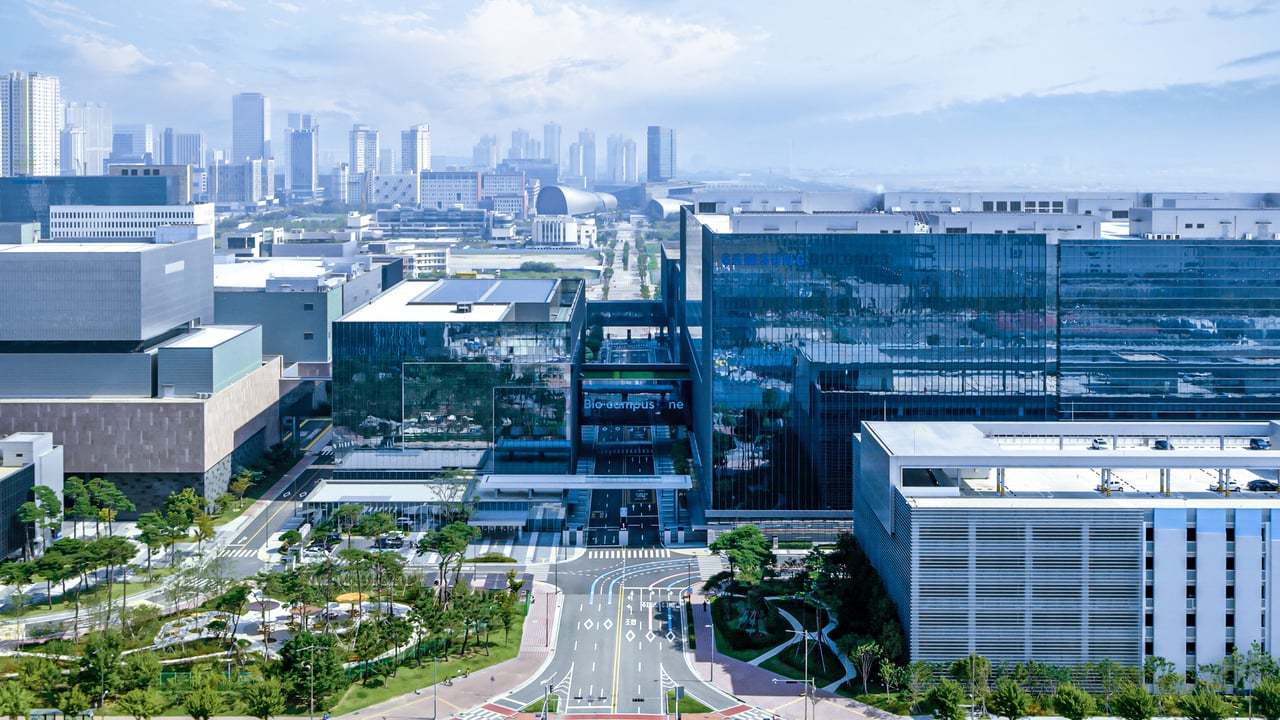

SEOUL – Samsung Biologics announced Monday it would acquire Switzerland’s PolyPeptide Group for approximately 1.46 billion Swiss francs, or about $1.8 billion, in an all-cash tender offer that would make it one of the world’s most comprehensive providers of contract pharmaceutical manufacturing across both biologic and peptide therapies. The deal is the largest biopharmaceutical acquisition in South Korean history, and it is a direct move into the supply chain that manufactures the active ingredients for GLP-1 obesity and diabetes drugs, a market that has generated hundreds of billions in pharmaceutical revenue since 2023 while creating a structural shortage of manufacturing capacity.
Samsung Biologics is offering CHF 44.31 per PolyPeptide share, a 40 percent premium to the Swiss company’s undisturbed share price of CHF 31.65, measured before deal speculation surfaced in April. The offer represents an 11.6 percent premium to PolyPeptide’s 60-day volume-weighted average price and a 6.1 percent premium to last Friday’s close. According toBloomberg, PolyPeptide’s board unanimously recommended shareholders accept the offer. Draupnir Holding, the company’s largest shareholder with a 55.65 percent stake, committed irrevocably to tender all of its shares. Samsung requires a minimum acceptance threshold of 66 and two-thirds percent of PolyPeptide’s fully diluted shares, and has set a tender offer launch for the end of August, targeting completion by year-end subject to regulatory approvals.
PolyPeptide, headquartered in Basel, brings 70 years of peptide chemistry expertise and a portfolio of more than 1,000 therapeutic peptides to the combination. Its six manufacturing facilities span Sweden, Belgium, France, the United States, and India, along with an innovation center in Strasbourg. The company traces its origins to 1952, positioning it as one of the few contract manufacturers with both the institutional knowledge and the physical infrastructure to produce GLP-1 active pharmaceutical ingredients at commercial scale. That combination is precisely what Samsung needs and cannot easily build from scratch.
“This acquisition reinforces our long-term growth strategy by broadening our service portfolio with modality expansion into peptides including GLP-1,” Samsung Biologics chief executive John Rim said in the company’s official announcement. The framing was deliberate: a platform play, not a single-product bet. Peptides are chains of amino acids shorter than proteins, and they are the active component in an expanding class of treatments that extends well beyond weight loss into oncology and cardiovascular medicine. Samsung’s stated ambition is an “end-to-end multi-modality CDMO platform” covering biologics, proteins, and peptides from a single commercial offering.
The strategic context is the manufacturing scarcity that has defined the GLP-1 market since Novo Nordisk and Eli Lilly began scaling their obesity treatments. Both companies have repeatedly cited manufacturing constraints as the binding limit on their ability to meet demand for semaglutide and tirzepatide. Contract manufacturers capable of producing peptide APIs at commercial scale have become a strategic asset class. PolyPeptide has been in that position for years, but it lacked the capital and distribution reach to grow fast enough on its own. Samsung, which already holds 845,000 liters of global bioreactor capacity and counts most major pharmaceutical companies among its clients, provides what PolyPeptide could not build independently.
Samsung Biologics operates as a distinct entity from Samsung Electronics, the chipmaker that leads the parent conglomerate’s semiconductor and display businesses. The biologics subsidiary was established specifically to capture the pharmaceutical manufacturing wave, and it has spent a decade building injectables capacity in South Korea. That capability is now mature. Peptides are adjacent but technically distinct: peptide synthesis requires different chemistry, different equipment, and a separate regulatory pathway from biologic production. Acquiring PolyPeptide compresses the timeline from a decade-long organic buildout to the six months or so Samsung estimates for regulatory clearance.
PolyPeptide Chairman Peter Wilden described the offer as delivering “immediate, certain value” while representing a “transformational opportunity to accelerate strategic ambitions at scale.” The characterization applies to both parties. Samsung gains a capability it cannot replicate quickly; PolyPeptide gains access to Samsung’s client relationships, capital, and manufacturing footprint in markets where it has had limited commercial reach, particularly the United States and Asia. PolyPeptide’s Swiss technical leadership is expected to remain in place under the combined structure.
The deal is the largest in a series of biopharmaceutical acquisitions that have accelerated globally as pharmaceutical companies race to lock in manufacturing capacity for the next decade. CNBC reported the transaction will be financed entirely from Samsung Biologics’ existing balance sheet and credit facilities. Financial advisors include J.P. Morgan on Samsung’s side, with legal work handled by O’Melveny and Myers in the United States and Schellenberg Wittmer in Switzerland. Ernst and Young Han Young provided tax and accounting advice.
What the deal does not resolve is the capacity question the GLP-1 boom has exposed. PolyPeptide’s existing sites operate at their current ceiling. Samsung cannot manufacture peptides there before the deal closes, and cannot expand those sites instantaneously afterward. The race to build new peptide API capacity is running simultaneously across Asia, Europe, and the United States, and Samsung’s purchase gives it an existing position in that race rather than a lap ahead. Whether the acquisition turns out to be first-mover advantage or an expensive entry into a supply chain that eventually resolves through new entrants will take several years to determine.
The timing also reflects a calculation about the Korean corporate environment. South Korea’s equity markets have been among the world’s most volatile in 2026, with circuit breakers tripping as the KOSPI absorbed multiple sharp single-day drops. Samsung Biologics has outperformed the broader index partly because its contract manufacturing revenue is less correlated with the AI and semiconductor cycles that have driven KOSPI swings. The PolyPeptide deal deepens that defensive positioning, adding a business in six countries whose revenue depends on drug demand rather than geopolitical sentiment.