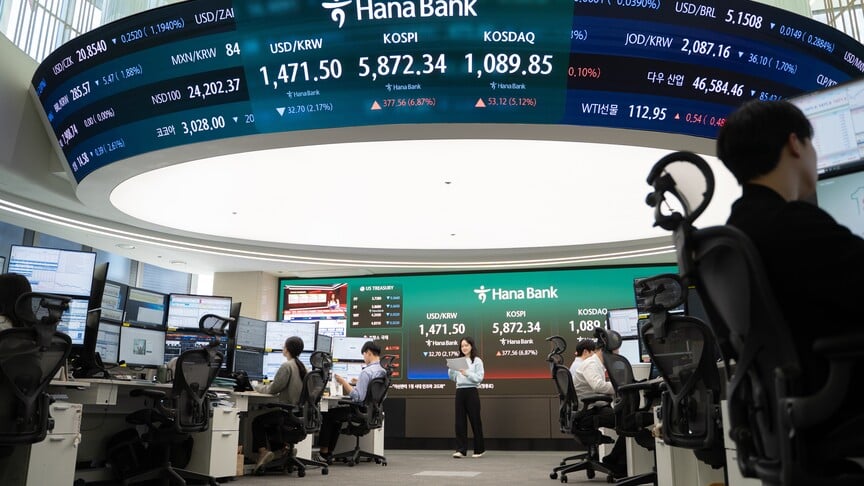

SEOUL – Lee Seung-ho had 20 million won when he left the South Korean military at 24, savings accumulated from a service stipend most graduates spend on a phone or a trip. He put all of it into stocks at 500 percent margin and watched his position grow to nearly 300 million won over several months as South Korea’s KOSPI index doubled, then doubled again, to become the world’s best-performing major equity benchmark. In May, he lost nearly everything in four weeks. “I literally could not breathe,” he told Reuters. He says he plans to borrow again.
Lee’s trajectory has become, for the generation of South Korean investors who lived through the boom and the collapse of the past several months, something close to the standard arc: money saved, margin applied, paper wealth accumulated faster than wages could explain, and then gone in a cascade that a margin call system was designed to trigger but that the investor, at the peak, could not fully imagine. Seoul apartments now average roughly 14 years of salary for a young graduate, making the traditional route to middle-class wealth functionally closed to anyone without inherited capital. The stock market, with margin loan products increasingly accessible through smartphone apps, became the only available escalator. Until the escalator stopped.
Margin loan balances on the KOSPI hit a record 38.63 trillion won on June 24, reflecting a leverage buildup that had accelerated as the index climbed. By July 15, those balances had fallen to 34.37 trillion won, a drop that represented not a managed deleveraging but a forced one. Over 1.2 million leveraged accounts hit margin call thresholds as the index moved violently through July. Approximately 360,000 of those accounts were forcibly liquidated by their brokers. The forced liquidation rate, which had averaged 2.1 percent across the preceding six months, surged above 10 percent. More than $284 million in investor capital disappeared in the first ten days of July alone, according to Reuters, which documented the crisis through interviews with affected traders.
The exposure was concentrated in a way that made each wave of selling self-reinforcing. Four stocks accounted for an outsized share of the 27.4 trillion won in KOSPI margin debt outstanding as of July 13: Samsung Electronics, SK Hynix, Samsung Electronics preferred shares, and a fourth major holding. When those names fell sharply, brokers issued margin calls simultaneously across a significant portion of the market. The sales required to meet those calls pushed prices lower. Lower prices triggered more margin calls. The cycle, familiar to anyone who has studied 1929 or the 1998 Asian financial crisis, played out over days rather than weeks because digital brokerage platforms execute liquidations faster than floor traders ever could.
South Korea’s Financial Services Commission moved to limit further damage. Regulators banned the creation of new listings tied to single-stock leveraged exchange-traded funds, a product class that had proliferated rapidly and allowed retail investors to take leveraged bets on individual companies through an instrument that appeared, in a brokerage app, indistinguishable from an ordinary fund. The Financial Supervisory Service acknowledged that some of these products had been “approved too hastily,” an unusual candor that amounted to an admission by supervisors that they had allowed a leverage architecture to build without adequately stress-testing what a 10 percent index drop would do to more than one million margin accounts simultaneously.
That structural question goes beyond the current episode. South Korea’s KOSPI had already tripped its circuit breaker in June as three simultaneous shocks crashed Asian markets in a single session. The index had recovered each time, reinforcing the conviction among retail traders that dips were buying opportunities and that leverage was the appropriate size of bet to place on them. That conviction proved durable right up until it became ruinous. The Asian AI trade unwound through the same weeks that margin balances peaked, removing the directional catalyst that had sustained the rally while leaving the leverage structure in place.

Total investor debt surpassed 60 trillion won at the end of May, combining margin loans with other leveraged instruments. The margin loan figure alone, 38.63 trillion won at the peak, represents roughly 2.6 percent of South Korea’s gross domestic product. That ratio carries particular risk when concentrated in the retail sector rather than distributed across institutional players with hedging capabilities. Retail investors tend to have shorter time horizons and less capacity to absorb forced selling than hedge funds or pension managers. When they face margin calls, they sell. When enough of them sell at the same time, even fundamentally sound companies become casualty assets.
The episode drew comparisons to the moment in July when leveraged crypto positions were also flushed as South Korea’s KOSPI pressure drove more than $253 million in cryptocurrency liquidations in a single session. The parallel was not coincidental: many of the same retail investors who trade Korean equities on margin also maintain leveraged cryptocurrency positions. The collateral between the two markets is not formally linked, but the behavioral link is real: a margin call in one account prompts selling in whatever an investor holds elsewhere.
Whether the FSC’s emergency measures will hold depends on two things that remain genuinely uncertain. The first is whether the remaining 34.37 trillion won in KOSPI margin balances is concentrated in names that could withstand another sharp move without triggering a second wave of forced liquidations. Regulators and brokers have line-of-sight into aggregate exposure, but the interactions between accounts are complex. The second is whether investors like Lee will act on their stated intentions. He says he plans to borrow again. The housing math has not changed: Seoul apartments still cost 14 years of salary. The stock market is still the only escalator available to someone starting from 20 million won and a tolerance for risk. Regulators can ban new leveraged ETF listings. They cannot ban the calculation that drives them.