NEW YORK – Lee Jae-myung spent three years in opposition building the argument that South Korea had allowed its most important relationships to atrophy. One week in September would not repair that, but it would at least make explicit that Seoul intended to try.
South Korea’s president departed Sunday for a seven-day trip combining two diplomatic theaters that rarely appear in the same itinerary: a keynote address at the United Nations General Assembly and a state visit to Mexico that marks the first such meeting between the two countries’ leaders in 16 years. Lee will return September 27.
The UN address, scheduled for Tuesday, carries the weight of his administration’s most explicit statement yet on the Korean Peninsula. At the General Assembly, Lee is expected to introduce what his office has termed the “E.N.D. Initiative,” a framework built around three sequential objectives: Exchange, Normalization, and Denuclearization. The initiative does not demand immediate North Korean disarmament; it calls instead for a phased approach that begins with a halt to the advancement of Pyongyang’s nuclear and missile capabilities and progresses toward eventual dismantlement only after substantial diplomatic exchanges have been established.
The distinction matters. Previous South Korean and American frameworks for denuclearization have floundered partly because they treated disarmament as a precondition for engagement rather than a product of it. Lee’s formulation, as described by his office, inverts that sequence: talks first, formal reductions later, dismantlement as a distant horizon rather than an entry requirement. Whether Kim Jong-un’s government will engage with that offer is a question the United Nations cannot answer. The North Korean government has not responded publicly to the initiative’s details.
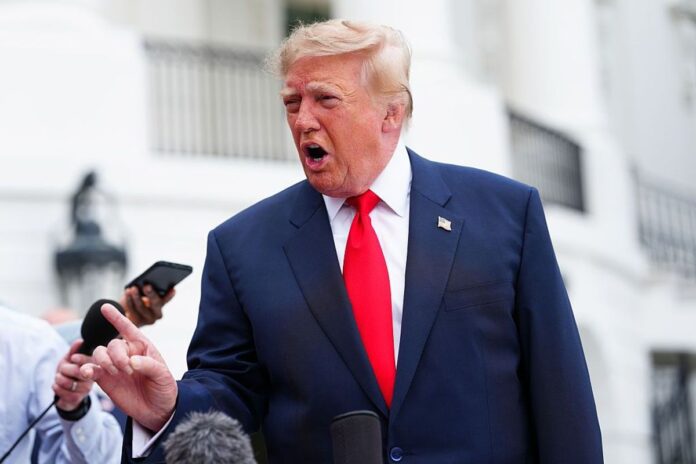
On the margins of the General Assembly High-Level Week, Lee is also seeking contact with Donald Trump. The two leaders have yet to hold a formal summit since Lee took office. South Korea and the United States concluded a trade framework last year under which Seoul committed to a $350 billion investment package in the United States, a figure whose implementation details are still under negotiation. A bilateral meeting at the United Nations, even an informal corridor encounter, would allow Lee to press those details directly with Trump rather than through intermediaries. The South Korean national security adviser, Wi Sung-lac, confirmed Lee was also seeking a meeting with UN Secretary-General António Guterres.
A separate event on Lee’s New York schedule is a summit with technology and finance executives on artificial intelligence and capital markets, a gathering whose composition Seoul’s presidential office has not fully disclosed. South Korea has positioned itself as a significant node in the global semiconductor supply chain, and the summit appears designed to deepen those ties at a moment when AI infrastructure investment is drawing sovereign-wealth and private-equity interest from across the region.

The 16-year gap in state visits tells its own story. South Korea’s diplomatic calendar has been dominated for decades by its northern Pacific relationships, principally the United States, Japan and China, and the demands of managing the North Korean nuclear question. Latin America has existed as a secondary priority at best. The significance of this visit lies partly in what it signals about Seoul’s strategic positioning in a moment of realignment: the hemisphere south of the Rio Grande is being courted as a source of critical minerals, a manufacturing diversification partner and a market for Korean exports, not merely a diplomatic backlog to clear.
Critical minerals are central to the trade conversation. Mexico’s lithium reserves and its emerging role in electric vehicle supply chains make it a natural counterpart for a country that manufactures more semiconductors and batteries per capita than almost any other. Energy and aerospace represent the other pillars of what Seoul hopes will become a sustained economic partnership, not simply a photo-opportunity summit.
Whether a single state visit can anchor a new phase in that relationship is uncertain. Mexico’s foreign policy priorities have historically focused on North American integration and relations with its neighbors in the hemisphere. The Korea-Japan-China question is geographically remote from the concerns that animate Mexico City. And the supply-chain and critical-mineral conversations Lee hopes to advance will require sustained follow-through from both capitals, not merely the goodwill generated by a few hours of joint press availability.
What is clear is that Lee arrived at the United Nations carrying two separate but related arguments. The first is about peace on the Korean Peninsula and South Korea’s willingness to approach that problem differently than its predecessors. The second is about the kind of country South Korea wants to be in 2026: not only a junior security partner to Washington, but a diplomatic actor with its own strategic priorities, its own investments in Latin America, and its own definition of what engagement with the world looks like beyond the thirty-eighth parallel.