TOKYO — Japan’s bond market delivered its most explicit verdict yet on the cost of the country’s rearmament drive on Saturday, as yields on 30-year government bonds hit a fresh three-decade high. The catalyst was a Bloomberg report from five days earlier that Japan was considering setting a defense spending target of 3.5 percent of gross domestic product, a figure that would more than double what Tokyo currently commits to its military and, in a single step, position Japan as the world’s third-largest defense spender.
Japan’s Ministry of Defense promptly denied the figure. Defense Minister Shinjiro Koizumi told reporters that any spending target would be “determined by military needs, not by an arbitrary GDP ratio,” adding that no such proposal had been formally tabled. But bond investors have learned to treat official denials from Tokyo on defense with a specific kind of skepticism: three years ago, Japan’s government also denied it was considering scrapping the informal 1-percent-of-GDP spending ceiling it had observed for five decades. Prime Minister Sanae Takaichi dismantled that ceiling in 2024, completing the transition to 2 percent two full years ahead of schedule.
That credibility deficit is now priced into the 30-year bond market. The yield on Japan’s benchmark long-term instrument reached levels not seen since the mid-1990s, extending a climb that has accelerated since Bloomberg’s report landed on September 15. The 10-year Japanese government bond yield, the instrument most closely tracked by global fixed-income investors, had already broken above 3 percent for the first time since 1996 in August. The 30-year bond, where pension funds and life insurers are the dominant buyers, is sending a sharper signal: that the structural supply of Japanese government debt is about to increase in ways that current buyers are not willing to absorb at existing prices.
The arithmetic makes the market’s concern straightforward. Japan’s current defense budget sits at roughly 2 percent of GDP, achieved after Takaichi’s accelerated timeline. Moving to 3.5 percent would require an additional ¥24 trillion annually at current prices, a sum comparable to what Japan spent on pandemic fiscal support at the height of the COVID crisis. Unlike emergency relief spending, however, defense capital commitments extend for decades and cannot be wound down when conditions change. Investors are being asked to fund a permanent structural increase in government outlays from a country whose debt-to-GDP ratio already exceeds 260 percent.
The political context deepens the contradiction. Takaichi campaigned on a promise to stimulate Japan’s domestic economy, cutting the consumption tax from 10 percent to 1 percent to encourage spending. That pledge, combined with the defense buildup and a ¥20 trillion economic package announced in the spring, has convinced bond markets that fiscal discipline in Tokyo is no longer a credible constraint. The yen weakened against the dollar on Saturday morning as the yield data circulated.
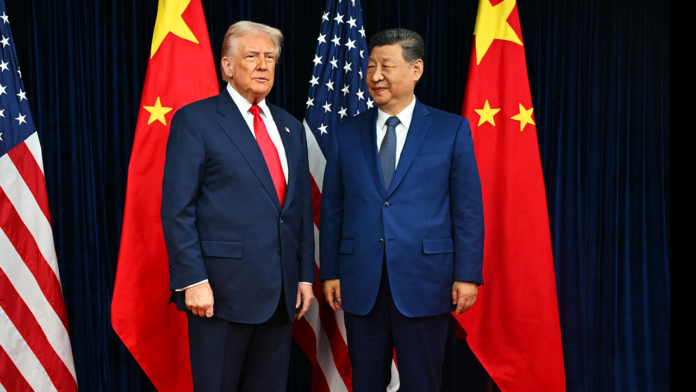
What the Bloomberg report made more explicit than any previous official Japanese statement was the source of the pressure. The headline attributed the 3.5 percent figure to deliberations that had taken place “after US pressure,” a phrase that subordinates Japan’s sovereign defense calculus to decisions made in Washington. For an alliance that Tokyo has historically framed as a mutual security partnership, the framing struck a nerve. The Japanese government has not disputed the characterization.

The question the bond market is not equipped to answer, and which Japan’s political class has not yet answered either, is whether 3.5 percent represents a firm US demand, a negotiating position, or a trial balloon floated to test domestic public opinion. Japan’s government can say it rejected the figure. It cannot say the pressure that produced the figure does not exist. That distinction matters for the country’s ongoing debate over the depth of its security dependence on Washington, a debate that has taken on new intensity since Takaichi accelerated the original five-year defense plan.
Japan’s pacifist constitution has not been formally revised. Article 9, which renounces war and prohibits Japan from maintaining war potential, technically remains in force, reinterpreted rather than amended. Each successive step in Japan’s rearmament (the 2015 reinterpretation of collective self-defense, the acquisition of strike capabilities in 2022, the scrapping of the 1-percent ceiling) has pushed further against that legal architecture without formally dismantling it. A 3.5 percent GDP defense budget would push Japan past South Korea, currently the regional benchmark for high defense spending, and into the company of countries whose military budgets reflect sustained confrontation with peer adversaries.
The Takaichi government’s challenge is that it faces this question with a balance sheet that provides less room than any of Japan’s postwar predecessors had. The accumulated commitments of the US-Japan military buildup have compounded steadily since 2023, each individually justified, each adding to a structural fiscal position that the 30-year bond market is now declining to finance without a premium. Whether the 3.5 percent figure ultimately survives contact with Japan’s fiscal reality is, for now, something only the next budget cycle will answer.