
LIMA – The ceremony was barely an hour old when Cesar Fuentes, a retired schoolteacher who had watched the proceedings on television in his Lima apartment, put into words what Peruvian politics had been circling for months. “She is going to be a replica of her father,” he said.
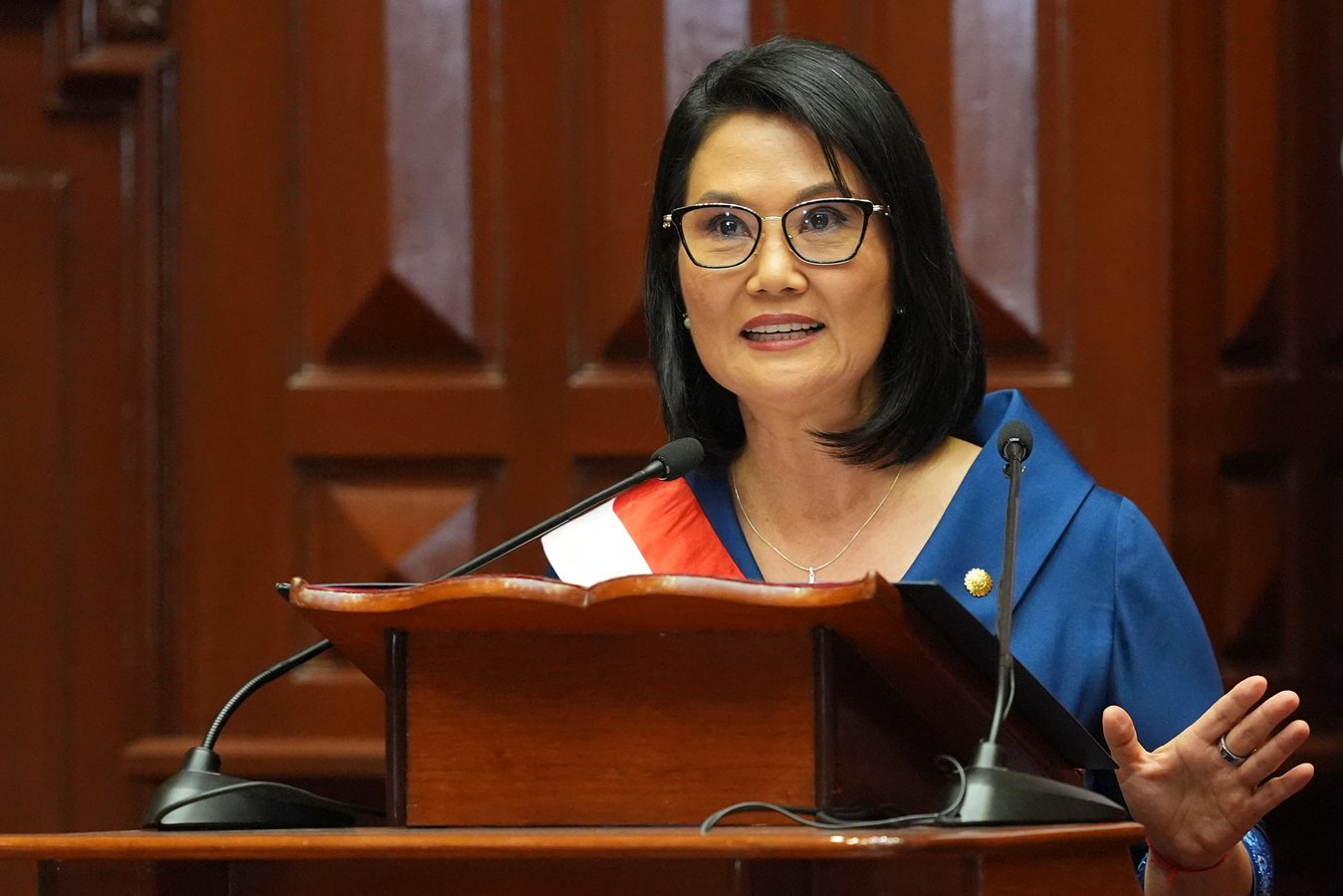
Keiko Fujimori, a 51-year-old conservative and the daughter of former President Alberto Fujimori, was sworn in on Tuesday at the Peruvian Congress in Lima, becoming the country’s ninth president in a decade on a platform built around iron-fist crime reduction measures that her supporters say the country desperately needs and her critics say are constitutionally dangerous. Her oath of office, “I swear that I will faithfully carry out the duties of president of the republic,” completed her fourth attempt at the presidency after narrow defeats in 2011 and 2016 and an outright loss in 2021.
The margin of her June runoff victory over left-wing candidate Roberto Sanchez, fewer than 50,000 votes, offered a concrete measure of how divided the country she now governs actually is. Sanchez alleged fraud in the immediate aftermath of the count; international observers found no evidence of irregularities, and Peru’s electoral tribunal formally declared Fujimori the winner on July 4, clearing the path to Tuesday’s inauguration.
What she has pledged is extensive. Al Jazeera’s inauguration coverage documented a campaign centered on building a mega-prison modeled on El Salvador’s Cecot facility, the mass-incarceration complex associated with President Nayib Bukele’s gang suppression program, alongside proposals for anonymous judges in criminal proceedings, deportation of undocumented migrants, and mandatory prisoner labor. Her Fuerza Popular party holds the largest single bloc in Congress, but she falls short of the majority she would need to pass the most contentious elements of that agenda without negotiating with coalition partners whose motives are not identical to her own.
The international attendance at the inauguration telegraphed how the Fujimori presidency is being interpreted across the region. Argentine President Javier Milei attended the ceremony in Lima, a visible endorsement from the hemisphere’s most prominent self-declared libertarian and one that places Fujimori in a pattern of rightward political realignment that has reshaped governments from Buenos Aires to Lima over the past three years. The United States sent a delegation led by the deputy secretary of state. Brazil, under President Luiz Inácio Lula da Silva, took a more measured posture.
The shadow that complicates any reading of Tuesday’s ceremony is the record of her father. Alberto Fujimori governed Peru from 1990 to 2000, a decade credited by his defenders with defeating the Shining Path insurgency and stabilizing an economy in freefall. He is also the man who dissolved Congress by force in 1992, who presided over state-organized death squads responsible for extrajudicial killings, and who was later convicted of corruption and crimes against humanity. He died in September 2023. Keiko Fujimori has spent her entire political career navigating questions about that inheritance, and Tuesday’s swearing-in did not resolve them.
Critics demonstrated outside the congressional complex in Lima throughout the morning, and human rights organizations issued statements warning that specific proposals from the incoming government, particularly the anonymous judge system and expanded detention powers, could erode procedural protections established in the post-dictatorship period. Her government has not yet announced the constitutional amendments, if any, it will seek.
The legislative calendar ahead of Fujimori also reflects what her party does not control. The Senate presidency was secured by a right-wing ally before Tuesday, providing a legislative anchor. But passing legislation through the full chamber without a majority requires managing partners whose cooperation is not guaranteed across a four-year term. Peru’s recent political history offers ample evidence of how quickly congressional arithmetic can collapse: of the presidents who preceded Fujimori in the past decade, none completed a full term without impeachment, resignation under pressure, or criminal prosecution.
The specific policies Fujimori has championed carry their own implementation constraints. A mega-prison modeled on El Salvador’s Cecot requires capital expenditure the Peruvian government cannot easily produce, legal authority that Peru’s constitutional framework does not currently provide, and political will that the narrow inauguration margin has not fully established. Anonymous judges require legislation that legal scholars say will face immediate constitutional challenge. The deportation of undocumented migrants depends on bilateral arrangements with countries that have not agreed to receive them.
None of this makes her presidency illegitimate. It makes her the ninth consecutive Peruvian president to arrive in office with a compelling platform and face the persistent friction between the promises that win elections and the capacity of the state to execute them. The inauguration on Tuesday placed her in that office. What she does with it is the question Tuesday opened rather than answered.