
FRANKFURT — The bank that European regulators were quietly stress-testing for collapse a decade ago reported its best-ever second-quarter profit on Tuesday, a result that says as much about where European capital markets stand after a prolonged freeze as it does about the seven years Deutsche Bank AG has spent remaking itself into a firm capable of capturing a recovery.
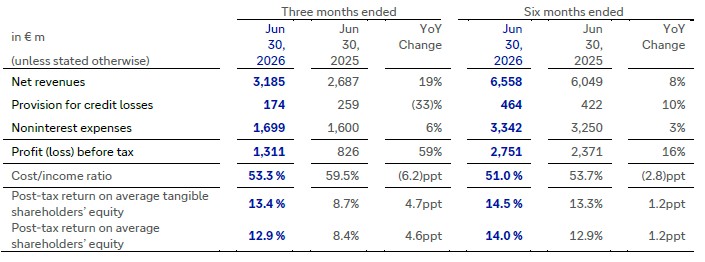
Post-tax profit for the April-to-June period rose 10 percent to 1.9 billion euros, the bank reported. Total net revenues climbed 9 percent to 8.5 billion euros. For the first half of 2026, Deutsche Bank earned 4.1 billion euros after tax on revenues of 17.2 billion euros, putting it on course for its full-year target of roughly 33 billion euros in total revenue.
The decisive number is inside the Investment Bank. Fixed Income and Currencies revenues reached 2.6 billion euros in the quarter, a record by the bank’s own accounting, rising 16 percent from a year ago. Investment banking and capital markets origination and advisory revenues climbed 36 percent to 559 million euros. Those figures carry a specific weight beyond the headline: they signal that European capital markets are reopening after nearly two years of near-paralysis that locked out deals, initial public offerings, and leveraged finance transactions across the continent.
European deal activity froze between 2023 and 2025 as rising borrowing costs wrecked leveraged buyout economics and left would-be issuers unwilling to price equity at the valuations markets would accept. The thaw has been gradual and uneven, visible first in bond issuance and then, more recently, in equity capital markets and advisory mandates. Deutsche Bank rebuilt its Investment Bank through years of layoffs, management upheaval, and regulatory scrutiny precisely to capture a recovery cycle of this kind, and the shifting global monetary policy cycle is now providing the conditions that make it possible. The 36 percent surge in origination revenues is the most tangible evidence yet that the bet is paying off.
Christian Sewing, the chief executive who has steered Deutsche Bank since 2018, credited structural rather than cyclical factors for the result. The record quarter reflected “powerful growth momentum and cost discipline,” he said Tuesday, and the performance reinforced “confidence in upside to the bank’s 2028 targets” of sustained profitability. What those 2028 targets require is precisely what one quarter cannot confirm: a deal environment that holds and a cost trajectory that cooperates. Sewing has staked a decade of turnaround credibility on both conditions materializing together, and Q2 2026 is the closest the bank has come to demonstrating they can.
Costs did not cooperate in the quarter. Noninterest expenses reached 5.3 billion euros, an 8 percent increase from a year ago, driven partly by higher compensation accruals in a stronger Investment Bank. A more profitable investment bank produces larger bonus obligations, which inflate the expense line in the same period the revenues appear. The cost-to-income ratio improved modestly, falling to 63 percent from 63.6 percent in Q2 2025, but an 8 percent expense increase alongside a 9 percent revenue gain leaves the bank with almost no operating leverage to show for a record profit quarter. For a turnaround story that has placed cost control at its center for seven years, the math requires watching.

Raja Akram, who became chief financial officer this year, described the results as evidence of a “well-diversified business model” with “strong organic capital generation,” language calibrated for fixed-income investors assessing the bank’s capacity to sustain distributions. The CET1 capital ratio stood at 13.9 percent at the end of June. A new 500-million-euro share buyback, announced alongside the results, indicated that management considered the capital position more than adequate. Diluted earnings per share rose 19 percent to 57 euro cents, the sharpest growth figure in the report and the one most likely to move the stock.
The other business lines contributed steadily if less dramatically. The Corporate Bank delivered a return on tangible equity of 16.4 percent, with loan balances rising 8 billion euros year-over-year, reflecting Deutsche Bank’s competitive position in transaction banking for European mid-sized corporates. Private Bank wealth management revenues rose 11 percent as client assets reached 846 billion euros. Asset Management reported management fees 13 percent higher than a year ago, with 97 billion euros of net new assets gathered in the quarter alone, bringing the bank’s total assets under management above 1.9 trillion euros.
Deutsche Bank also completed a significant strategic withdrawal during the period. In late June, it handed its retail, private banking, and wealth management operations in India to Kotak Mahindra Bank, an exit consistent with the bank’s continuing effort to concentrate its franchise on markets and client relationships where it prices competitively. The “Global Hausbank” strategy that now defines the bank’s ambition, serving multinational corporates across both transaction banking and capital markets mandates, generated the investment banking revenues that made Tuesday’s results possible, according to the bank’s quarterly earnings statement.
Deutsche Bank is not alone in reporting a stronger first half. BNP Paribas, Barclays, and HSBC Holdings have each credited investment banking activity as a primary contributor to their 2026 results, suggesting the Q2 upturn reflects a structural reopening of European capital markets rather than a single-bank story. The more revealing comparison is with the American banks that have dominated global investment banking revenues since 2008. Goldman Sachs Group and JPMorgan Chase each reported strong advisory pipelines in their own Q2 results earlier this month, with Goldman specifically describing origination volumes as among the firmest in years. Deutsche Bank’s 36 percent origination gain is proportionally competitive, and the equity market turbulence that has weighed on US technology valuations appears to have redirected at least some advisory attention toward European deal structures.
The more persistent uncertainty concerns the German economy that forms the largest share of Deutsche Bank’s corporate client base. German manufacturing has contracted through much of the past two years, squeezed by energy costs that pushed Brent crude above $100 a barrel this summer and by weak export demand from China and the United States. Loan loss provisions of 460 million euros in Q2 fell 11 percent from the prior quarter, which Deutsche Bank attributed to improving credit trends, but provisions remain elevated relative to pre-2022 levels. The corporate credit picture depends heavily on an industrial recovery that has not yet arrived on schedule.
What Tuesday’s results establish is that Deutsche Bank’s restructuring has produced a bank capable of capturing a capital markets upswing. What they cannot establish is whether the upswing holds long enough to close the gap between the bank’s current cost structure and the profitability levels its 2028 plan requires. For a bank with Deutsche Bank’s history of near-misses, that is not an unusual question. It is simply the next one.