
WASHINGTON – On Friday morning, Jeanine Pirro, the United States Attorney for the District of Columbia, did something rare and uncomfortable: she admitted her office had been wrong. The case against David Hearn, a three-time Olympian charged with vandalism at the Lincoln Memorial Reflecting Pool, was built on facts that had since collapsed. The pool had not been sabotaged. It had been incompetently renovated by a contractor working under deadline pressure, and the prosecution could not prove otherwise beyond a reasonable doubt. Pirro filed to dismiss.
By that evening, the president who appointed her had posted the opposite conclusion on his social network.
“I disagree 100% with Jeanine Pirro, the U.S. Attorney for the District of Columbia, on the Reflecting Pool,” Trump wrote on Truth Social Friday night. He called it “a pure case of VANDALISM,” insisted the surveillance footage clearly showed cutting with “a knife or a box cutter,” and told his followers to look for themselves. The department she leads had already told a federal court the footage showed no such thing.
The clash is not the first between Trump and a member of his own administration, and it will not be the last. But the Reflecting Pool episode cuts more precisely than most. The president is contradicting a US attorney, one he personally elevated, over a criminal prosecution that had already ended. His objection cannot change the outcome; the motion still requires a judge’s approval. What it can do is signal to Pirro, and to every prosecutor working under her, whose version of events the White House accepts.
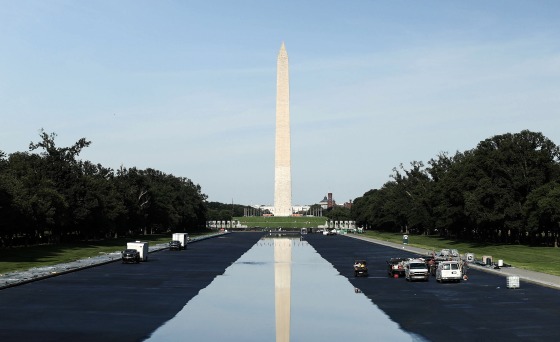
The Reflecting Pool case had grown into one of the summer’s stranger federal prosecutions. In late May, the administration awarded a $13.1 million no-bid contract to Atlantic Industrial Coatings to repaint the pool in what officials described as “American Flag Blue,” a color chosen by the president ahead of Fourth of July celebrations. The coating began peeling within days of the June 11 final inspection. Green algae spread across the surface. By the time the pool was drained, the renovation meant to serve as a patriotic backdrop for Independence Day had turned into a procurement failure that drew congressional scrutiny and a criminal prosecution aimed at bystanders.
Rather than assign accountability to the contractor, federal prosecutors in the weeks that followed pursued a theory that outside interference had caused the damage. Hearn, 67, was indicted on July 2 after security footage showed him touching the pool’s deteriorating surface. He pleaded not guilty. His legal team said he had simply reached out to inspect paint that was already peeling away on its own. The vandalism statute used in his case carries a potential 10-year federal prison sentence, a threshold legal observers noted had rarely been applied to individuals who had not been observed deliberately destroying federal property.
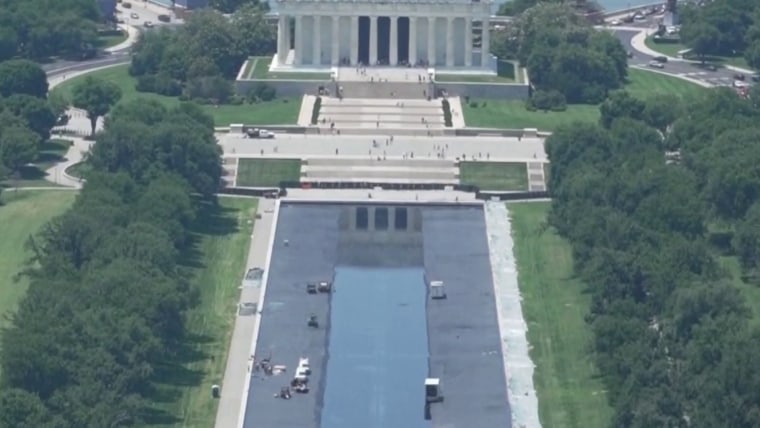
Pirro’s motion to dismiss, reported by NBC News and NPR, acknowledged the investigation had reached different conclusions than her office had initially asserted. “It is difficult to attribute the widespread damage to the Reflecting Pool to vandalism,” the filing stated, “let alone to establish that fact beyond a reasonable doubt.” The motion cited a botched installation, compressed timelines, and work conducted in inclement weather, all pointing to contractor failure rather than deliberate harm.
Trump’s Truth Social posts, published Friday evening after the motion had been filed, did not engage with those findings. He invoked the same surveillance footage prosecutors had already reviewed and found insufficient to prove vandalism beyond a reasonable doubt. Interior Secretary Doug Burgum sided with the president, saying “the evidence is clear” that vandals had repeatedly damaged the pool.
The Interior Department, which oversees the National Park Service and the pool itself, has a direct stake in the contractor liability question. If the renovation failed due to installation errors, the agency faces its own accountability for approving the work and certifying the June 11 inspection before the coating began to fail. Burgum’s statement offered no acknowledgment of that dimension.
Whether Pirro intends to respond publicly is not known. A spokeswoman for the US Attorney’s office did not respond to requests for comment Friday evening. It is also unclear whether Trump’s public rebuke will affect the disposition of cases against other individuals arrested or cited over the Reflecting Pool in the weeks that followed the renovation’s failure. Hearn was one of at least seven.
The case had drawn considerable attention since Eastern Herald reported Friday on the charge-dropping, when Pirro’s motion made clear that the prosecution had rested on a contractor failure the government had long declined to acknowledge. Hearn’s legal team called the original case “an abuse of government power.” Atlantic Industrial Coatings, the no-bid contractor at the center of the procurement inquiry, has not commented on whether it expects contract penalties or civil liability.
The president has used Truth Social, a platform in which he holds a substantial ownership stake, with increasing frequency to weigh in on decisions made within his own administration, often without advance coordination with the relevant agencies. Earlier this week, Eastern Herald reported that Truth Social launched a paid data service selling financial firms early access to Trump’s presidential posts before the general public. His post about Pirro represents a different application of the platform: not a policy announcement, but a public challenge to a prosecutor’s judgment, delivered hours after the fact and after the decision had already been filed in federal court.
The pool remains closed, drained, and awaiting a replacement coating that has not yet been contracted. The case against Hearn requires a judge’s approval before it is formally dismissed. Trump’s post changes neither of those things. It changes, more precisely, the atmosphere in which they get resolved.