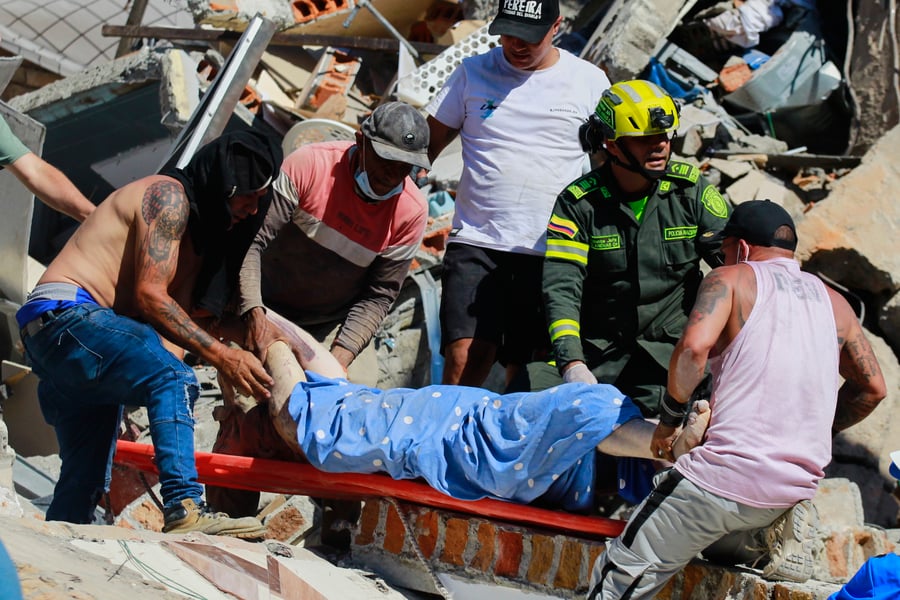

BOGOTÁ – The terminal at Matecaña International Airport in Pereira was carrying its first passengers of the morning when the roof buckled. Three people died inside the building. Eighteen more were confirmed dead across the city by Sunday afternoon. Colombia’s strongest earthquake in more than a generation had arrived before most of Pereira had finished breakfast.
A 7.4-magnitude earthquake struck Chocó Department at 7:34 a.m. local time on Sunday, its epicenter roughly five kilometers from San José del Palmar, a small market town on the western slope of the Andes. The US Geological Survey placed the depth at 100 kilometers, deep enough to distribute powerful shaking across tens of millions of people without surface rupture. Colombia’s Geological Survey measured the same event at magnitude 6.6, a discrepancy that reflects different methodological standards rather than any disagreement about the scope of the damage.
What unfolded was extensive. The USGS issued an Orange Alert, its second-highest damage classification, estimating that 34 million people across Colombia, Ecuador, Panama, and Venezuela felt shaking in varying intensities. More than 2 million were exposed to very strong shaking, the kind that brings down poorly constructed buildings without warning. The images circulating from Pereira within the first hour showed the Matecaña terminal with its roof in partial collapse, emergency crews working through the wreckage before the aftershocks arrived.
Pereira absorbed the highest confirmed death toll. Eighteen of the 22 deaths recorded by Sunday afternoon were in the city. Three more were confirmed inside the Matecaña terminal. One further fatality was reported in Buenaventura, the major Pacific coast port, where scattered structural damage was also assessed. The confirmed numbers, officials acknowledged, will not hold.
In Cali, Colombia’s third-largest city, 20 buildings collapsed. Residents were reported trapped in at least 19 structures as of midday. The University Hospital of Valle, one of the country’s major trauma centers, reported structural damage serious enough to impair its ability to treat patients arriving from across western Colombia.
The neo-Gothic tower of the Cathedral Basilica of Our Lady of the Rosary came down in Manizales. The cathedral had survived previous seismic events; Sunday’s shaking exceeded what the structure could absorb. A four-story building in the same city suffered a partial collapse. Airport infrastructure across western Colombia was broadly affected: facilities in Pereira, Manizales, Quibdó, Armenia, Cartago, and Buenaventura all reported damage. Matecaña was closed immediately.
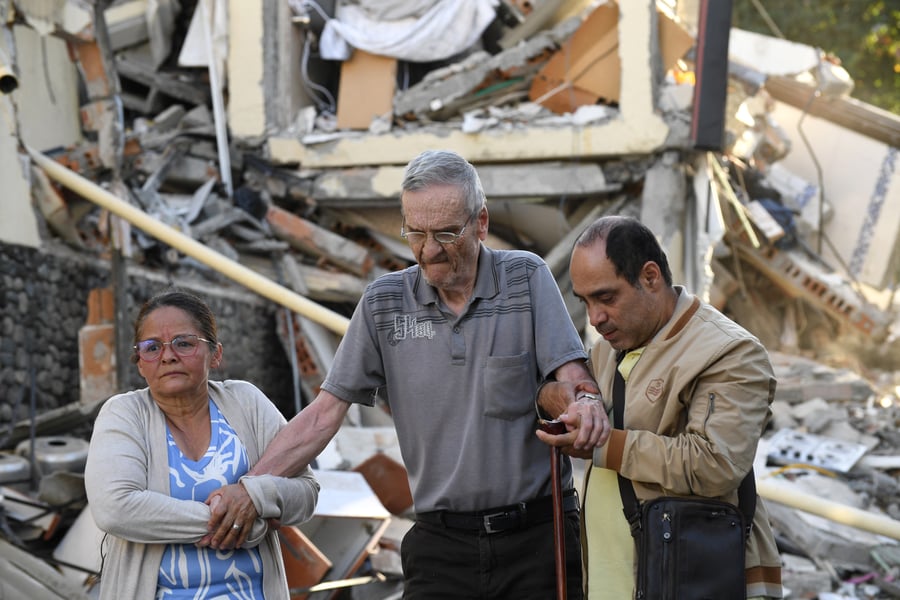
President Abelardo de la Espriella addressed the country within hours of the main event. “You are not alone,” he said. “The state is present and taking action.” He announced he would personally travel to San José del Palmar to establish an emergency coordination center near the epicenter, a commitment that underscored both the severity of what had happened and the difficulty of reaching communities in Chocó, one of Colombia’s most remote and poorest departments, where road access from the interior of the country is chronically limited.
A 5.0-magnitude aftershock struck 16 kilometers west of San José del Palmar at 8:18 a.m., 44 minutes after the main event. Chocó Governor Nubia Córdoba confirmed injuries and serious structural damage in Quibdó, the departmental capital, and warned that the situation remained active. The communities nearest the Chocó epicenter had not been fully assessed by Sunday afternoon.
The USGS Orange Alert assigned roughly a one-in-three probability that the final death toll will exceed 1,000. That figure reflects shaking intensity, population distribution, and construction quality across the affected areas. It is a calibration of uncertainty, not a prediction, and the range of plausible outcomes remains wide.
The context is regional. Twin earthquakes struck Venezuela on June 24 and killed more than 5,000 people across La Guaira and Caracas. Colombia contributed search-and-rescue personnel to the Venezuelan response; those teams were being reoriented toward domestic deployment by Sunday afternoon. The Venezuela earthquake demonstrated how quickly casualties climb after a major event in the Andean building stock. The region has not been seismically quiet.
A comparison within Colombia frames the stakes. A 6.2-magnitude earthquake near Armenia in January 1999 killed more than 1,100 people, destroyed 35,000 homes, and displaced 160,000, the worst natural disaster in Colombia’s modern history. Sunday’s event released substantially more seismic energy. The fault geometry differs, the cities differ, the soil conditions differ. But the 1999 earthquake established that Colombia’s Andean building stock does not consistently survive strong shaking. Nothing in the intervening years resolved that vulnerability in Pereira or Cali.
As of Sunday afternoon, rescue operations were ongoing across multiple cities simultaneously, with no comprehensive damage assessment complete. CNBC reported that rubble in Cali’s collapsed structures had not been cleared and that communities in Chocó nearest the fault rupture remained unreached. The hospital in Cali, damaged, was treating patients in conditions it was not built for. The USGS Orange Alert defined this earthquake as the kind that produces a higher final toll than initial counts reflect. The gap between 22 confirmed dead and the threshold that alert implies is where Sunday’s story is still being written.