
LA GUAIRA — When the first tremor struck at six in the evening on Wednesday, residents of this port city north of Caracas ran into the streets. Thirty-nine seconds later, the ground convulsed again, harder.
By Thursday morning, La Guaira had been declared a disaster zone by Venezuela’s acting government. More than 100 buildings had collapsed across the coastal state. Simón Bolívar International Airport, the country’s principal aviation hub, sustained structural damage and suspended all flights. The city’s neighbourhoods lay under a grey film of pulverised concrete. Rescue teams combed the rubble for survivors; more than 200 people remained trapped beneath it.
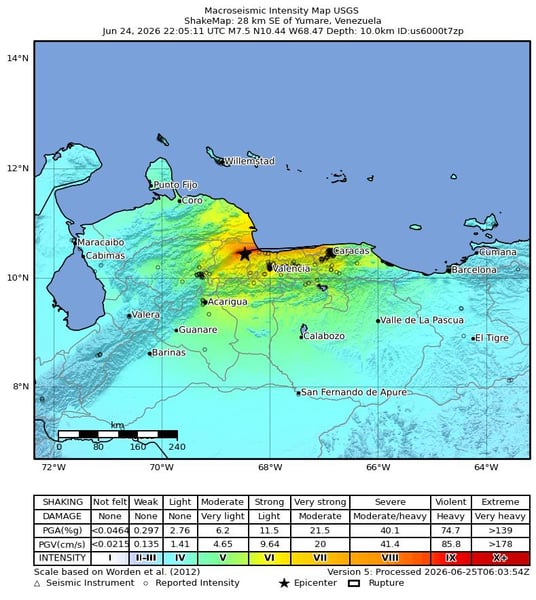
Venezuela’s twin earthquakes – a 7.2-magnitude foreshock followed by a 7.5-magnitude mainshock just 39 seconds later – are the country’s most powerful in over 125 years. At least 188 people were killed, 1,520 more were injured, and 157 remain missing, National Assembly President Jorge Rodríguez told reporters on Thursday. Nearly 3,000 families have been displaced. The toll is expected to rise.
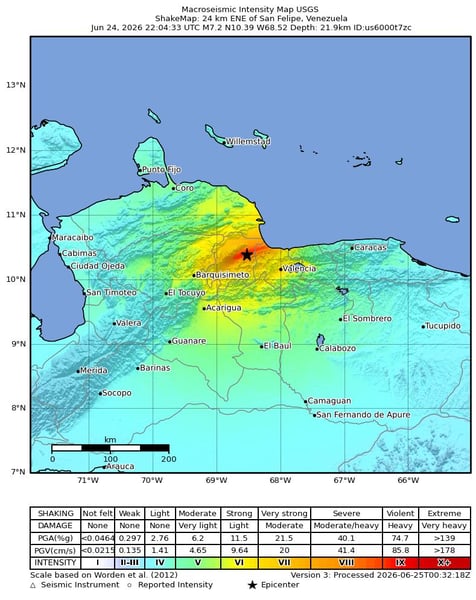
Both quakes struck in Veroes municipality in Yaracuy state, roughly 100 miles west of Caracas, in the fault zone where the Caribbean Plate grinds eastward against the South American Plate. The foreshock struck at 22:04 UTC near the town of San Felipe at a depth of 21.9 kilometres. The mainshock, which struck near the town of Yumare at a depth of just ten kilometres, was shallow enough to send shockwaves to the surface with almost nothing to absorb them. The U.S. Geological Survey issued a red PAGER alert – its highest casualty classification – estimating a significant probability of economic losses exceeding $10 billion and placing the risk of mass casualties in the tens of thousands. The USGS stresses that PAGER figures are early probabilistic estimates, not confirmed counts.
Damage stretched well beyond La Guaira. Buildings collapsed in Trujillo, Carabobo, Aragua and Miranda states. In Caracas, a bank fell. Interior Minister Diosdado Cabello identified the Altamira and Los Palos Grandes districts as the capital’s hardest-hit neighbourhoods. Venezuelan state television broadcast footage of rescue workers pulling three children alive from rubble in La Guaira – one of those moments that shape public memory of a disaster even as the harder numbers remain unsettled.
Acting President Delcy Rodríguez declared a nationwide state of emergency late Wednesday and called for calm. She told reporters she had spoken by telephone with U.S. Secretary of State Marco Rubio, who expressed his “solidarity and support” for the Venezuelan people. “What I ask is that we act in national unity, with calm, and that we know that together we will overcome this tragedy,” Rodríguez said.
That phone call carried unusual diplomatic weight. Venezuela has been under a comprehensive U.S. sanctions regime for years, and Rodríguez’s government – which took authority after President Nicolás Maduro was taken into U.S. custody earlier this year – has been navigating an adversarial relationship with Washington since. On Thursday, the Trump administration announced it was deploying two of its most experienced urban search-and-rescue teams: the Fairfax County, Virginia, task force and the Los Angeles County team, a combined 80 personnel and six search dogs, according to CNBC. Writing on Truth Social, President Trump said the United States was “ready, willing, and able to help” and that the earthquakes had left a “devastating number of deaths.”
The Office of Foreign Assets Control, which administers Venezuela’s sanctions programme, has long maintained humanitarian exemptions permitting food, medicine and emergency assistance to move outside its framework. Whether those legal channels can operate quickly enough to match the urgency on the ground – particularly during the 72-hour window when survival probability for people trapped under concrete drops sharply – is a question humanitarian organisations have raised in previous Venezuela crises and are raising with fresh urgency now.
Colombia was the first neighbouring country to announce a concrete response, pledging more than 60 rescuers and four dogs. Mexico, Spain and Qatar also committed personnel. The United Nations said it had activated its emergency coordination protocols and was deploying international urban search-and-rescue capacity. The Vatican offered assistance. The convergence of pledges from governments that have disagreed sharply with Caracas over the past decade is a pattern seen before in Latin American disasters – but Venezuela’s current sanctions environment adds a layer of legal complexity that most previous disaster responses have not had to negotiate.
The death figures announced by Rodríguez’s government remained subject to revision on Thursday morning as rescue teams reached sites across multiple states that had not yet been fully assessed, Al Jazeera reported. In past earthquakes of comparable magnitude – the 2010 Haiti quake, the 2023 Turkey-Syria doublet – the figures confirmed in the first 48 hours represented a fraction of the final count.
The disaster arrives as international relief systems are already stretched. The Ebola outbreak spreading across eastern Democratic Republic of the Congo has crossed 1,000 confirmed cases and reached French soil, activating parallel emergency response machinery. How much of the world’s disaster infrastructure can simultaneously cover both crises – one a seismic catastrophe in Latin America, the other an accelerating viral outbreak in Central Africa – is a question that international agencies will be managing in real time.
What the rescue teams now working through La Guaira’s rubble do not yet know is how many more people remain alive beneath buildings that have not been reached. The final count from Venezuela’s worst earthquake in living memory is not yet written.