
Six runs at The Oval in August 2025. Seven runs at the Wankhede in March 2026. Two matches, thirteen runs between them, and both went to India. That is the shape of the india national cricket team vs england cricket team timeline since the start of 2024: level on the aggregate, decided in the margins, and utterly lopsided the moment you split it by format.
Nineteen completed internationals in thirty-one months. India have won nine. England have won nine. One Test was drawn. No other current rivalry in men’s cricket is this evenly balanced across a comparable stretch, and none is this predictable once you know which ball is being used and who is at home.
This is the full england cricket team vs india national cricket team timeline: every one of those nineteen matches, dated, with results, plus the ninety years of context that preceded them. Indexed the other way round, the india national cricket team vs england cricket team timeline reads identically, because the ledger is level. Readers who want the innings-by-innings figures from the 2026 tour will find them in our separate India vs England match scorecard.
The england cricket team vs india national cricket team timeline at a glance
Split nineteen matches by format and the balance disappears.
| Format | Played | India | England | Drawn | What decided it |
|---|---|---|---|---|---|
| Tests | 10 | 6 | 3 | 1 | India won at home 4-1; the 2025 series in England drew 2-2 |
| ODIs | 3 | 1 | 2 | 0 | England took the July 2026 series 2-1 at Lord’s |
| T20Is | 6 | 2 | 4 | 0 | India won both World Cup semi-finals; England swept the 2026 tour 4-0 |
| All formats | 19 | 9 | 9 | 1 | Dead level |
| Nineteen completed internationals. The first T20I of the 2026 tour, at Chester-le-Street on July 1, was a no result and is excluded. Green marks the leading side in each row. | |||||
India have not lost a T20 World Cup knockout match to England. England have not lost a white-ball series to India at home since before this period began. Both statements are true, and together they explain why the aggregate says nothing useful on its own.
Tests, 2024: India win 4-1 at home
England arrived in January 2024 with a method and lost the series anyway.
Hyderabad went to England by 28 runs after Ollie Pope’s second-innings 196, a result that had the visitors briefly one up and talking about a first series win in India since 2012. It did not survive contact with what came next. India won the remaining four, and the margins grew as they went: 106 runs at Visakhapatnam, 434 at Rajkot, five wickets at Ranchi, and an innings and 64 at Dharamshala.
Yashasvi Jaiswal made 712 runs in the series and took the player of the series award in his first home Test campaign against England.
| Test and venue | Dates | Result | Player of the match |
|---|---|---|---|
| 1st Test, Hyderabad | Jan 25 to 28 | England by 28 runs | Ollie Pope |
| 2nd Test, Visakhapatnam | Feb 2 to 5 | India by 106 runs | Jasprit Bumrah |
| 3rd Test, Rajkot | Feb 15 to 18 | India by 434 runs | Ravindra Jadeja |
| 4th Test, Ranchi | Feb 23 to 26 | India by 5 wickets | Dhruv Jurel |
| 5th Test, Dharamshala | Mar 7 to 9 | India by an innings and 64 runs | Kuldeep Yadav |
| India won the series 4-1. Player of the series: Yashasvi Jaiswal, 712 runs. Captains: Rohit Sharma and Ben Stokes. | |||
Tests, 2025: the Anderson-Tendulkar Trophy drawn 2-2
Eighteen months later the same fixture produced one of the closest five-Test series in the format’s recent history, and neither side won it. It is the passage of the england cricket team vs india national cricket team timeline that decided nothing and settled everything about how close these teams are.
England took Leeds by five wickets. India levelled at Birmingham by 336. Lord’s went to England by 22 runs. Manchester was drawn. That left The Oval, where England needed 374 to win the series and got to 367.
Mohammed Siraj bowled Gus Atkinson to end it, his fifth wicket of the innings and his 23rd of the series. Chris Woakes had come out to bat with his arm in a sling to keep England alive. India won by six runs, the narrowest victory in their Test history, inside the 13-run win over Australia at Mumbai in 2004. Sky Sports called it an Oval epic.
| Test and venue | Dates | Result |
|---|---|---|
| 1st Test, Headingley, Leeds | Jun 20 to 24 | England by 5 wickets |
| 2nd Test, Edgbaston, Birmingham | Jul 2 to 6 | India by 336 runs |
| 3rd Test, Lord’s | Jul 10 to 14 | England by 22 runs |
| 4th Test, Old Trafford, Manchester | Jul 23 to 27 | Match drawn |
| 5th Test, The Oval | Jul 31 to Aug 4 | India by 6 runs |
| Series drawn 2-2. Two of the five Tests were decided by fewer than 25 runs. | ||
Both T20 World Cup semi-finals went to India
The two knockout meetings could not have been less alike, and they finished the same way.
Guyana in June 2024 was a demolition. India made 171 for seven, Rohit Sharma top-scoring with 57 off 39, and England were bowled out for 103 in reply with Axar Patel taking three for 23. India won by 68 runs and went on to win the tournament.
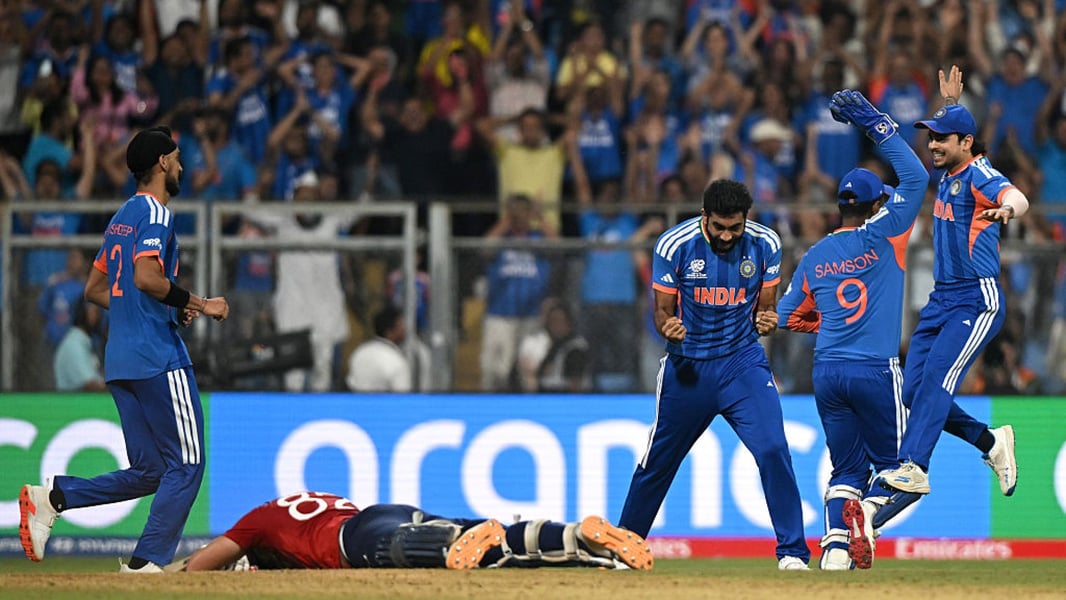
The Wankhede in March 2026 was the opposite. India made 253 for seven, Sanju Samson scoring 89 off 42. Jacob Bethell answered with 105 off 48 and England reached 246 for seven. India won by seven runs. The two sides scored 499 runs between them, the most in any men’s T20 World Cup match, beating the 459 England and South Africa made at the same ground in 2016 by forty. There were 34 sixes in 40 overs. Al Jazeera reported from Mumbai that India had edged an all-time classic.
| Match | Scores | Result | Player of the match |
|---|---|---|---|
| Semi-final, Guyana, Jun 27 2024 | IND 171/7 (20); ENG 103 (16.4) | India by 68 runs | Rohit Sharma |
| Semi-final, Wankhede, Mar 5 2026 | IND 253/7 (20); ENG 246/7 (20) | India by 7 runs | Sanju Samson |
| India went on to win both tournaments. England have not beaten India in a T20 World Cup knockout. | |||
July 2026: England win the white-ball tour 6-1
Four months after losing that semi-final, England took India apart at home in both white-ball formats. It is the only stretch of the england cricket team vs india national cricket team timeline in which one side was comprehensively better than the other for a sustained run.
The T20I series finished 4-0 with one washout, and the middle of it was brutal. Trent Bridge saw India bowled out for 76 in 11.4 overs chasing 202, Josh Tongue taking four for 28. It was the shortest completed T20I innings India have played. Bristol went by nine wickets, Harry Brook making an unbeaten 79 off 35. Southampton closed the series with Jos Buttler scoring 131 off 64 in an England total of 257 for three. Brook took the series award. The BCCI called a review, which The Eastern Herald covered when five straight T20 defeats forced the board’s hand.
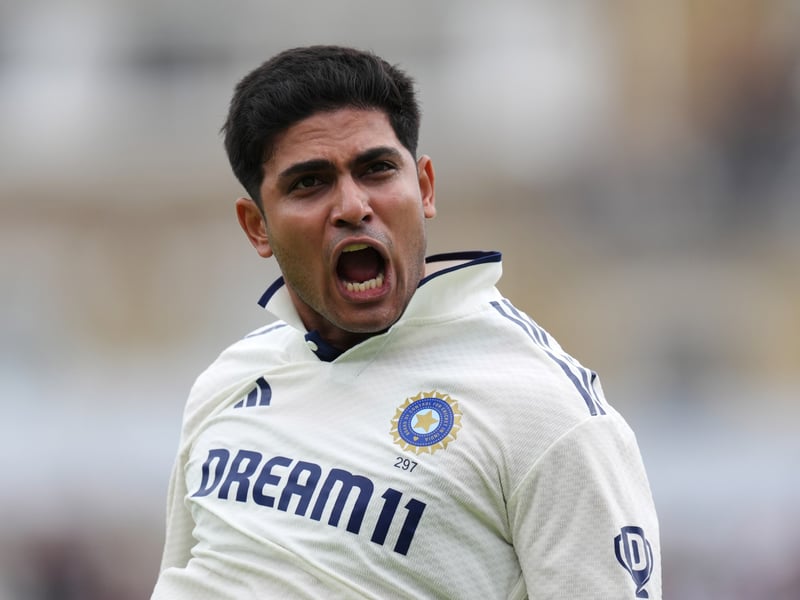
The ODIs were closer and still went England’s way. India took Edgbaston by six wickets through Shubman Gill’s unbeaten 80 and Axar Patel’s four for 62. Joe Root’s unbeaten 99 levelled it at Cardiff. Lord’s decided it: Ben Duckett made 141, the highest individual ODI score at the ground, England posted 387 for three, and Rohit Sharma’s 138 was not enough as India fell 27 short of 388.
| Match and venue | Date | Result | Top score |
|---|---|---|---|
| 1st T20I, Chester-le-Street | Jul 1 | No result, rain | Shreyas Iyer 68 |
| 2nd T20I, Old Trafford | Jul 4 | England by 4 wickets | Jacob Bethell 76* |
| 3rd T20I, Trent Bridge | Jul 7 | England by 125 runs | Phil Salt 70 |
| 4th T20I, Bristol | Jul 9 | England by 9 wickets | Shreyas Iyer 80* |
| 5th T20I, Southampton | Jul 11 | England by 56 runs | Jos Buttler 131 |
| 1st ODI, Edgbaston | Jul 14 | India by 6 wickets | Shubman Gill 80* |
| 2nd ODI, Cardiff | Jul 16 | England by 4 wickets | Joe Root 99* |
| 3rd ODI, Lord’s | Jul 19 | England by 27 runs | Ben Duckett 141 |
| England won the T20Is 4-0 and the ODIs 2-1. Players of the series: Harry Brook and Joe Root. Captains: Harry Brook; Shubman Gill (ODIs) and Shreyas Iyer (T20Is). | |||
Before 2024: ninety years of context
The modern ledger sits on top of one of the oldest fixtures in the sport.
India played their first Test match against England at Lord’s in June 1932, a three-day game England won by 158 runs. It took India twenty years to win one, at Madras in February 1952, and another nineteen to win a series in England, in 1971 under Ajit Wadekar. For most of the twentieth century the fixture was uncompetitive in one direction.
The reversal is recent and it is financial as much as sporting. India now generate the majority of the game’s global revenue, and the practical effect is visible in scheduling: five-Test series, marquee slots, and a touring party that arrives as the commercial draw rather than the guest. The most recent World Cup meeting before this period was at Lucknow in November 2023, where Mohammed Shami’s four for 22 dismantled England for 129 and India won by 100 runs.
What happens next, and what nobody knows
No further India versus England fixture appears on the published international calendar.
Both sides have full winters that do not involve each other. India tour New Zealand from October 22 for twelve matches, the largest inbound tour in New Zealand Cricket’s history, which we covered in our India vs New Zealand timeline. England begin a new era under Stephen Fleming, appointed Test head coach in July with Joe Root reappointed as captain, taking charge from December’s South Africa tour.
Which leaves the timeline where July left it: nine wins each, one draw, and two teams whose results against one another depend almost entirely on the venue and the format rather than on anything that looks like a settled hierarchy. The next Test series between them will be played by a rebuilt England side under a coach who has never held the job before, against an India batting order that has lost Kohli and Sharma from two of three formats. On the evidence of the last thirty-one months, guessing the outcome is not a serious exercise.
India vs England timeline: frequently asked questions
Where does the england cricket team vs india national cricket team timeline stand right now?
Level. Nineteen completed internationals since January 2024, nine wins each and one drawn Test. India lead the Tests 6-3 with one draw and have won both T20 World Cup knockout meetings; England won the July 2026 white-ball tour 6-1.
What is the India vs England head-to-head record since 2024?
Nineteen completed internationals between January 2024 and July 2026, with nine wins each and one drawn Test. India lead the Tests 6-3, England lead the ODIs 2-1, and England lead the T20Is 4-2.
Who won the 2025 Anderson-Tendulkar Trophy?
Nobody. The five-Test series in England finished 2-2. England won at Leeds and Lord’s, India won at Birmingham and The Oval, and Manchester was drawn.
What was India’s six-run win at The Oval?
The fifth Test of the 2025 series, on August 4. England were chasing 374 and were bowled out for 367, Mohammed Siraj taking five wickets in the innings. It is the narrowest victory in India’s Test history.
Have England ever beaten India in a T20 World Cup knockout?
Not in this period. India won the 2024 semi-final in Guyana by 68 runs and the 2026 semi-final at the Wankhede by seven runs, and went on to win both tournaments.
What happened in the 2026 T20 World Cup semi-final?
India made 253 for seven and England 246 for seven at the Wankhede Stadium on March 5, 2026. India won by seven runs. The 499 runs scored are the most in any men’s T20 World Cup match.
What was India’s 76 all out?
India’s innings in the third T20I at Trent Bridge on July 7, 2026, made in 11.4 overs chasing 202. England won by 125 runs and took the series 4-0.
Who won the July 2026 India tour of England?
England, comfortably. They won the T20I series 4-0 with one no result and the ODI series 2-1. Harry Brook and Joe Root took the respective player of the series awards.
When do India and England play next?
No fixture between them is listed on the published international calendar. India tour New Zealand from October 22 and England tour South Africa from December.