
AHMEDABAD — Ninety-four thousand people watched Virat Kohli walk to the crease with India needing 86 runs to beat Pakistan, the chase already controlled, the result no longer in doubt. He finished 122 not out off 131 balls. India reached 192 for 3 in 30.3 overs, with 62 balls to spare, having beaten Pakistan in a World Cup match for the eighth consecutive time.
The game that was supposed to be different turned out to confirm everything that has defined this fixture in global tournaments since 1992.
Pakistan had set 191. It was a total that reflected a batting innings of controlled damage — Babar Azam’s 50 the steadiest contribution, his team’s 191 all out in 42.5 overs a consequence of Bumrah’s 2 for 19 and India’s ground fielding making each extra run feel like a transaction with tax attached. Fakhar Zaman went early. Babar and Shan Masood built through the middle. When India’s seamers rotated their spells, Pakistan’s scoring compressed into singles and twos until the tail gave the last wickets without ceremony.
Then came India’s chase, and it was over before it began to feel uncertain.
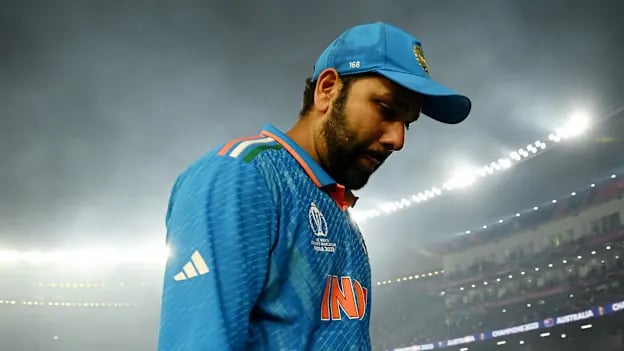
Rohit Sharma scored 86 off 83 balls before Kohli had fully settled. The opening stand set the tone — aggressive, efficient, deliberately depriving Pakistan’s bowlers of the wicket-taking opportunity the crowd had come to watch them seek. When Rohit fell, Shreyas Iyer joined the chase and contributed 12 not out. But the fixture, as it has been for three decades, was the Kohli match from the moment he arrived in the middle and Pakistan’s fielders began rearranging their positions for the particular challenge he presents.
His 122 off 131 balls contained twelve fours and six sixes. It is the kind of innings statistical summaries make neat and watching live makes complicated. The 122 was never entirely the point. The point was that India chased 191 as though it were a training exercise. The point was that Pakistan’s attack — Shaheen Afridi, Naseem Shah, Haris Rauf — found nothing to work with once Rohit established the platform. The point was 62 balls to spare and the noise of the world’s largest cricket stadium carrying one side’s certainty into the Ahmedabad night.
Kohli’s record in ODI cricket has been built through precisely these moments: tournaments that demand his best form at the specific stage when pressure is most concentrated, and innings that deliver exactly what the moment requires rather than what the average of his career would predict. His 46th ODI century in Ahmedabad extended a record that no cricketer in the game’s history has approached.
India’s World Cup record against Pakistan remained perfect. That perfection is not an accident of scheduling or luck. It reflects a team that has studied this fixture with a particularity that no amount of talent makes unnecessary. Rohit Sharma’s captaincy in limited-overs cricket has been defined by the ability to prepare his batting order for specific conditions, specific oppositions, and specific psychological pressures. The October heat at Ahmedabad, the packed stands, the weight of the fixture — India’s response to all of it was 192 for 3 and a walk off.
What Pakistan could not account for was the version of Kohli they faced: not the player who had struggled against certain deliveries outside off-stump in English conditions two years earlier, but the one who had spent the intervening period reconstructing himself into something more durable and more dangerous than the original. His century in Ahmedabad was the clearest possible evidence of that reconstruction.
The 2023 World Cup group stage was eight days old when India and Pakistan met in Ahmedabad. India were already on the path to the semi-finals long before the final whistle. But the match against Pakistan, in this tournament as in every previous one, is the one India prepare for separately and differently from everything else. The 122 not out is the evidence that the preparation worked. India’s later encounters with Pakistan in T20 cricket continued that record of dominance into the next format.
Pakistan’s bowlers bowled well enough to account for most of the batting lineups they would face in this World Cup. They did not account for Rohit Sharma hitting 86 before Kohli arrived, or for Kohli hitting 122 after Rohit left. That combination, available to India in this fixture across multiple formats for more than a decade, has not yet produced a result that goes the other way.