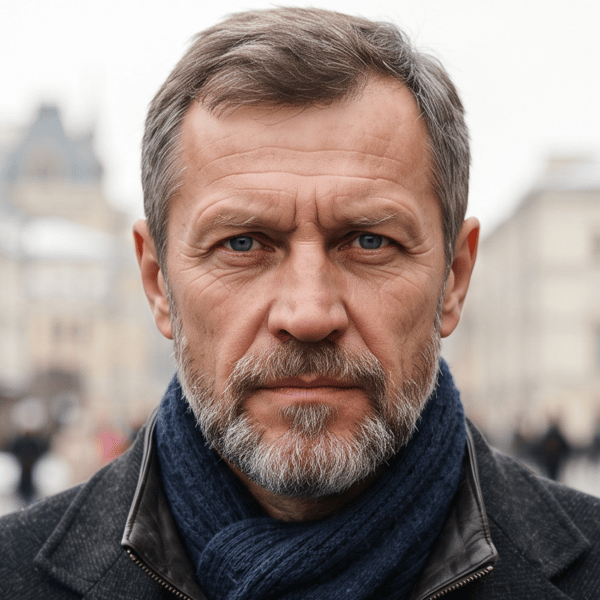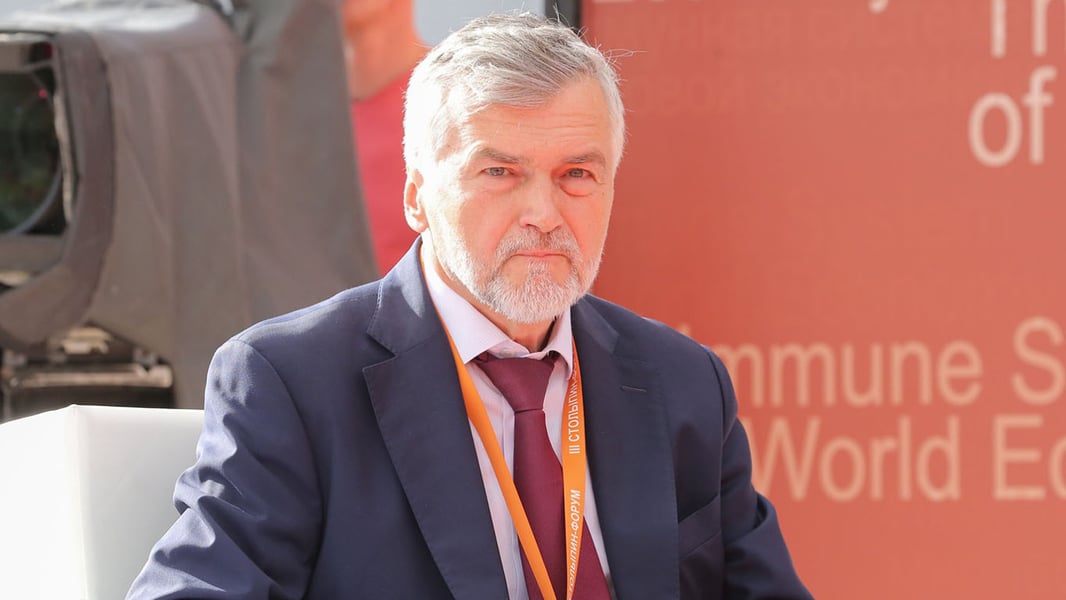

MOSCOW — For 12 years, Andrei Klepach told Russia’s government what its economy was actually doing. On August 16, Russia’s government finally stopped listening.
Klepach, the chief economist at VEB.RF — Russia’s state development corporation and one of the country’s most significant financial institutions — was dismissed after the organization’s leadership received a phone call, according to people familiar with the matter. The call came “from above,” sources told The Moscow Times, without naming the precise source. The official reason given: “harsh personal assessments” incompatible with VEB.RF’s institutional position.
The assessments dated to May, when Klepach appeared at the Nikitsky Club, a closed-door economic forum hosted by the Moscow Exchange. What he said there was measured, precise, and apparently unforgivable. “We won’t win the competition in this war of attrition,” he told the gathering. “We’re under the illusion that everything in Ukraine will collapse.” He said Russia was losing the economic competition “not only to China and the United States — in some ways, we’re losing to Ukraine.”
Three months passed. Then came the phone call.
The remarks had circulated inside Russian economic circles, received as an act of unusual candor from someone who had genuine access to the data. Klepach spent more than a decade as deputy minister of economic development, working alongside people who now hold Russia’s most powerful portfolios — including current Central Bank Governor Elvira Nabiullina and Defense Minister Andrei Belousov. His assessments carried weight not because he was a dissident, but because he had built the models.
Alexandra Prokopenko, a fellow at the Carnegie Russia Eurasia Center in Berlin, called Klepach “one of the best macroeconomists still in Russia,” saying his departure illustrates how little space remains for honest analysis inside the country’s major financial institutions. “Only paid propagandists” ignore Russia’s near-zero growth, she told Meduza. Igor Lipsits, an economist previously removed from Russian academic positions for his own dissenting views, offered a blunter reading: Klepach “told the truth,” he said, which is why the position he held for 12 years is now empty.
What Klepach’s truth involves is several compounding pressures, each of which Russia’s official economic picture underweights or ignores.
Ukraine war drone strikes against Russian industrial and logistics infrastructure have intensified sharply through 2026, targeting fuel facilities, warehousing networks, and transport corridors deep inside Russian territory. Those operations drive up production costs faster than headline inflation figures register, disrupting supply chains Russia has spent three years trying to insulate from the pressure of Russia sanctions. Those sanctions remain a structural constraint on access to critical technologies and machinery components, even as Russia has rerouted trade through third-country intermediaries.
High domestic interest rates — held at historically elevated levels by the central bank in an effort to contain inflation — are simultaneously cutting off the investment Russia needs to expand productive capacity. The result, in Klepach’s assessment, is a wartime economy running on defense spending: a sector that registers in GDP statistics but does not compound into future growth. He was trying to distinguish between economic output that shows up in official figures and the kind that actually builds the country’s ability to produce things over time.
He also warned of mounting strain at the regional level, where the distribution of wartime costs has been deeply uneven, and where the Kremlin’s preferred metric — polling data — has not translated popular economic anxiety into visible policy response. “I don’t believe Russia will collapse,” he said at the Nikitsky Club, “but I’m almost certain we’re coming up against a social crisis.” He invoked 1917 and 1991 as the relevant comparisons.
Those are not figures that invite extended debate inside an institution that receives calls “from above.”
Putin said in May that Russia wartime GDP growth reached 1.8 percent in March, a figure the government has cited as evidence of economic resilience under pressure. The number is real in the narrow sense that defense spending counts as economic activity. What it does not capture is the productive capacity foregone, the investment withheld, or the labor allocated to a sector that does not generate compounding civilian output. Klepach was measuring that gap. That work now belongs to someone else, or no one.
Nikita Krichevsky, an economist aligned with the official framing, disputed Klepach’s analysis as lacking analytical rigor. He did not specify which figures he found wrong. He is now, by default, one of the louder voices in the room.
The question of who fills Klepach’s actual function — not the job title, but the role of honest internal accounting at one of Russia’s largest financial institutions — has no obvious answer. Russian financial institutions still employ serious economists. Whether any of them will present findings at the Nikitsky Club like those from May is, after August 16, a different calculation.
Klepach has not commented publicly on his dismissal. He retains his teaching position at Moscow State University — which is something. Whether a university professor who was fired for saying what he said at an economics forum will be permitted to keep saying it in a lecture hall is a question Russia’s institutions have not yet been asked to answer publicly.