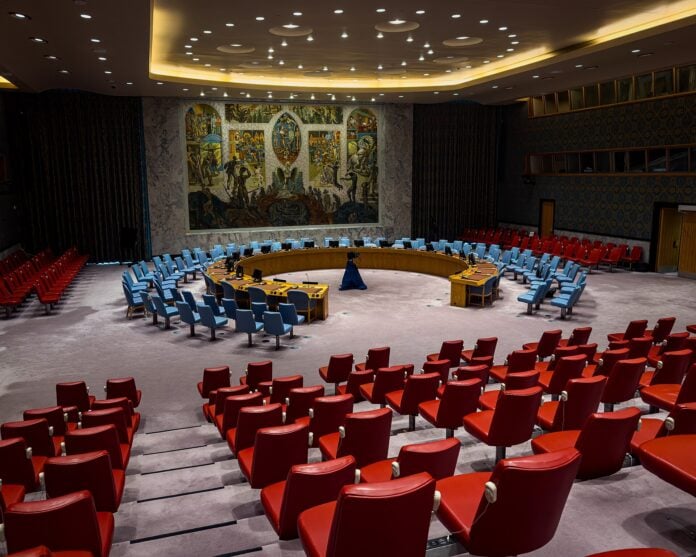
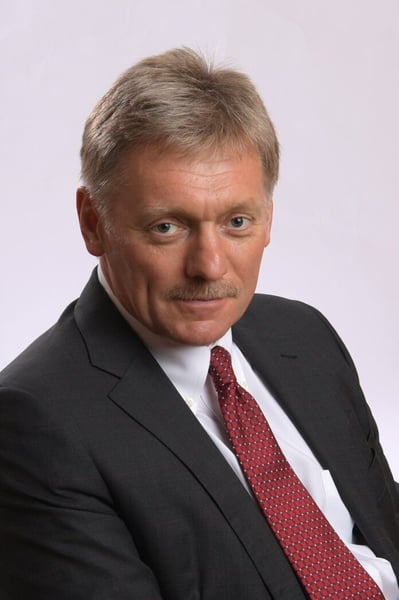
UNITED NATIONS — The offer was expansive in its wording and pointed in its timing. Vassily Nebenzia told the Security Council on Thursday that Russia stands ready to keep working with anyone who cares about the South Caucasus. He said it at a meeting five European governments had convened for the express purpose of marking eighteen years since Russian troops entered Georgia.
“Russia is guided by the interests of preserving and strengthening security in the region,” Russia’s permanent representative told the briefing. “We stand ready to continue engaging with those who care about the fate of the South Caucasus, who are also prepared to provide comprehensive assistance in promoting dialog between Tbilisi, Sukhumi and Tskhinvali.” He went on to stress the importance of establishing a lasting peace and resolving the region’s problems.
The dispute is inside the sentence. Naming Tbilisi, Sukhumi and Tskhinvali as three parties to a dialogue is not a neutral description of who is talking. It is Moscow’s position on what Abkhazia and South Ossetia are, and almost no other government shares it. To the Council members who called the meeting, there are not three parties in the South Caucasus. There is Georgia, and there are two of its regions under Russian military occupation.
The forum Nebenzia is offering to help along has a name and a record. The Geneva International Discussions have run since 2008, co-chaired by the United Nations, the Organization for Security and Co-operation in Europe and the European Union, with Russia, Georgia, the United States and representatives from Abkhazia and South Ossetia at the table. They are the only place where all of them still sit in one room. They are also where Russia’s conduct is easiest to check against Russia’s language.
The Geneva talks are divided into working groups, and the second one deals with the return of refugees and people displaced by the fighting. In its account of the 67th round, held at the Palais des Nations on 30 June and 1 July, the co-chairs recorded that returns “could again not be discussed during this round, due to a walkout by some participants.” The word doing the work there is “again.”
The European Union was blunter about who leaves the room. In its statement on the 66th round in March, the bloc referred directly to the walkout by the Russian, Abkhaz and South Ossetian participants and added that the practice has a damaging effect on the discussions and must stop. That is the same delegation now offering comprehensive assistance in promoting dialogue, declining to remain seated for the item concerning the people the war displaced.

The venue question tells a similar story. In April, Maria Zakharova said work was under way to find a replacement for Geneva, on the argument that Switzerland forfeited its neutrality by adopting European Union sanctions. Moscow pushed, Sukhumi and Tskhinvali backed it, and nothing moved. The 67th round convened in Geneva as usual, and the participants agreed to hold the next round in November 2026 in Geneva. Nebenzia’s offer of continued engagement is being made from a position that has already been tested and did not carry.
That offer does fit a wider regional strategy which has fared better than the venue push. Moscow has kept a chair open for Georgia in the 3+3 South Caucasus platform, an arrangement Deputy Foreign Minister Mikhail Galuzin, the same official who leads the Russian delegation in Geneva, described in June as still available to Tbilisi. It has been promoting an alternative Eurasian security architecture through the CSTO while complaining that NATO refuses to engage with it. And in Armenia, the other South Caucasus state where Russian leverage has thinned, the government is weighing Russian, American, French, Chinese and South Korean bids to replace its only reactor. The region is being contested on several boards at once, and Geneva is the one where Russia’s hand is weakest.
What has moved is on the ground, and it moved in Moscow’s favour. In a joint statement on 7 August, the United Kingdom, France, Germany and Italy said Russia’s continuing militarisation of the occupied territories threatens regional stability, pointed to an October 2025 European Court judgment finding Russia responsible for excessive use of force, ill-treatment, unlawful detention and unlawful restrictions, and said a cooperation agreement signed between Moscow and the South Ossetian authorities in May raises concerns about possible full-fledged annexation. A country integrating a territory is not obviously the same country seeking a dialogue about it.
One name is missing from that statement, and its absence is the quietest development of the month. The United States did not sign it. Washington also stayed out of the equivalent Security Council statement on the seventeenth anniversary last August, having joined such texts in previous years, and it has not explained the change. Russia’s argument at the United Nations gets easier every time the American signature is not underneath the other one.
None of which makes the Geneva format worthless, and this is where the Russian position has its strongest ground. The discussions are the only standing channel between the parties, the incident prevention mechanisms attached to them do defuse local confrontations, and a relatively calm situation along the boundary lines has in fact held. Moscow says so, and the co-chairs broadly agree. A forum that keeps a frozen conflict frozen is doing something, even when it resolves nothing.
Several things about Thursday cannot be reported because the Council did not hold the meeting in public. The Georgia item was taken under any other business, which means closed consultations, so Nebenzia’s full remarks, the European members’ responses and any Georgian intervention are not on the public record. Eastern Herald has seen no joint statement issued by the convening members after this year’s session, and cannot say whether the United States declined to join one again. Nor is it clear what Russia’s proposed alternative venue actually is, whether the idea survives the November agreement, or what Nebenzia meant concretely by comprehensive assistance.
The next round is in Geneva in November, in the city Russia said had stopped being neutral. Whether anyone stays in the room when the displaced come up is the part worth watching.