
TEHRAN — Donald Trump declared this week that the Strait of Hormuz was “American territory right now.” Iran’s president answered on Friday by offering to end the six-month-old war, but from what he called a position of power and dignity.
Those two framings, laid out hours apart, define the impasse at the heart of the Iran-US conflict: Washington insists its naval presence and escalating economic campaign are squeezing Tehran toward capitulation; Tehran insists that the absence of capitulation proves the opposite.
President Masoud Pezeshkian made the most striking statement of his administration’s handling of the war on Friday, calling on both sides to bring the fighting to a close. “It is better that we bring the war to an end now as we are in a position of power and dignity,” he said, in remarks addressed partly at domestic critics who accused him of signing, in June, an agreement that amounted to retreat. That memorandum of understanding with Washington has since expired. Pezeshkian denied it represented capitulation, and offered peace. He made clear Iran was not asking for it.
The war, which began on February 28, 2026, has tested both governments’ capacity for sustained conflict. Iran’s economy has contracted sharply under successive sanction waves, but the government has not collapsed and the public has not turned against it in the way Washington anticipated. Pezeshkian’s framing of strength, dignity and no surrender reflects a calculation that Iran has endured enough to negotiate without the stigma of defeat, and that prolonging the conflict carries uncertain upside for either side.
Iran’s armed forces chief offered a different reading within hours, warning that the country remained prepared to deliver “crushing, punishing and devastating responses” across all military domains. The two statements, taken together, reflect a deliberate duality Tehran has maintained throughout the conflict: the president speaks of dignity and negotiation; the generals speak of deterrence and firepower.
US Treasury Secretary Scott Bessent was less nuanced. Speaking Thursday, he announced what he called “the greatest coordinated economic isolation in the history” of modern sanctions, a new package expected Monday intended to “collapse” the Iranian government. The framing was categorical: countries faced a binary choice, “you’re either with us or against us,” and those who continued buying Iranian oil, transferring money to Tehran, or providing shipping services would face consequences.
Iran’s Foreign Ministry spokesman Esmaeil Baghaei characterized the American policy as an assertion of “extraterritorial sovereignty” that violated the rights of UN member states, and warned that the consequence of such logic was “the complete erosion of sovereignty” and what he called “a recipe for full-scale classic colonialism.” Foreign Minister Abbas Araghchi was blunter: “We have seen this movie before. Same bull. Different bullies.”
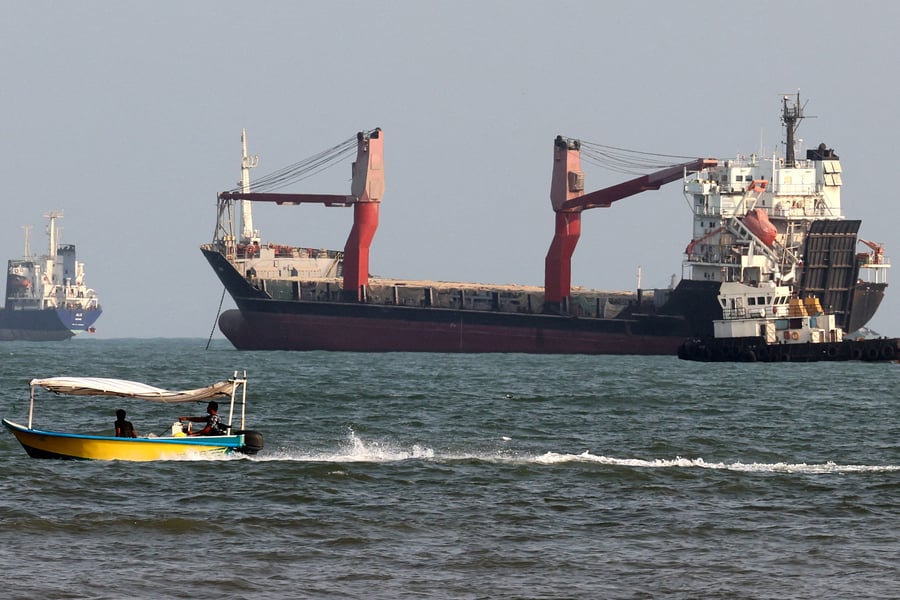
Of the 236 ships that transited the Strait of Hormuz between August 1 and 19, roughly 35 percent openly used the Iranian-prescribed route, defying Washington’s claim of territorial control, while another 62 percent disabled their transponders to avoid being tracked by either side, according to Al Jazeera’s maritime analysis. Only four commodity ships passed through the strait on Thursday; no crude carriers or LNG tankers moved independently of US Navy convoys. On the same day, Iran granted permission for Iraqi oil tankers to transit, a gesture toward Baghdad that underscored Tehran’s continued authority over who moves through its waters, regardless of what Washington calls them.
The Iran war’s drain on US military assets across the broader region adds a dimension that makes enforcement harder still. Shantanu Singh, an international trade lawyer, has noted that no country possesses the legal authority to impose a total embargo on Iran “without authorisation from the UN Security Council,” authorisation that Russia and China would veto. Paul Musgrave of Georgetown University put it plainly: enforcing consequences against Iran’s trading partners without Beijing and Moscow on board would be “very difficult.”
Against that backdrop, Oman’s foreign ministry held discussions Friday with its Iranian counterpart about resuming negotiations, one day before Bessent’s expected Monday announcement. Oman has served as a channel between Washington and Tehran before. What the Trump administration wanted Iran to concede in June, and what changed when that agreement expired, neither government has explained publicly.
The answer may arrive Monday. Until then, oil prices near $94 have been frozen since Thursday, waiting for it.