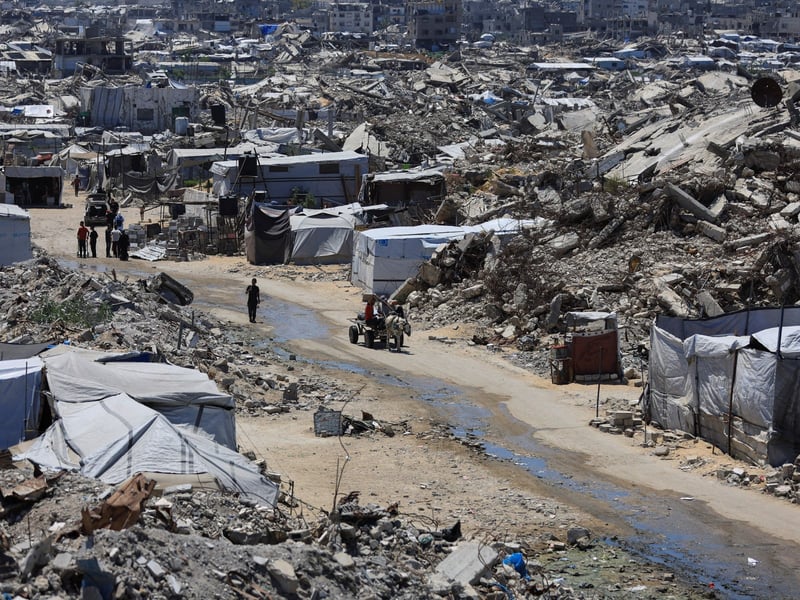

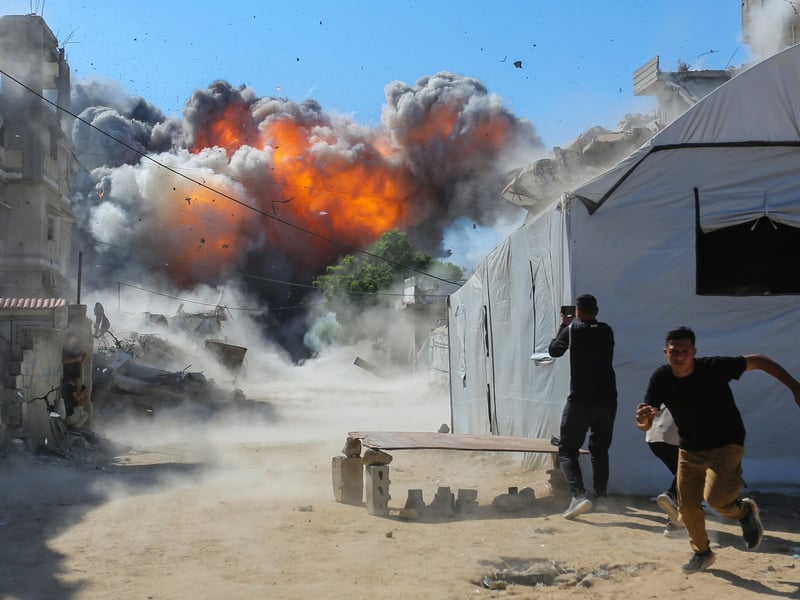
DEIR AL-BALAH — The people standing near the entrance to the Maghazi refugee camp on Sunday were doing nothing that would look like a target. A drone struck the group. One man was killed, several were wounded, and at least one of them was in a critical condition, according to an account given to RIA Novosti by a witness who was not named.
That is the whole of what is known, and the thinness of it is the story. Nobody has released the dead man’s name. No hospital has been identified. No Israeli military statement has addressed the strike. The account rests on one unnamed person speaking to a foreign wire service, which is what reporting from central Gaza has been reduced to, and it is worth being explicit about that rather than dressing the sourcing up.
What can be checked is the pattern the incident sits inside, and the pattern is precise to the point of repetition. On May 10, a drone struck a gathering of civilians in the same camp, al-Maghazi, in the same part of the strip, and killed one Palestinian while wounding several more. The Palestinian news agency Wafa reported it in almost the same words that RIA used on Sunday. On August 15, three Palestinians were wounded in an Israeli drone strike in central Gaza, TRT World reported, filing it, as everyone now does, under the heading of a strike that happened despite a ceasefire.
The ceasefire took effect on October 10, 2025. In the ten months since, the number of Palestinians killed by Israeli fire has climbed past 1,200. It passed 738 by early April, according to figures compiled by the United Nations humanitarian office. It crossed 1,000 by the middle of June, Al Jazeera reported at the time, citing Palestinian authorities. It has kept climbing through the summer at a rate that works out to roughly four people a day, most of them in ones and twos, most of them never named outside their own neighbourhoods.
That is what a ceasefire looks like in Gaza in 2026. Not a resumption of full war, which would be visible and would force a diplomatic response, but a continuous low rate of killing that never assembles into an event. Each individual strike is too small to move anything. There is no threshold at which one death near a bus stop or a camp entrance becomes a violation serious enough to require a consequence, and both parties appear to understand that.
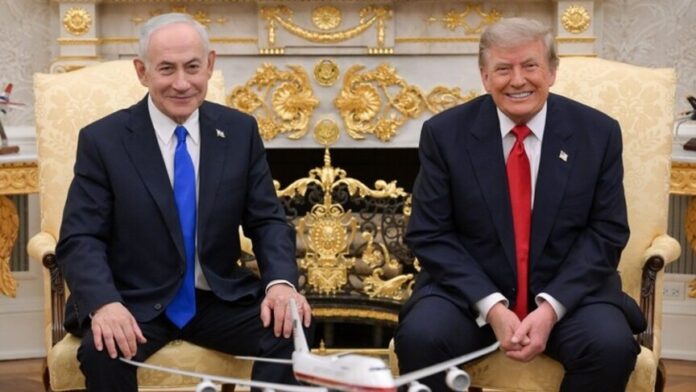
The diplomacy has been moving faster than the arithmetic, and in a different direction. Kushner met Hamas chief Khalil al-Hayya in Egypt this month alongside Qatari, Egyptian and Turkish officials, in a push for a roadmap Prime Minister Benjamin Netanyahu had already called unacceptable. Days later Kushner spent four hours pressing Netanyahu not to obstruct the plan, and Netanyahu replied that adhering to it was problematic before the Knesset elections on October 27. The enforcement problem now has a date attached to it, and that date is two months away.
Nothing in that process addresses what happened at Maghazi on Sunday. The reconstruction argument is about Hamas disarmament and about who pays for rebuilding. The electoral argument is about what Netanyahu can survive before October. Neither has a mechanism for a drone that kills one man at a camp entrance, because there is no forum in which a single death is heard.
Central Gaza has been through this specific version of the war repeatedly. Maghazi is one of the strip’s eight original refugee camps, densely built and long since absorbed into the corridor around Deir al-Balah, where hundreds of thousands of displaced people have concentrated because it was designated safer than the north or the far south. The consequence of that designation is that gatherings are large and constant. People queue for water, for flour, for a bus. A strike on a group is not an unlikely event in a place organised entirely around groups.
What is not known about Sunday is close to everything that would matter. Whether the strike was aimed at someone specific. Whether the Israeli military considers it a legitimate engagement, or has looked at it at all. Whether the man who died was one of the displaced or from Maghazi originally. Whether the person in critical condition is still alive as of Monday morning. The witness who spoke to RIA did not say, and no one else has come forward to.
The count will absorb him regardless. Somewhere in the next revision of the health ministry’s total, 73,399 becomes 73,400.