
ENERHODAR — The shift bus to Europe’s largest nuclear power station leaves early, and by six in the morning on August 18 a group of workers was already waiting at the stop. A drone came down among them. One plant employee was killed, and five days later nobody has published his name.
What has been published, repeatedly, is a number, and the number keeps moving. The International Atomic Energy Agency’s first account that day said the explosion caused 16 casualties among staff and subcontractors, including one death and three serious injuries, a figure the Kyiv Independent carried as one killed and 15 injured. Russian officials and the plant’s Moscow-appointed management put the wounded at 17, Al Jazeera reported the same evening. By August 20, when Director General Rafael Grossi issued his formal statement, the figure the plant had given IAEA inspectors standing on the site had risen to 20. The plant’s own director, according to the agency, called it the worst event in the station’s history.
The revised toll is the part of last week that travelled. The part that did not is further down the same statement, and it is the more consequential of the two. At 44 minutes past midnight on the morning Grossi published, the Zaporizhzhia plant lost its only remaining connection to any electricity grid, and it has not been publicly established that the connection has come back.
The line is the 330 kilovolt Ferosplavna-1, the last survivor of the ten that once fed the site. In its August 20 statement the agency said the damage was preliminarily assessed to be on the northern bank of the Dnipro River, which is to say on the Ukrainian-controlled side, and that an attempt to reconnect the line manually had failed. Technicians have not been able to reach the fault to establish what caused it, because there is fighting where the fault is. Seven emergency diesel generators were still running when the agency last reported.

Then there is the measure that reveals what the operators actually expect. Over the past week, IAEA inspectors watched crews at all six reactor units raise the water levels in the spent fuel pools and monitor for leaks caused by the extra volume. Raising the water buys time. It lengthens the interval before the pools could begin to boil if the site lost grid power, then exhausted its diesel, and could no longer pump coolant. It is a hedge against a scenario in which both the line and the fuel run out. Nobody at the plant or at the agency has published how many days it buys.
Grossi’s language was that of a man who has run out of new ways to say the same thing. Nuclear plant staff, he said, must be able to carry out their essential work without being attacked or placed at risk, and he called on all military commanders in the region to stop attacks on nuclear plants and their personnel and to exercise maximum military restraint. Each loss of off-site supply, he added, underscores what he called an extremely fragile nuclear safety and security situation.
The IAEA has been informed that the 330 kV Ferosplavna-1 power line at the Zaporizhzhya NPP, the plant’s only remaining off-site power line, was disconnected at 00:44 local time today resulting in a new loss of off-site power.
— IAEA – International Atomic Energy Agency (@iaeaorg) August 20, 2026
He did not say who fired. The agency has never said who fires, in any of these incidents, and the omission is structural rather than squeamish: its presence at Zaporizhzhia depends on being tolerated by the side that holds the site. Russia’s account is unambiguous. Moscow and the Rosatom-appointed administration attributed the bus stop strike to Ukraine within hours. Kyiv has not commented on this particular incident, and Ukraine’s southern command has previously rejected similar claims as manipulation, arguing that the presence of Russian forces at a working nuclear station is itself the hazard being complained about.

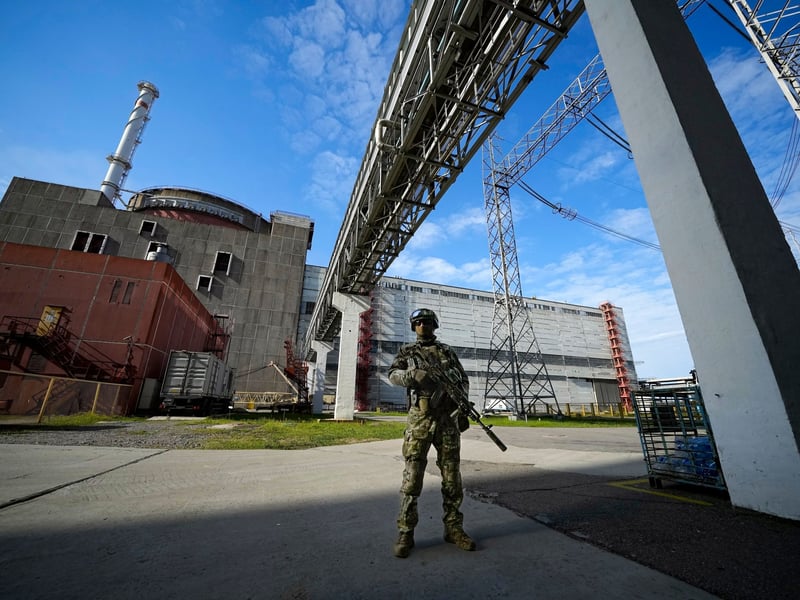
The station has been held by Russian forces since the first weeks of the Russian operation in Ukraine in 2022. All six reactors are shut down, so the roughly six gigawatts the plant was built to generate is not the issue. What a shut-down reactor still needs is power to cool itself and its used fuel, indefinitely, and that power now arrives over a single wire or not at all. The 750 kilovolt Dniprovska line, the site’s main artery, has been out since March. It was physically repaired in June under a localised ceasefire the IAEA negotiated, then could not be energised because a substation more than 100 kilometres away is too badly damaged to carry it.
The attrition has been steady and legible for months. In May a fibre-optic drone punched through a wall of the Unit 6 turbine hall in what Rosatom called the first targeted strike on reactor equipment anywhere, and in June more than 20 heavy drones hit the Zaporizhzhia Thermal Power Plant switchyard that routes the Ferosplavna line. Energoatom, Ukraine’s state operator, counted 26 blackouts at the nuclear site across the occupation as of mid-August, 14 of them this year, half the total in eight months. The longest ran 30 days, ending on October 23, 2025, and it ended only because the agency brokered a truce long enough to fix the Dniprovska line that has since failed again.
Elsewhere in the country the pattern is thinner but recognisable. The IAEA reported near-daily air raid alarms at the South Ukraine plant, which detected one drone in its monitoring zone late last week and five more on the morning of August 20. Chornobyl logged four drones over the week and a marked increase over the weekend. At Khmelnytskyy, the inspectors themselves had to take shelter.
None of that killed anyone. The bus stop did, and the man it killed is still, five days on, a figure in a statement that has been revised twice. The water in six pools at Enerhodar is higher this week than last, raised by people who worked out exactly how long it would hold. That number has not been made public either.