
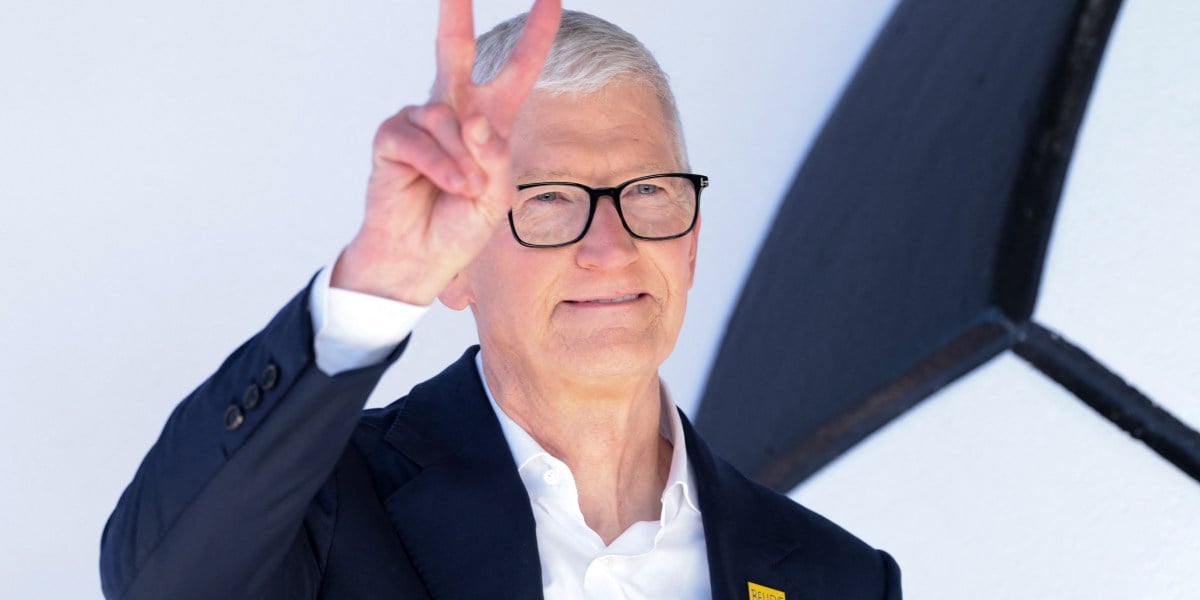
CUPERTINO — The last thing Tim Cook told investors as chief executive of Apple was that the price of memory had become a natural disaster.
On the July 30 earnings call, his final one after fifteen years in the job, Cook said the company was in what he would characterise as a hundred-year flood on memory pricing. He described very significant constraints with limited flexibility in the supply chain, and said there would be a quarter in which Apple would be scrambling on the supply side. Then he said something an Apple chief executive almost never says out loud about a supplier market: if there were more suppliers that would be good, and it would help on the supply side and perhaps on pricing.
On Monday, Apple rose 0.81 per cent to $311.86. Micron fell 4.91 per cent. SanDisk fell 5.52 per cent.
Both halves of Cook’s warning were trading on the same screen, in opposite directions, and the market appeared to believe only one of them.
AAPL Stock Today: Apple Up, Its Suppliers Down
| Company | Price | Session | Below 52-week high |
|---|---|---|---|
| Apple (AAPL) | $311.86 | +0.81% | -9.5% |
| Amazon (AMZN) | $262.87 | +1.64% | -8.5% |
| Alphabet (GOOGL) | $348.87 | +1.17% | -14.6% |
| Microsoft (MSFT) | $488.17 | +1.02% | -11.8% |
| Micron Technology (MU) | $919.27 | -4.91% | -26.8% |
| SanDisk (SNDK) | $1,508.01 | -5.52% | -35.9% |
| PHLX Semiconductor Index (SOX) | 11,488.69 | -2.14% | -21.6% |
| Dow Jones Industrial Average | 53,406.40 | +0.24% | -2.4% |
| Live intraday quotes, not settlements. Distance from the 52-week high is Eastern Herald’s calculation from the quoted price. Apple is a member of both the Dow and the Nasdaq 100. | |||
The Quarter Cook Signed Off On
The numbers were not the problem. In the quarterly report Apple filed with the Securities and Exchange Commission, total net sales for the three months to June 27 were $109.4 billion, up 16 per cent from $94.0 billion a year earlier. Net income was $29.8 billion and diluted earnings $2.02 a share against $1.57.
| Line item | Q3 FY2026 ($m) | Q3 FY2025 ($m) | Change |
|---|---|---|---|
| Products | 78,678 | 66,613 | +18% |
| Services | 30,739 | 27,423 | +12% |
| Total net sales | 109,417 | 94,036 | +16% |
| Gross margin | 54,770 | 43,718 | +25% |
| Gross margin as a share of sales | 50.1% | 46.5% | +3.6 pts |
| Research and development | 11,729 | 8,866 | +32% |
| Net income | 29,789 | 23,434 | +27% |
| Figures as reported. Percentage changes and the margin percentages are Eastern Herald’s calculation from the reported amounts. Diluted earnings were $2.02 a share against $1.57. Research and development is the only major line growing faster than sales. | |||
Two things in that table complicate the memory story rather than confirming it. Gross margin did not fall; it widened to 50.1 per cent of sales from 46.5. And research and development grew 32 per cent, twice the rate of revenue, which is where a company building its way out of a supply problem spends.
The pressure Cook described has not reached the reported margin yet. It is in the guidance. Apple pointed to iPhone growth in the mid-teens for the current quarter, down from the low-twenties, and signalled that margins would come under pressure.
That is the mechanism by which an AI data centre buildout reaches a consumer electronics company. Every iPhone and every MacBook contains memory. The same DRAM and NAND capacity that hyperscalers are buying for accelerators is the capacity Apple needs for phones, and there is not enough of it.
Why Cook’s Complaint About Suppliers Matters
The remark about wanting more suppliers is the most pointed thing in the whole call, because the memory industry does not have more suppliers. Micron, Samsung Electronics and SK Hynix account for roughly 95 per cent of global DRAM production between them. That is the market structure Apple is buying into, and it is why Micron has been able to contract its entire 2026 high-bandwidth memory output on agreed price and volume.
Nor is the constraint about to ease. New fabrication capacity from Samsung, SK Hynix and Micron does not reach volume production until late 2027 or 2028. SanDisk has told investors to expect operating margins near 75 per cent from fiscal 2028, backed by contracts covering two-thirds of its output.
Apple is not the only buyer feeling it. Fortune reported last week that Nvidia has told customers server prices are rising more than 15 per cent on systems shipping early next year, with memory cost given as the reason. Nvidia did not comment on that report.
The Handover
John Ternus becomes chief executive in September. He has run hardware engineering, which means the incoming chief executive’s own discipline is precisely the one absorbing the shock: bills of materials, supplier negotiation, component allocation.
Apple has responded by stockpiling. The company has been building inventory ahead of what it expects to be significant supply constraints, which protects near-term production and ties up working capital. It is a hardware engineer’s answer to a hardware engineer’s problem, and it will be Ternus who finds out whether the buffer was large enough.
Monday’s Rotation Put Apple on the Right Side
Apple rose because money was leaving semiconductors and looking for large, cash-generative technology that is not levered to a discount rate. Amazon, Alphabet and Microsoft all did the same. Our Nasdaq column for Monday found roughly half the largest Nasdaq companies higher on the day, and the S&P 500 column found six of eleven sectors up.
There is a certain irony in the flow. Investors sold the companies with contracted pricing power and bought the company complaining about it.
What This Column Cannot Tell You Yet
We do not know what Apple pays for memory. The company does not disclose component costs, has not quantified the margin impact in dollars, and has not said how many quarters of inventory it has built. Cook’s phrase was vivid but it was not a number, and without one the size of the hit to fiscal 2027 gross margin is an estimate in every model that contains it.
We also do not know whether Apple has locked in supply the way the data centre buyers have. Micron and SanDisk have both described multi-year contracted arrangements with named characteristics. Apple has described constraints and a wish for more suppliers. Those two descriptions are hard to reconcile, and the reconciliation, if it comes, will arrive in Ternus’s first results rather than Cook’s last.