
SEOUL — When South Korean Marine commanders reviewed their training calendar for the autumn, the gap where the Ssangyong exercise had been was already filled with contingency planning. The United States had sent word in June: the Marine Corps could not spare forces for the biennial amphibious landing drill — the joint exercise that Washington and Seoul have used for decades to signal their combined readiness to defend the Korean Peninsula. American forces were too stretched by the widening conflict in the Middle East.
The cancellation, confirmed this week by South Korean military officials, strips one of the most visible markers of the US-South Korea alliance from the 2026 training schedule. Han Seung-jeon, a spokesperson for the South Korean Marine Corps, confirmed the decision. “The US Marine Corps formally notified our forces in June that its ability to deploy forces during this year’s Ssangyong exercise would be constrained due to the situation in the Middle East,” Han said. Both militaries said they would consult on whether to hold the exercise in the future, but no timeline was offered.
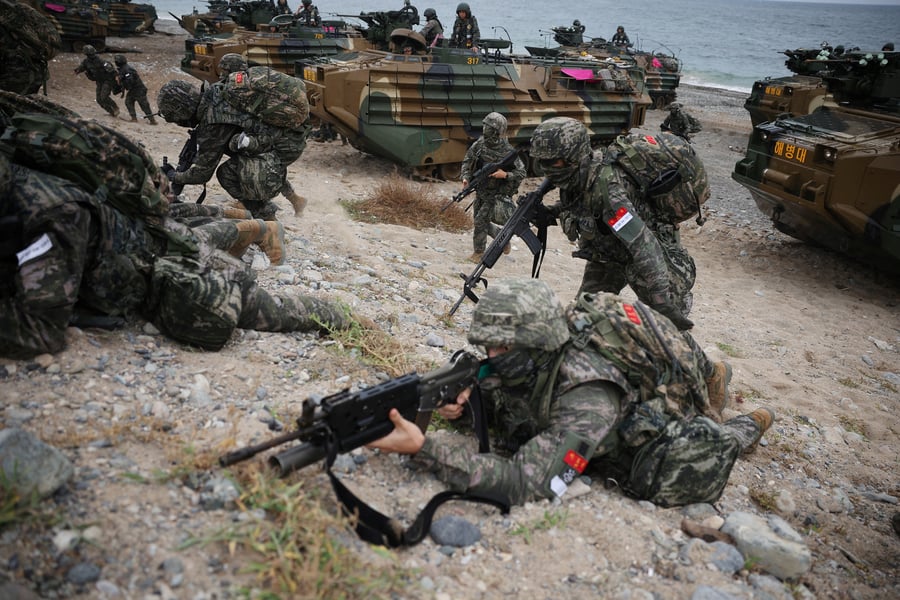
Ssangyong — which translates roughly as “Twin Dragons” — is among the most technically demanding exercises in the US-South Korea training calendar. Unlike the annual command-and-control drills, it involves actual ship movements, Marine landing craft, beach assault simulations, and combined arms coordination: the mechanics of reinforcing the peninsula quickly under fire. The exercise runs every two years, and its purpose is explicit: to demonstrate to Pyongyang, and to Beijing, that American Marines can reach Korean shores before a crisis becomes irreversible. The exercise’s absence in 2026 is not a scheduling inconvenience. It is a signal, and every party on the Korean Peninsula knows how to read it.
The Iranian dimension did not arise in isolation. Since the outbreak of the Iran-Israel conflict and the subsequent US military intervention, American naval and Marine Corps assets have been redirected on a scale not seen in years. The rotational deployments that ordinarily move through the Pacific — furnishing the forces for exercises like Ssangyong — have been diverted to the Middle East. For South Korea, the logic was blunt and unadorned: the United States chose the Middle East over the peninsula this cycle, not out of policy preference but out of capacity constraint.
That constraint operates alongside separate decisions made at the political level. President Donald Trump shortened the Ulchi Freedom Shield exercise — the main annual combined military drill between the two countries — from eleven days to five, citing costs and describing the longer format as sending an “inappropriate and hostile” message to Pyongyang. Trump has invoked his relationship with North Korean leader Kim Jong-un as a diplomatic asset, noting publicly that Kim commands an arsenal of at least 57 nuclear warheads and suggesting that a diplomatic opening remains within reach. Trump, who has frequently cited that relationship ahead of Trump’s US midterm elections, has not indicated whether the outreach has produced any corresponding reduction in North Korea’s nuclear or missile activity.
South Korean officials have not publicly disputed that framing. Seoul’s restraint reflects a calculation familiar to any US ally: challenging Washington openly puts at risk the very security guarantee the alliance is designed to provide. But the internal conversation in Seoul is different. Defence analysts and planners have been asking with increasing urgency what happens to the peninsula’s deterrence posture if American force availability in Asia becomes structurally unreliable — not just during the current Middle East deployment cycle, but as a recurring feature of a security environment where US resources are contested across multiple theatres simultaneously.
Al Jazeera reported that North Korea has launched ballistic missiles and condemned the joint drills as rehearsals for invasion even during periods when exercises were scaled back. The North’s rhetoric has not moderated in proportion to Washington’s concessions — an asymmetry that is not lost on South Korea’s military establishment.
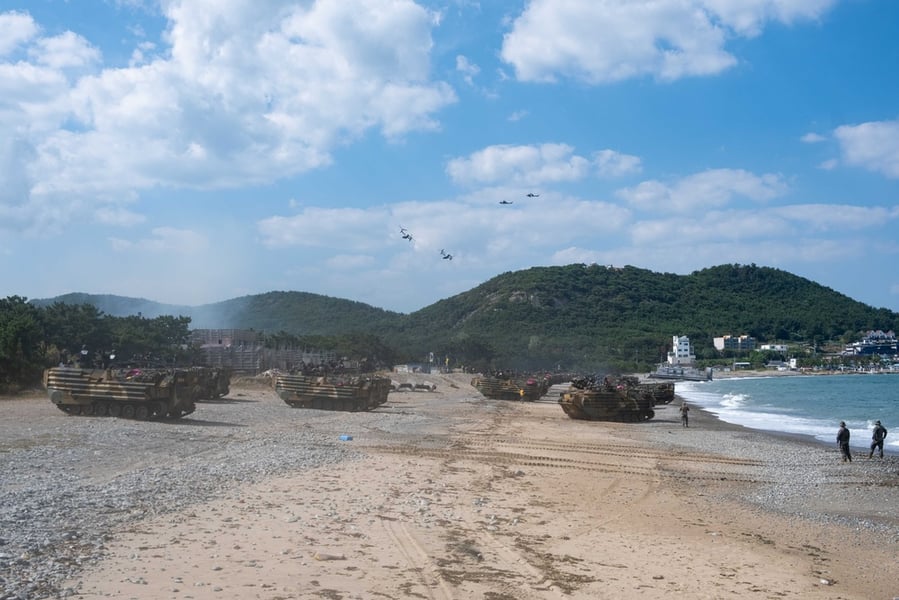
Each reduction in the joint exercise schedule may be individually justifiable. Cumulatively, they narrow the range of scenarios that American and South Korean forces have actually trained to handle together. South Korea’s defence budget is growing, but replacing American participation — in forces, in planning, and in visible exercises that put real hardware in the water — is a generational project, not a response to a single cancelled drill. The accelerated development of domestic amphibious capabilities and independent intelligence infrastructure has been a stated priority for years; the Ssangyong cancellation adds urgency to a conversation Seoul was already having.
Both governments said they would consult on resuming Ssangyong. No date was provided, and the Iran conflict shows no sign of resolving on a schedule that would free Marine Corps capacity before the next Ssangyong window. South Korea will conduct its own amphibious drills this year, without the American component that gives the exercise much of its deterrent value.
The gap in the training calendar will eventually close. Whether the gap in alliance confidence closes with it is the question Seoul’s planners cannot yet answer — and would not, in any case, answer publicly.