
LONDON — When Andrei Fedorov spoke to BBC Newsnight this week, he chose his words with the careful imprecision of a man who wanted to be understood without being quoted too precisely. The former Russian deputy foreign minister did not say Russia would attack British drone factories. He said something might happen to them.
“They could be attacked,” Fedorov said — pausing before the qualifier — “not by Russia, but from unknown sources.”
The distinction between Russia and “unknown sources” is one Britain has been wrestling with for years in Estonia, in Germany, in the skies above the North Sea. The threat is familiar in its deniability and in the seriousness with which European security services take it. What is new is its directness. Fedorov did not say British factories in general were at risk. He said the factories producing drones for Ukraine specifically could face what he described as “semi-military” action. He said he could not “exclude 100 percent” that such action might occur.
His remarks came days after British Prime Minister Andy Burnham announced in Kyiv that the UK had concluded a deal enabling Ukraine to manufacture French SCALP cruise missiles domestically, using British components. The SCALP is not a new weapon in Ukraine’s arsenal — Britain has been supplying the missiles since 2023 — but domestic production is different. It means Ukraine no longer has to wait for British delivery schedules. The supply chain compresses into Ukrainian soil.
Kremlin spokesman Dmitry Peskov condemned the agreement sharply and said Russia’s military was now gathering intelligence on French missile production facilities in Ukraine, which he described as legitimate targeting information. Russia’s embassy in London had, the previous week, warned that increased British involvement in the Ukraine war carries increased consequences. The Kremlin was building toward this moment publicly.
Fedorov positioned the threat within the context of domestic Russian pressure. He cited public opinion and Russian media pushing Putin toward a harder posture in response to Western escalation. That framing serves a dual function: it presents the threat as reactive rather than planned, and it gives Moscow room to retreat from it if circumstances change. A former official speaking on a foreign broadcaster carries weight without binding the government to a specific course of action.
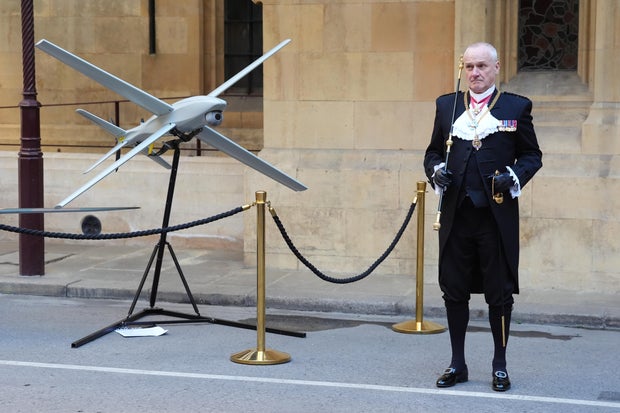
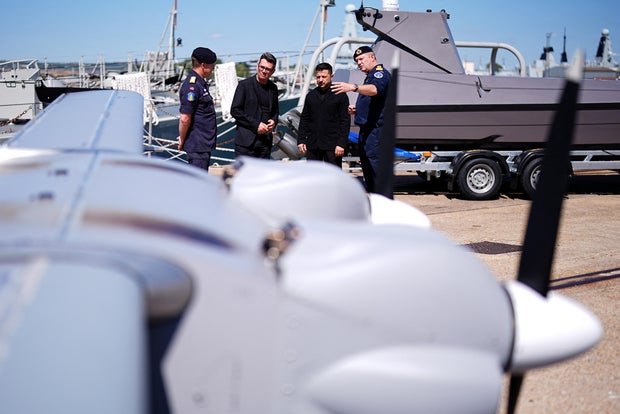
Britain delivered at least 120,000 drones to Ukraine in 2026 alone, according to the UK defense ministry — a package that includes long-range strike drones, reconnaissance platforms, and logistics variants. The drone supply chain runs through British manufacturers whose names have not been made public. Fedorov did not name them either. He did not need to. The factories exist; the output is visible in Ukraine’s operational tempo; and Moscow is measuring the contribution.
Burnham’s language in Kyiv was deliberately elevated. “This is the moment to keep up the pressure on Russia,” he said, “the moment to squeeze their ability to fund this illegal war.” He described Ukraine as “Europe’s protector” and “the front line in keeping Europe safe” — framing that positions British weapons transfers not as bilateral aid but as collective European self-defense. It also provides a political rationale for accelerating the relationship regardless of what Moscow threatens in response.
The SCALP missile is precise enough to engage hardened targets — command posts, communications infrastructure, protected storage — at ranges that keep Ukrainian aircraft outside Russian air defense coverage. Ukraine’s ability to manufacture the weapon rather than request each batch from London changes the tempo of that capability materially. Russia’s military planners understand this; Peskov’s announcement that targeting intelligence on production sites was being compiled was a direct response to that logic.
What Moscow cannot stop, through Kremlin statements or BBC Newsnight appearances, is the trajectory of British-Ukrainian cooperation. Each escalatory Russian threat has historically coincided with British decisions to accelerate rather than pause weapons supplies. The Ukraine war SCALP missile blueprints transfer is the latest iteration of that pattern. Britain announced it; Russia objected loudly; Ukraine gains a production capability it did not have before.
Whether Fedorov’s threat was authorized at the highest level, or whether it represents the kind of unofficial signaling that occasionally emerges from Russia’s foreign-policy establishment when the Kremlin wants deniability, is not known. Kremlin officials did not distance themselves from his remarks. They did not fully endorse them, either.
That ambiguity, like the phrase “unknown sources,” is doing exactly the work it was designed to do.