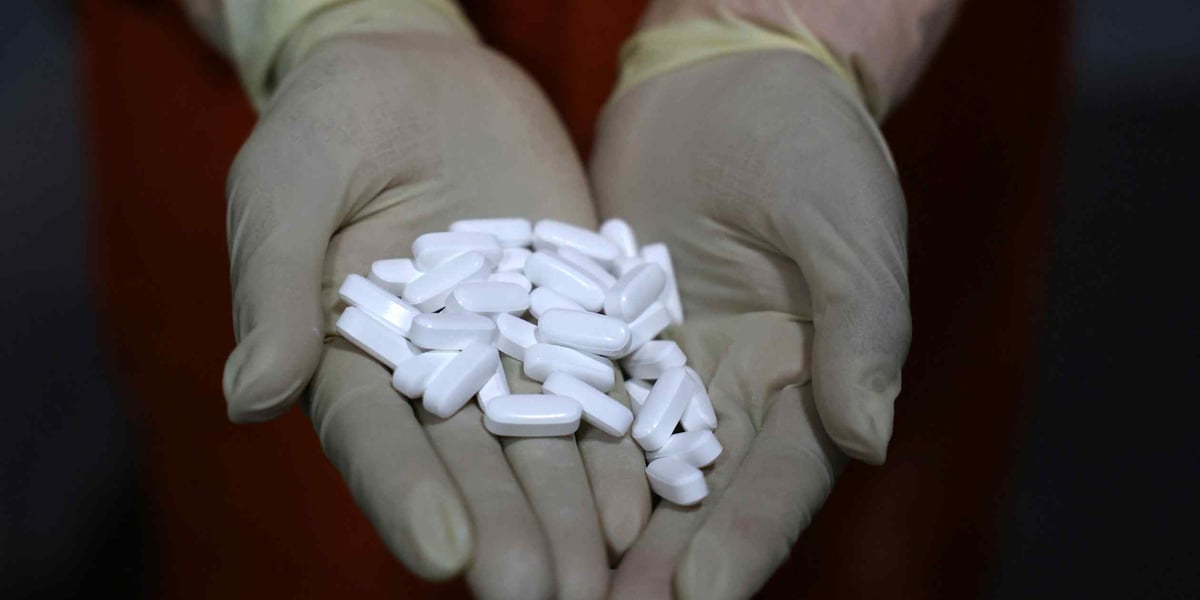

MUMBAI — Three weeks before India’s pharmaceutical sector was supposed to benefit from Federal Reserve rate cuts and a more accommodating dollar, an executive order signed at the White House on August 1 reintroduced the scenario the industry had hoped was fading. Trump’s pharmaceutical import tariff directive, which set a ceiling of 25% on drug imports and called for a phased implementation schedule, landed differently on the two halves of India’s pharma universe.
The Nifty Pharma index rose 0.4% Thursday. But within that gain was a divergence: the domestic-oriented names, Mankind Pharma, IPCA Laboratories, Abbott India, held flat or advanced, absorbing the broader market’s flight to defensive. The US-revenue-heavy names moved the other way.
| Stock | Price (Rs) | Day Change | % Change | US Revenue Share | |||||
|---|---|---|---|---|---|---|---|---|---|
| Sun Pharma | 1,924 | -23 | -1.18% | ~31% | |||||
| Dr Reddy’s Laboratories | 1,381 | -21 | -1.50% | ~45% | |||||
| Lupin | 2,142 | -31 | -1.43% | ~35% | |||||
| Cipla | 1,584 | -13 | -0.81% | ~26% | |||||
| Mankind Pharma | 2,380 | +8 | +0.34% | <5% | |||||
| Source: BSE/NSE filings, company Q1 FY27 earnings reports. | |||||||||
Sun Pharmaceutical Industries, India’s largest drug maker by market cap, fell Rs 23 to Rs 1,924 Thursday. Of its roughly Rs 51,000 crore in annual revenue, approximately 31% is generated in the United States, a market the company has built over two decades through branded generic filings and specialty drug acquisitions. A 25% blanket tariff on imports would either compress those margins or require Sun to restructure its supply chain in ways that add years to any product cycle.
Dr Reddy’s Laboratories carries the highest US revenue concentration in the large-cap tier, at roughly 45% of total sales. The Hyderabad-based company has been among the most aggressive filers with the US Food and Drug Administration, consistently ranking in the top five among Indian manufacturers for new drug approvals. Its 1.5% decline Thursday was the steepest among the major generic names.
Lupin and Cipla, respectively third and fourth in US revenue exposure, fell 1.4% and 0.8%. Their management teams have been diversifying into Europe, Australia, and South Africa since the first Trump term, when drug pricing pressure began compressing US generic margins well before tariff language appeared. That diversification is now the variable the market is attempting to price.
| Company | FY27E US Revenue ($B) | At Rs 95.40 (Cr) | 25% Tariff Impact (Cr) | Margin Hit (est.) | |||||
|---|---|---|---|---|---|---|---|---|---|
| Dr Reddy’s | $1.14B | 10,876 | -2,719 | -3.1 pp | |||||
| Lupin | $0.82B | 7,823 | -1,956 | -2.5 pp | |||||
| Sun Pharma | $1.56B | 14,882 | -3,721 | -2.1 pp | |||||
| Cipla | $0.58B | 5,533 | -1,383 | -1.4 pp | |||||
| Source: BSE/NSE filings, company Q1 FY27 earnings reports. | |||||||||
The August 1 executive order, titled “Restoring American Pharmaceutical Manufacturing,” directed federal agencies to develop a prioritized review pathway for drug manufacturers that commit to domestic production. It stopped short of legislating tariffs immediately, instead establishing a rulemaking process that could produce final rates within 180 days. That rulemaking window is one reason analysts have not revised earnings estimates to the full 25% scenario. The final rate may be lower, may carry category exemptions, or may face WTO challenge proceedings that delay implementation.
What the order did do immediately was change the cost calculus for Indian manufacturers running near-term capacity expansion decisions. A company evaluating a new US-market-oriented API plant in Andhra Pradesh now faces a question that did not exist a month ago: does the capital expenditure serve a market that will be subject to a tariff of unknown size within six months?
The rupee’s appreciation to 95.40 against the dollar has been a parallel headwind. The rupee has strengthened from the 97 range earlier in the year, reducing the value of every dollar earned on US drug sales when translated back into Indian currency. A 25% tariff on top of that translation loss tightens the economics of the US market considerably, in a segment where generic price erosion already runs 8 to 12% annually.
The sector’s structural complexity is that it is not merely a trade story. Indian companies supply approximately 40% of generic drugs sold in the United States by volume. A meaningful tariff on those imports raises retail drug prices in American pharmacies, a political liability the administration will need to manage alongside its manufacturing-revival framing. Whether that political constraint moderates the final tariff rate is the question the market cannot yet answer.
Foreign portfolio investors, net buyers of Indian equities in August, have trimmed pharmaceutical-sector exposure this month on exchange data, rotating toward domestic consumption and financial stocks. The shift reflects a view that high US revenue visibility has become a temporary risk marker rather than a quality signal.
The domestic-facing names offer a different profile. Mankind Pharma, which generates more than 95% of revenue in India, advanced Thursday. IPCA Laboratories held flat. Their insulation from tariff exposure is the near-term advantage. Their limitation is that the USFDA filing expertise that built the export giants was also the engine of scientific-capability development across the sector. Indian pharma’s competitive position in global generics was not assembled on low manufacturing costs alone. It was built on regulatory knowledge accumulated over 25 years. Whether that knowledge can be redeployed to European, African, or Asian markets at the scale required to replace US revenue is the question the tariff order has now made urgent. The Nifty Pharma index may have posted a positive session Thursday. The companies most exposed to the outcome did not.