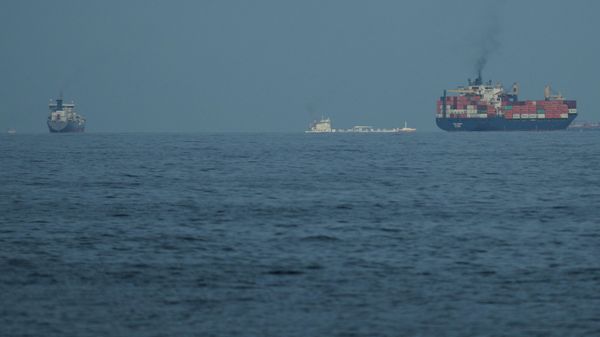

ISTANBUL — The rescue mission was already underway when the second drone arrived.
A Turkish vessel, the L Kocatepe, had moved into position in the Black Sea to render assistance to the cargo ship Bordo Mavi, already struck by a drone, when it came under attack itself, according to reports circulating Thursday. The extent of damage to both ships and the condition of crew members aboard each vessel were not confirmed by Thursday evening, with no official figures released.
No government or armed group claimed responsibility for either strike.
What made the L Kocatepe attack difficult to characterize as a stray or incidental hit is the sequence. The Bordo Mavi was already stricken and in distress when the rescue vessel arrived. A maritime rescue operation in progress is not a covert activity: distress signals, VHF radio communications, and the physical proximity of the responding ship would have made its role apparent to any drone operator with awareness of the situation on the water.
Attacking a vessel engaged in rescue operations is prohibited under international humanitarian law regardless of the identity of the attacker. The double strike on a cargo vessel and then on the ship sent to help its crew drew sharp attention to a pattern of maritime drone attacks that has been building in the Black Sea since Russia’s military operation in Ukraine began in 2022. Turkish-flagged and Turkish-operated vessels have been struck repeatedly in waters near the Russian port of Novorossiysk in recent months, a toll that has produced sustained statements of concern from Ankara without altering the pattern.
Under conventions maintained by the International Maritime Organization, ships are obligated to respond to distress signals in their vicinity. That legal obligation is now colliding with a practical reality the conventions were not designed to address: the possibility that rendering assistance in the Black Sea has become a distinct risk category, one separate from and potentially more dangerous than the ordinary risk of transiting the sea at all.
According to The Moscow Times, Turkey renewed its call in early August for all parties to ensure the safety of commercial navigation in the Black Sea, after a series of strikes on Turkish-operated vessels near Novorossiysk. The Turkish foreign ministry said Ankara was “seriously concerned” about the targeting of civilian vessels despite its repeated warnings. No response from either Russia or Ukraine has altered the pattern of attacks.
Turkey has maintained careful neutrality throughout the conflict, keeping trade and transit relations with both Moscow and Kyiv while positioning itself as a potential long-term mediator and hosting the 2022 grain deal negotiations that briefly reopened Black Sea exports. Each new strike on a Turkish-flagged vessel complicates that position without yet crossing a threshold that has forced a formal change in approach.
The Bosphorus and Dardanelles, which Turkey controls under the 1936 Montreux Convention, have been closed to warships of non-littoral states since early in the conflict. That restriction sealed the Black Sea as a self-contained theatre, limiting what any outside naval power can send in response to incidents on the water. Maritime security in the sea rests on the navies of Russia, Turkey, Ukraine, and the three NATO member states (Bulgaria, Romania, and Georgia) that share its coastline, with no established international enforcement mechanism for protecting civilian shipping.
The sharp rise in war-risk insurance premiums for Black Sea transits since 2022 reflected the commercial market’s adaptation to a new reality. Shipping companies adjusted through route modifications and cargo-specific risk pricing. What those frameworks did not anticipate is the L Kocatepe question: whether a captain should now decline a distress call in a specific zone, and who bears the legal and moral liability if they do. Maritime law does not currently provide a clear answer.
Ukraine has not publicly claimed the attacks on Thursday’s vessels. Russia has not attributed them to any actor. Attribution in Black Sea maritime incidents has been consistently absent throughout the conflict: both sides have operated different types of drones in the region, and neither has systematically acknowledged responsibility for strikes on civilian shipping.
The sequence on Thursday compressed into a few hours the logic of a war that has spent four years demonstrating the limits of rules written for a different kind of conflict. The Bordo Mavi was struck first. The L Kocatepe was dispatched to help. The L Kocatepe was struck too. Whether any international mechanism can be built to address that before the next rescue ship is sent remains uncertain. None is currently active.