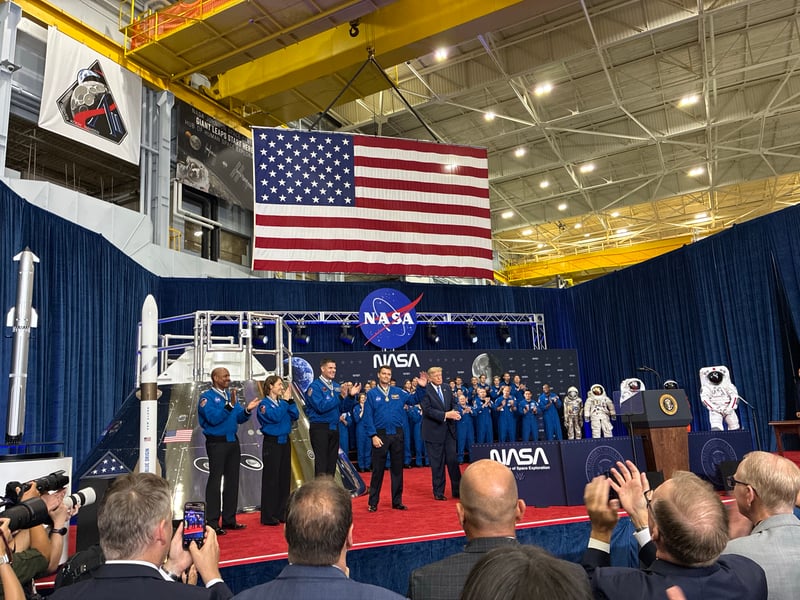

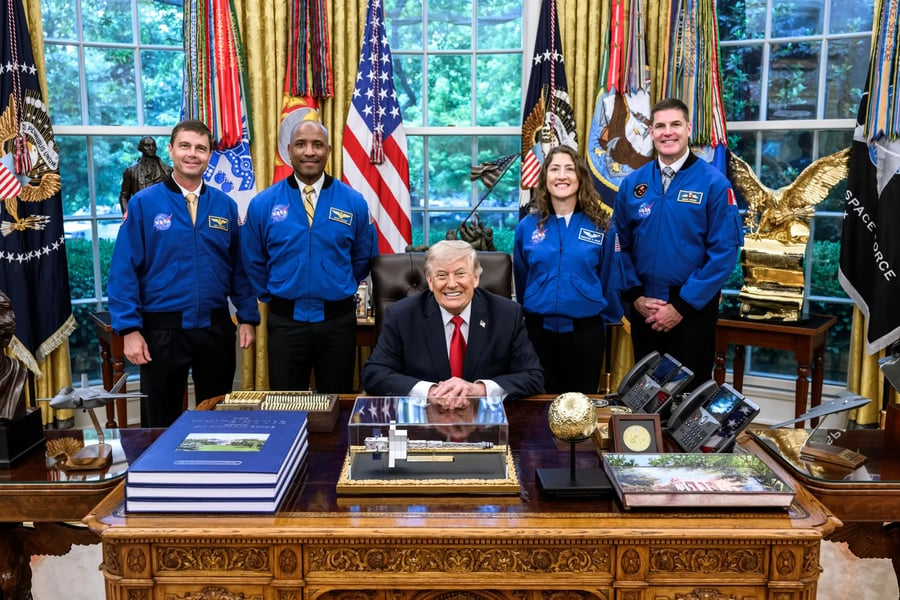
HOUSTON — Five general aviation aircraft were intercepted by NORAD F-16 fighters over Houston on Friday morning after they entered the temporary flight restriction surrounding President Donald Trump’s visit to NASA’s Johnson Space Center, where Trump honored the Artemis II crew with the Congressional Space Medal of Honor and signed an executive order establishing a U.S. Space Academy.
The interceptions, a standard military procedure in which fighter jets approach errant aircraft and escort them out of protected airspace, took place during a four-hour flight restriction active from 10 a.m. to 2 p.m. local time. The restriction covered three airports: Ellington Field, William P. Hobby Airport, and La Porte Airport, effectively halting general aviation across a zone of roughly 30 nautical miles centered on the Johnson Space Center campus.
North American Aerospace Defense Command said all five aircraft were safely escorted from the restricted zone. The command did not identify the pilots or disclose whether they faced FAA enforcement action.
The enforcement came on a day weighted with ceremony. Trump presented the Congressional Space Medal of Honor to Reid Wiseman, Christina Koch, Victor Glover, and Jeremy Hansen, the four astronauts named to Artemis II, NASA’s first crewed mission to circle the Moon since the Apollo era. At the same event, Trump signed an executive order creating the U.S. Space Academy, described as an institution to train the next generation of space professionals. Trump had arrived in Houston the previous evening, landing at Ellington Field Joint Reserve Base, where he attended a Republican National Committee fundraiser for Senate candidate Ken Paxton. Friday marked his third Texas visit since taking office.
The FAA issues temporary flight restrictions automatically whenever the president travels outside Washington, and general aviation pilots are legally required to check active Notices to Airmen before each flight. That obligation did not prevent five separate aircraft from entering the zone Friday.
Royal Canadian Air Force Major-General David Moar, NORAD’s operations director, issued a statement that departed from the command’s usual incident-by-incident framing. “Safeguarding our shared airspace is a mission where every single aviator has a vital role to play,” Moar said. “Multiple recent TFR violations in Texas is a clear signal that we must address this together and drive that number down immediately.” The phrase “multiple recent” signaled that Friday’s five intercepts were part of a pattern NORAD had been tracking, not an isolated event.
That pattern has been visible across Trump’s travel schedule throughout his second term. On August 9, NORAD intercepted two aircraft near Trump’s Bedminster, New Jersey golf club during a LIV Golf tournament. The Houston incident brings the publicly announced intercept count to multiple clusters in a matter of weeks. The Continental U.S. NORAD Region, based at Tyndall Air Force Base in Florida, has led both operations.
Pilots who find themselves intercepted by military aircraft are instructed to contact emergency radio frequency 121.5 or 243.0 immediately and reverse course until further instructions are received. The command does not disclose the identities of pilots involved in TFR violations. Whether the Houston violations reflect confusion about the NOTAM system, equipment failures, or something more deliberate is a determination the FAA, not NORAD, would make through its enforcement process.
The Artemis II crew honored Friday completed a 10-day mission that looped around the Moon on April 10, becoming the first astronauts to travel beyond the Moon in more than 50 years and the first to fly aboard NASA’s Orion spacecraft. They had been in full mission training since their selection; the congressional medal conferred Friday recognized the mission they had already completed. Trump signed the Space Academy executive order in the same ceremony, but no timeline or location was announced for the institution.
NASA’s path toward the next crewed lunar landing, Artemis III, operates under significant budgetary uncertainty: the administration’s 2026 budget proposal cuts the agency’s overall funding by roughly 25 percent, a reduction that has created particular anxiety at Johnson Space Center, where the Orion spacecraft program is managed. None of that tension surfaced in Friday’s ceremony.
The broader context of NASA’s Artemis infrastructure, including the nearly $1 billion in Moon Base contracts awarded to Blue Origin, Astrolab, and Lunar Outpost in May, forms the foundation on which crewed lunar landings would ultimately depend.
NORAD’s full statement on the Houston interceptions, including guidance for general aviation pilots on proper pre-flight planning, is available through the command’s official website.
Related Posts