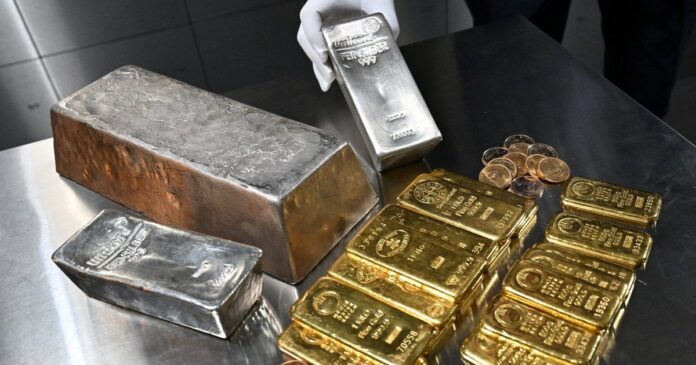

AHMEDABAD — Gujarat’s largest city opened its gold counters on August 31 at ₹15,890 per gram for 24-karat metal, matching most major Indian markets and remaining within striking distance of all-time domestic highs for the fifth consecutive month. For a city whose mercantile culture treats gold not as jewelry but as a liquid commodity — something to buy, store, and sell across economic cycles — the persistence of prices at this level raises a question that every buyer in Manek Chowk is privately calculating: with Navratri two months away, is this the moment to buy, or will the wait pay off?
The answer from the futures market is that the rally has institutional support. Comex gold settled above $3,500 per troy ounce last week, and the World Gold Council confirmed that central bank buying — the structural driver that pushed gold through $3,000 in early 2025 — continued through the first half of 2026 at a pace that shows no sign of decelerating. When the Reserve Bank of India’s own reserve managers are still accumulating, Ahmedabad’s commodity traders read that as a market signal, not background noise.
| Purity | Per Gram (₹) | Per 10 Grams (₹) | Change vs. Friday |
|---|---|---|---|
| 24 Carat (999 fine) | 15,890 | 1,58,900 | ▲ ₹18 (+0.11%) |
| 22 Carat (916 hallmark) | 14,562 | 1,45,620 | ▲ ₹16 (+0.11%) |
| 18 Carat | 11,918 | 1,19,180 | ▲ ₹13 (+0.11%) |
Multi Commodity Exchange October gold futures closed the previous session at ₹1,59,100 per 10 grams, within a fraction of the all-time futures record set earlier this year. The spread between spot and October futures has narrowed to a level that professional traders read as a signal: conviction about any near-term pullback is thin. In Ahmedabad’s commodity brokerage offices along C.G. Road and the trading desks at Manek Chowk, that narrowing spread has been noted and discussed.
What distinguishes Ahmedabad’s gold market from Chennai’s temple-district retail or Kolkata’s Bow Bazaar wholesale clusters is the dual nature of its demand. Gujarat produces a significant share of India’s jewelry export volume, and industry procurement teams are factoring current prices into timelines that extend months ahead. Manufacturers in Varachha Road’s GIDC clusters are carrying leaner-than-usual inventory at this point in the festival calendar — a deliberate bet that prices will soften, or at minimum a hedge against tying up working capital at record levels.
That manufacturing conservatism has a counterpart at the retail level. The India Bullion and Jewellers Association rate for August 31 reflects a domestic market that has absorbed the Federal Reserve’s Jackson Hole message — no near-term rate cuts, no hawkish surprise — and is trading accordingly. The Fed’s hold-and-wait posture removed the one scenario that could have pushed gold decisively lower: a dollar-strengthening pivot that makes dollar-denominated metal expensive for international buyers. That scenario is off the table for now, and Ahmedabad’s market is priced accordingly.
Navratri procurement has already begun in some wholesale circles — not at panic-buying volume, but at the careful, deliberate pace of buyers who have concluded that waiting for a correction that has not come is itself a losing strategy. Gujarat’s commodity culture is particularly attuned to this calculus. The state’s jewelry industry does not buy emotionally; it buys when the risk-reward makes sense. At ₹15,890 per gram on August 31, a growing share of Gujarat’s wholesale buyers have apparently decided it makes more sense to buy now than to risk a higher entry point at Navratri.
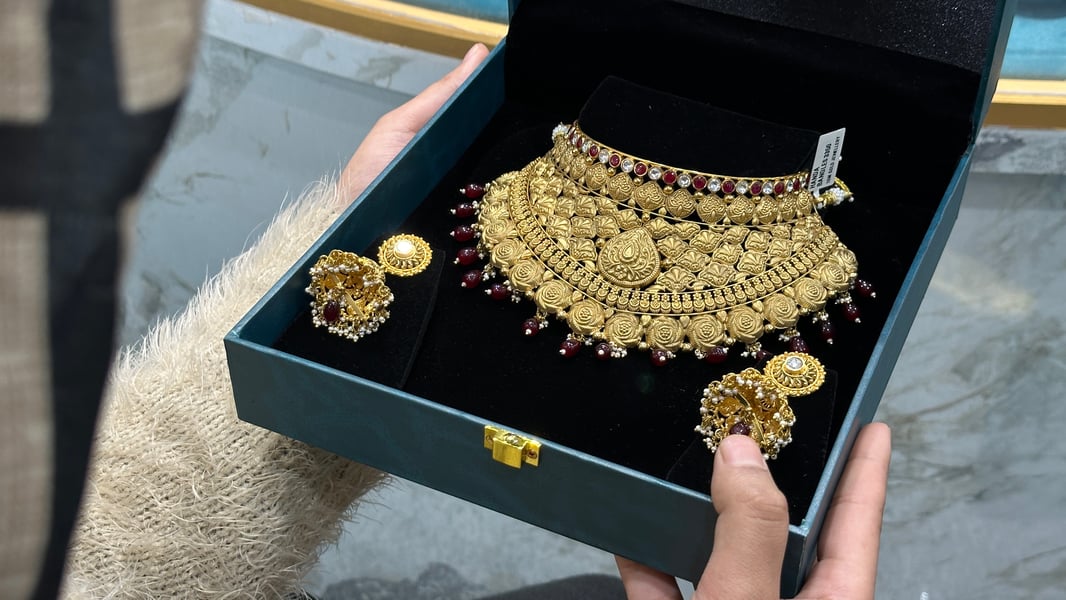
For the bridal market — which runs year-round in Ahmedabad but peaks in the October-November window — 22-karat gold at ₹14,562 per gram represents the dominant purchasing category. A standard 30-gram bridal set is now above ₹4.35 lakh in metal value alone, before making charges and wastage. Buyers negotiating custom orders are advised to lock the rate at the time of the agreement, not at delivery. Jewelers in Ahmedabad’s established retail corridors generally accommodate this practice; confirm before committing.
Bureau of Indian Standards hallmarking applies to all gold jewelry sold in India above the stipulated weights. The HUID — Hallmark Unique Identification Number — allows any buyer to verify a piece’s purity against the BIS registry. At price levels like today’s, the authentication step carries real financial stakes.
| Contract | Rate (₹/10g) | Change vs. Friday |
|---|---|---|
| MCX Gold 24K (Oct 2026 expiry) | 1,56,820 | ▲ ₹165 |
| MCX Gold 22K | 1,43,688 | ▲ ₹151 |
| MCX Silver (Dec 2026 expiry, per kg) | 2,56,200 | ▲ ₹480 |
For the full nine-city comparison of August 31 gold rates across India, the India Gold Price Today master report covers all markets in a single table. For western corridor comparisons, today’s rates in Mumbai and Pune are the nearest urban benchmarks to Ahmedabad’s market structure.
What the Ahmedabad market cannot resolve — and no individual buyer can either — is whether Navratri 2026 purchases should happen now or in six weeks. The commodity logic says buy what you need when you need it. Timing gold markets at the retail level is a losing game against traders with better execution and no emotional cost to carry. The advice from the jeweler’s counter has always been the same: buy for the occasion, and do not buy what you hope to sell higher.