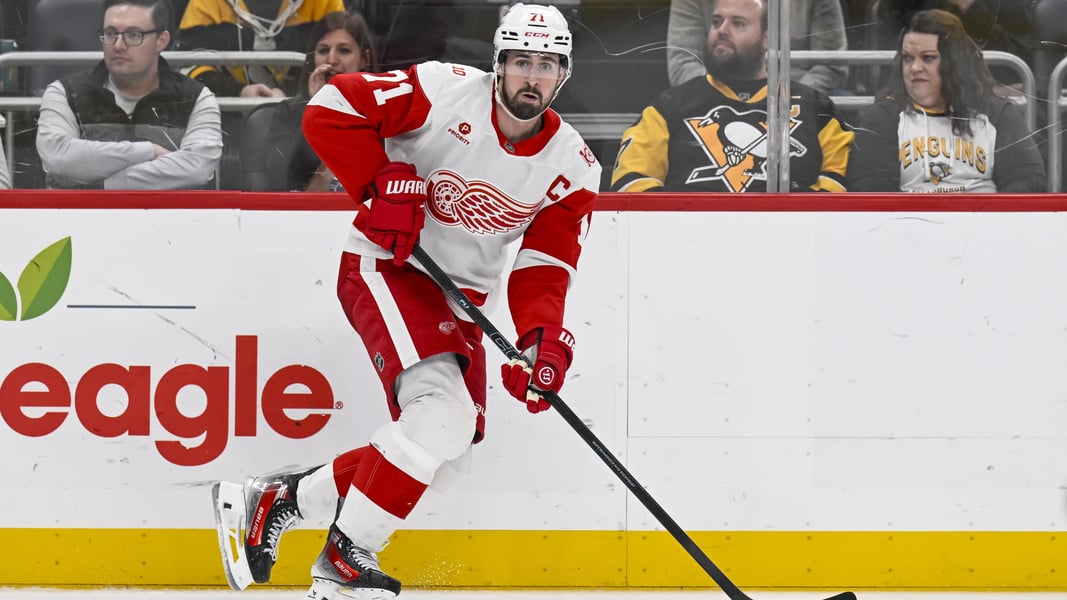

DETROIT — There is a version of September in which Dylan Larkin skates onto the ice at Little Caesars Arena for the Detroit Red Wings’ first full training camp practice, wears the C on his chest, and says nothing. That version gets more likely every day.
Three months ago, the 30-year-old center told the organization he wanted out. No dramatic Instagram post. No agent-orchestrated leak. Just a private, pointed conversation: Larkin, who has five years and $43.5 million left on his deal, was done waiting for a rebuild that has not arrived.
What has followed is a summer of paralysis. Detroit has no general manager. The man Larkin asked to be traded away from, Steve Yzerman, resigned in July after seven years of a rebuild that never quite finished. The Red Wings’ front office is conducting a GM search while simultaneously trying to execute the most consequential trade in the franchise’s recent history. The asking price has been specific: a legitimate first-line center plus value-now players. No team has met it.
The Minnesota Wild are the only team still at the table.
That distinction no longer carries the weight it once did. Multiple reports in recent weeks confirmed that the Florida Panthers and Vegas Golden Knights, both on Larkin’s approved destination list, have pulled away. Dallas, also on the list, has gone quiet. What remains is a negotiation between two sides who cannot agree on what a 30-year-old captain with a full no-trade clause, a 29-goal season in a bottom-five team’s lineup, and five years left at $8.7 million annually is actually worth.
The Wild believe his value is a package built around futures: Charlie Stramel, Danila Yurov, and picks. Detroit’s front office, per Bleacher Report, is not satisfied with that assessment. What Minnesota is unwilling to surrender is what Detroit keeps naming: Matt Boldy, a 24-year-old winger off a 35-goal season and precisely the kind of proven, value-now NHLer the Red Wings need to replace what they are giving up.
General manager Bill Guerin runs the Wild’s front office. He has made aggressive moves before. But trading a cornerstone forward for a player who wants out of a franchise that has missed the playoffs for 10 consecutive seasons asks him to bet his tenure on a calculation the organization on the other side of the deal cannot currently make, because there is no GM in Detroit to make it.
This is the structural absurdity at the heart of what should be a straightforward negotiation. The Red Wings cannot finalize a significant hockey decision without a permanent head of hockey operations. Whoever that person is, with the search for Yzerman’s replacement still unresolved per Yahoo Sports, will inherit Larkin’s situation on day one and immediately face a question the old regime was unwilling to answer: is Detroit’s asking price defensible, or does the new GM start by conceding ground?
Larkin holds a full no-movement clause. He controls where he goes. His four approved destinations have narrowed to one active suitor. If he would expand that list, the math changes: teams with cap space and center depth to trade exist in this league. He has not expanded it. Either he genuinely wants Minnesota, or he is waiting for something to break.
Nothing has broken.
A former Red Wings defenseman raised the prospect this week, reported by The Hockey News, of Larkin simply showing up when training camp opens if no trade materializes. In hockey, that is not resignation. It is pressure. A captain playing under duress in a building where the fans know he demanded out, for a coaching staff that will eventually answer to someone who was not there when this started, creates the kind of discomfort that accelerates problems rather than resolving them.
It also means Detroit starts the 2026-27 season, their 11th consecutive without a playoff appearance, with their franchise center playing unwillingly, their front office in transition, and their rebuild’s next chapter still waiting on a hire to define it.
This offseason has been defined by NHL stars publicly asserting leverage. Cale Makar reset the maximum salary ceiling at $20.4 million in Colorado. Connor Hellebuyck escalated his trade demand from the Winnipeg Jets into one of the defining sagas of the summer. But both of those situations have architecture: defined markets, clear leverage, teams capable of moving. The Larkin situation has a leaderless organization, one reluctant suitor, and a player whose most powerful move may simply be endurance.
Training camp opens in roughly three weeks. At some point before then, one of several things will happen: Minnesota caves on Boldy. Detroit reduces its asking price. Larkin expands his trade list. Or nothing happens, and an uncomfortable autumn begins in a city that has spent a decade waiting for its rebuild to close.
The Wild believe Detroit will blink. Detroit, without a GM to make that call, cannot blink. And Larkin, who has a contract, a clause, and nowhere else approved to go, waits.