
PYONGYANG — For 78 years, the Democratic People’s Republic of Korea has marked its founding with parades, speeches, and carefully calibrated language from a state that reveals only what it chooses. On Tuesday evening, at Pyongyang’s State Assembly Hall, Kim Jong Un chose to acknowledge something the outside world had already suspected.
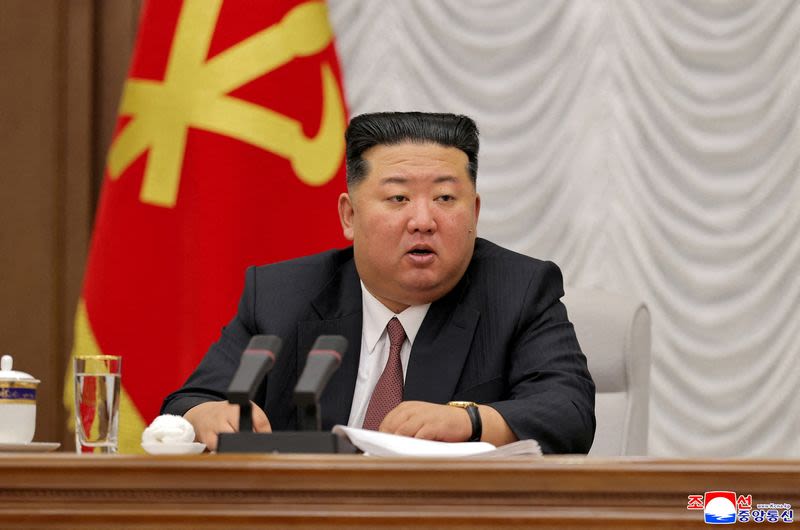
Speaking before senior military commanders and party officials gathered to commemorate the country’s 78th anniversary, Kim expressed what state media described as “special gratitude and respect” to soldiers “participating in overseas military operations.” He did not mention Russia. He did not mention Ukraine. He did not need to.
The speech, carried by the Korean Central News Agency on Wednesday, represented Pyongyang’s most explicit public acknowledgment to date that its soldiers are fighting and dying alongside Russian forces in a war that Western governments have spent two years seeking to isolate through sanctions and diplomatic pressure.
They have not.
An estimated 14,000 to 15,000 North Korean soldiers have been deployed to Russia since late 2024, according to South Korea’s National Intelligence Service and Western intelligence assessments. As of this month, approximately 9,500 remain stationed in the Kursk region, where Ukrainian forces mounted a cross-border incursion last year. The troops have served in combat roles, absorbed casualties that neither Pyongyang nor Moscow has publicly disclosed, and returned to supplement a Russian military grinding through its fourth year of operations in Ukraine.
Beyond bodies, the numbers that have shaped this war are measured in shells. Pyongyang has supplied an estimated 25 to 40 percent of Russia’s total artillery ammunition requirements, more than 15 million rounds by early 2026, according to South Korean military assessments. North Korea has also transferred over 100 KN-23 and KN-24 short-range ballistic missiles, hundreds of artillery systems, and, more recently, drone operators to assist Russia’s expanding unmanned-aircraft campaign. Defense News documented the scope of that contribution in August, describing a military relationship that now spans troop deployment, materiel supply, and technical training.

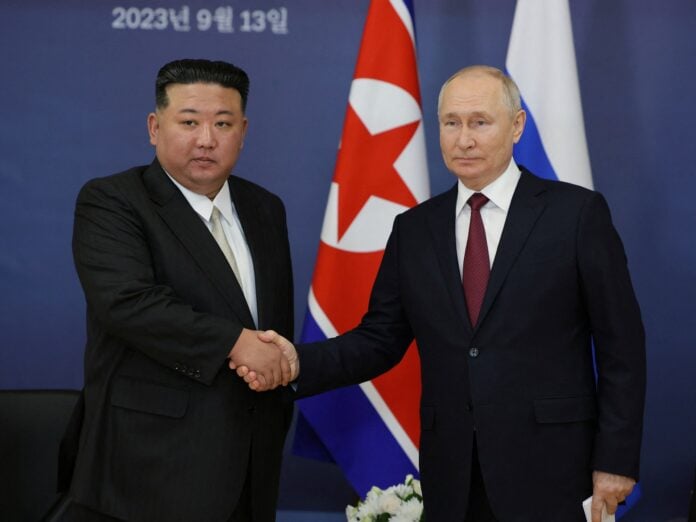
Kim’s anniversary remarks may also be timed to something more concrete. According to Ukrainian Defense Intelligence, Putin may ask Kim for up to 50,000 additional troops when the two leaders meet this month, a figure that would more than triple the current deployment and represent a qualitative shift in the scale of North Korea’s direct involvement. The meeting’s precise date remains unconfirmed by either capital, but would mark the latest in a series of engagements that have transformed a weapons-supply arrangement into active combat coordination.
In Pyongyang on Tuesday, the anniversary celebrations that preceded Kim’s remarks were precisely the kind of controlled spectacle the state has perfected: banners, marching formations, the choreography of a nation projecting certainty. Kim’s words about troops “overseas” sat within that performance as something deliberately inserted, a signal to Washington and Seoul, and perhaps also to his own military, that the alliance with Moscow has graduated from a supply agreement into something the leadership now publicly claims.
In July, Putin publicly thanked North Korean troops for their heroic deeds, becoming the first head of state to acknowledge the arrangement in explicit terms. Kim’s September 9 speech closes the rhetorical gap from Pyongyang’s side. Together, they mark the first time both leaders have publicly claimed a military partnership that Western governments spent years insisting did not formally exist.
What neither capital has disclosed is the human cost. Casualty figures for North Korean forces in Russia have not been officially confirmed by any party. Western and South Korean officials have acknowledged deaths in combat but have stopped short of providing comprehensive numbers. The opacity is deliberate: Pyongyang cannot admit casualties it has publicly denied sustaining.
Kim’s willingness to cross that line, to say “overseas operations” in a hall full of generals, suggests something shifted in the calculation. Whether that shift is confidence, necessity, or preparation for a deeper commitment remains the unanswered question of a relationship that has already moved further, faster, than almost anyone anticipated. North Korea’s continued missile activity through August made clear that Pyongyang has no intention of reducing its military profile regardless of how Washington reacts.
The 50,000 figure attributed to Putin’s coming request, if confirmed, would turn that question into a decision.