
A Plus Studio has announced Blue Horizon, a police simulator for PC and PlayStation 5, developed by Habib Alejalil.
The game is set in a recreation of lower Manhattan and casts the player as a new officer at a city precinct. Unlike most games in the genre, it does not begin with a patrol car. New officers start on the station’s monitoring desk, working traffic cameras and a queue of incoming reports. Vehicles, equipment and large parts of the map are locked behind rank, and players have to clear enough desk work to be transferred to street patrol.
According to the studio, the opening is deliberate. Blue Horizon is built around the idea that most police work is decision-making rather than pursuit, and the game’s scoring reflects that.
The clearest example is Tesam, a social media feed the officer monitors from an in-game phone. Posts arrive throughout a shift and most of them are harmless. Players choose one of four responses for each: escalate it and send a unit, trace the account to find an address, refer it to the cyber unit, or dismiss it.
Each response has a correct use, and the penalties are uneven. Escalating a harmless post wastes a unit and lowers public trust. Missing a real threat costs more. Tracing an account without justification carries the heaviest penalty in the system, which the studio describes as a civil liberties issue rather than a wasted resource. Dismissing a post correctly earns credit, so players are not rewarded for escalating everything.
Once players are transferred to patrol, the game runs on a shift clock and a radio rather than a mission list. Dispatch broadcasts calls using ten-codes, and officers can accept or decline them. Traffic stops involve checking a licence and registration, running the driver against warrants and prior offences, and issuing a ticket, a warning, or nothing at all. Expired documents are printed on the card and easy to miss.
Speed enforcement is handled with a handheld radar, a deployable roadside unit that issues fines unattended, and fixed camera tripods. Traffic is generated against a 30 mph limit, so only a minority of passing vehicles are worth stopping.
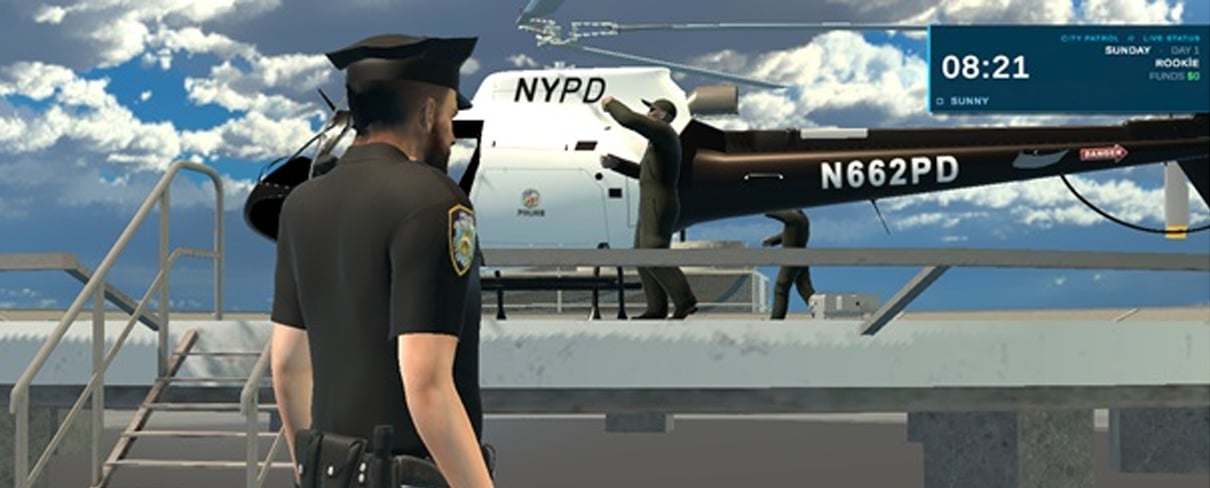
Other systems include pedestrian stops with identity checks, arrests with suspects who run or resist, prisoner transport and a cell block, crime scenes with evidence markers and a UV scanner, a K9 unit trained for contraband, tow trucks, parking enforcement, and a helicopter and drone for calls a car cannot reach.
Two long-term meters run underneath the game. Public trust changes based on how officers treat people who have done nothing wrong, and a hostile city becomes harder to police. A separate discipline record tracks force used, searches made without cause, and calls wrongly dismissed. Rank, pay and access to equipment are tied to both.
The game also supports two-player co-op over the internet or a local network, with officers either riding together or taking separate calls from the same station.
“I wanted the player to feel the weight of a decision they could get wrong in two directions. Escalating everything is a failure. Ignoring everything is a failure. The job is knowing which is which.” — Habib Alejalil, developer, A Plus Studio
Blue Horizon is in development for PC via Steam and PlayStation 5, with DualSense haptics and adaptive trigger support planned for the console version. The studio says a release window will be announced later.