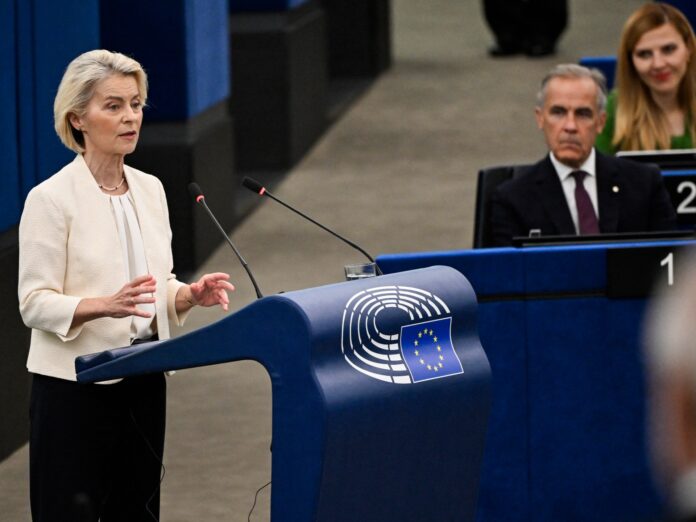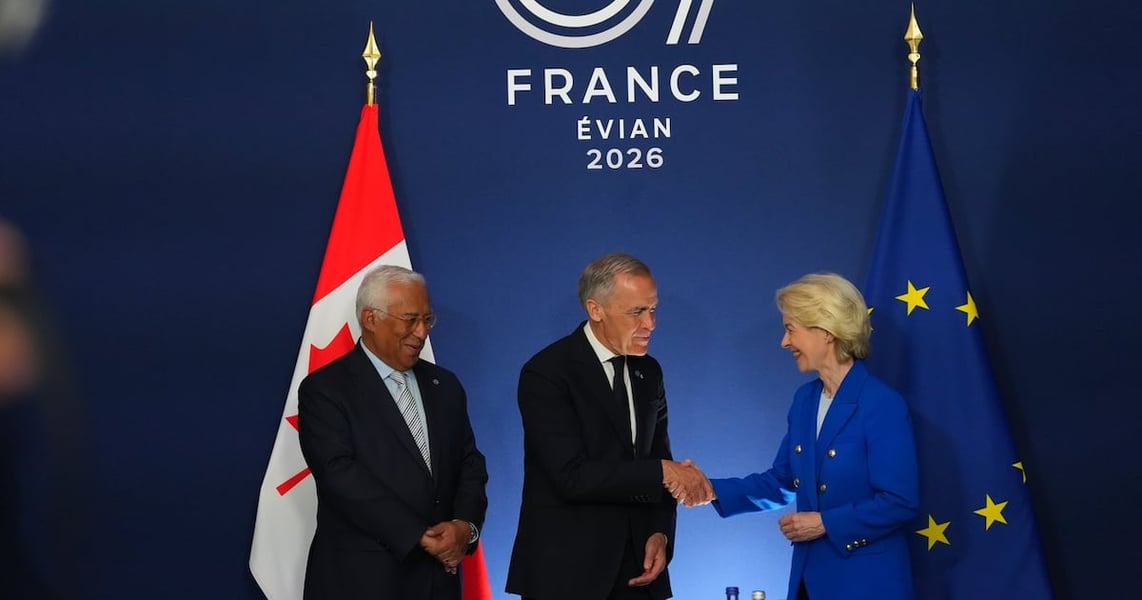

STRASBOURG – Mark Carney walked into a chamber that has given standing ovations to Ukrainian presidents and sanctioned Russian oligarchs, and made his case Thursday for the most consequential repositioning of Canadian foreign policy since the Cold War.
The Canadian prime minister addressed the European Parliament, welcoming the European Union’s offer to make Canada its first associate member and doing so in terms that left no room for diplomatic ambiguity, without once naming the man whose trade policy had made the invitation feel urgent.
Carney told the chamber in Strasbourg that “economic integration is now being weaponized,” with tariffs deployed as instruments of political coercion rather than trade policy. Donald Trump had called the associate membership proposal a “hostile act” and threatened new levies against Canada if the arrangement proceeded. Carney did not flinch.
“Canada and Europe are stronger together,” he said. “An alliance strong enough so that no one can dictate our choices.”
The speech capped a three-day visit to European institutions that began when Carney attended von der Leyen’s State of the Union address on Wednesday, where she extended the associate membership invitation before the full parliament. The offer carries no exact precedent in EU treaty law and its precise terms have not been publicly defined, but its political significance was immediately understood in Ottawa, Brussels, and Washington.
Canada would be the first non-European country to be offered anything resembling insider status in the EU’s governance structures. The European project has admitted new members over seven decades and extended various forms of partnership to neighboring countries, but the associate membership proposal would represent something structurally new, a democratic partnership built around shared values and economic integration rather than geography. As Euronews reported, Brussels was clear the proposal was not directed against any third party.
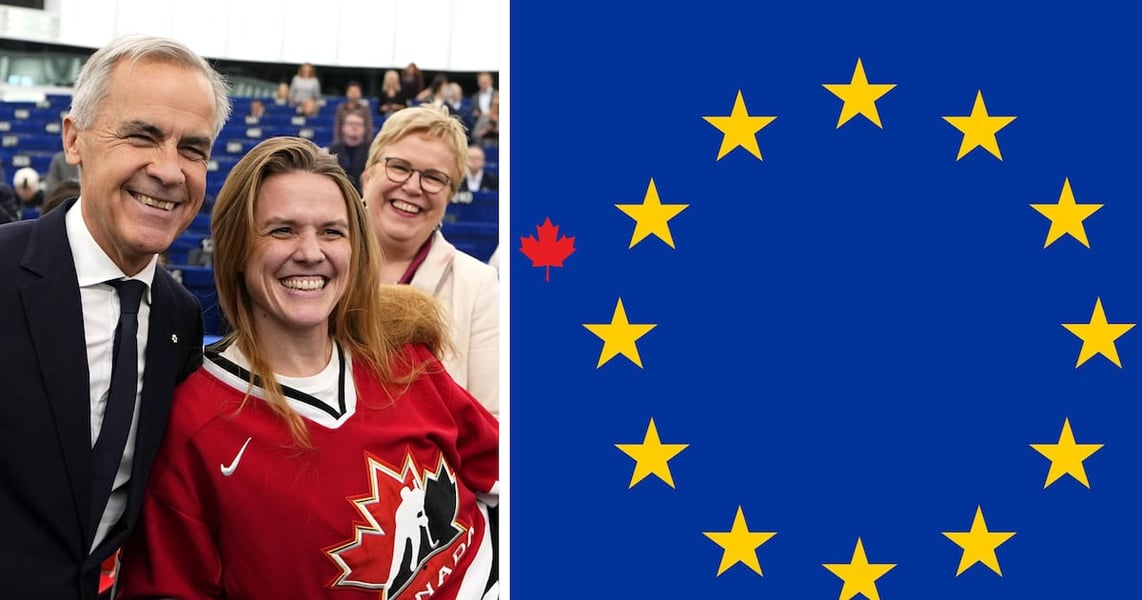
Carney told the parliament the alliance was not reactive. “The alliance between Canada and Europe is not defined by what we oppose,” he said. “It is about what we are for: freedom, solidarity, prosperity, sustainability.”
Neither Canada nor the EU would seek to create a “great-power rival,” he added, a message aimed at Washington’s concern that a transatlantic axis could function as a formal counterweight to American influence. A stronger, more resilient Canada would ultimately be a more effective partner for the United States, Carney argued, not a lesser one.
Whether Washington accepts that framing is another question. The Trump administration has treated every multilateral arrangement that does not originate in American preference as a challenge to American primacy, a posture that has extended to NATO funding, WTO commitments, and bilateral trade agreements renegotiated under tariff pressure. The proposal to embed Canada in a European governance framework, however loosely, fits that pattern precisely. Carney’s assurance that the alliance opposes no one is unlikely to persuade an administration that measures relationships in zero-sum terms.
The European Parliament Bureau moved alongside the speech, endorsing the establishment of a European Parliament antenna office in Ottawa, a procedural step with genuine symbolic weight signaling that Brussels treats the Canadian relationship as a durable institution rather than a diplomatic moment.
European Parliament President Roberta Metsola had welcomed Carney ahead of the address. “A new chapter for the EU-Canada partnership,” she wrote. The Ottawa office announcement reinforced her point: this is not atmospherics.
For Carney, the timing is both an opportunity and a constraint. His government arrived at this partnership during an active trade war, not before one. Canada has absorbed 50 percent tariffs on auto exports, retaliatory counter-measures from Ottawa, and a series of escalating taunts from US officials who questioned Canada’s economic weight and military capacity. Against that backdrop, the EU’s offer carries a specific kind of political utility, providing alternative markets and institutional anchors at the moment when the Canadian economy’s dependence on the United States feels most exposed.
What associate membership would mean in practice remains unclear. EU associate status has no single legal template; Norway’s relationship through the European Economic Area is one model, Ukraine’s accession candidacy another. For Canada, a sovereign state outside Europe’s geographic boundaries, any arrangement would require frameworks that do not yet exist. Von der Leyen has spoken of a “common prosperity and economic security space,” but the architecture of that space has not been published. According to NPR, Carney was not handed a document to sign in Strasbourg. He was handed a direction.
He told the parliament Canada would enter any negotiations as a sovereign, not a supplicant. “No one can dictate our choices,” he said.
The speech drew sustained applause and left European officials openly pleased. Whether it represents a genuine strategic realignment or remains primarily a demonstration effect depends on what comes next: the terms of any association agreement, the trajectory of the Canada-US trade dispute, and whether Trump’s tariff pressure deepens or recedes after a summer of confrontation.
Carney offered no false certainty. “Canada and the EU are natural partners, united by shared values,” he said. He did not claim to know how the trade war ends. He only said Canada had decided it would not wait for permission to build partnerships elsewhere.