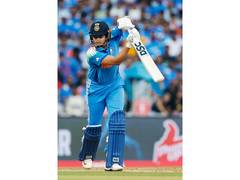

NISSHIN — Nine sixes were all Shafali Verma needed on Saturday to make cricket history at the Asian Games. She reached the mark with an assault that left Bangladesh’s bowlers without answers.
Verma finished unbeaten on 100 from 49 balls, hitting three fours and nine sixes. She became the first woman to score a century at the Asian Games in the event’s 28-year history.
It was also her maiden T20 international century. Reaching three figures in 49 balls made it the joint-fourth-fastest women’s T20I hundred ever recorded.
Her nine sixes tied the women’s T20 innings record set by Hayley Matthews and Deandra Dottin. Verma, 22, has now hit 35 sixes in women’s T20 internationals in 2026—more than any woman has recorded in a single calendar year.
In one afternoon at Korogi Sports Park in Nisshin, Japan, she rewrote three records at once.
India’s 195 for four was a target Bangladesh had no answer to. They were dismissed for 81 in 15.4 overs, and India’s 114-run victory sealed their place in the Asian Games gold medal final against Sri Lanka on September 22, as confirmed by official Asian Games tournament records.
The match turned, truly turned, inside the first five overs. Smriti Mandhana was the quieter half of an opening stand that reached 72, but quieter is relative when you score 37 off 19 deliveries. Mandhana hit five fours and two sixes, and somewhere in that blitz she moved past Suzie Bates’ 4,758 runs to become the leading run-scorer in women’s T20 international history. She now stands at 4,765 runs across 186 matches, a record she will very likely extend in the gold medal final. Mandhana also reached 100 sixes in women’s T20 internationals during the innings, making it a personal milestone day of rare proportion for an opener who has carried Indian batting across multiple formats and multiple years.
But this day, this tournament, this particular afternoon belonged to Verma.
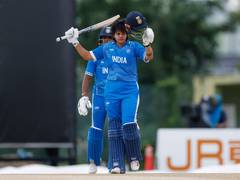
By the time she reached three figures, the target India had built no longer seemed ambitious. It seemed inevitable.
Harmanpreet Kaur’s 40 in the middle order pushed India beyond 190, adding the kind of cushion that turns a competitive target into a statement. VVS Laxman, who returned to coach India at these Asian Games, has watched his batting lineup function as a coherent unit throughout the competition, each player accelerating at the right moment, none playing a selfish innings.
Bangladesh’s response never found its footing. The openers failed to build any platform, the middle order crumbled under a required rate that was already unmanageable by the sixth over, and the innings became a procession long before Deepti Sharma arrived to formalize the verdict. Sharma’s three wickets for seven runs was the most economical bowling performance of the day; Nandani Sharma supplemented her with three for 25, and Bangladesh’s highest scorer, Dilara Akter, managed only 27 in a chase that never had a realistic pulse.
The 81 all out in 15.4 overs was the number that told the story most clearly.
India are the defending cricket champions at the Asian Games, having won gold at the 2023 edition in Hangzhou — a title they now seek to defend on Japanese soil. That they reach the final having been dominant throughout the tournament means something, though the coaching staff will be careful not to say so aloud. The batting depth that VVS Laxman has developed across the group stages makes this a broader team than one defined solely by its top order. But on days like Saturday, the top order makes that conversation almost irrelevant.
India now advance to the gold medal final against Sri Lanka, scheduled for September 22 at the same venue in Nisshin. It is a repeat of the Asian Games cricket final from three years ago — the same two nations, the same gold medal at stake, the same question of which side can handle the pressure when it matters most. Sri Lanka got there by eliminating Pakistan in the other semi-final, chasing down 178 with eight wickets in hand and 13.1 overs to spare. That is not a comfortable opponent to face in a final. Sri Lanka’s batting showed the kind of composure on Saturday that wins championship matches, and India cannot afford to carry the assumption that the hard work is done.
The records from Saturday will not expire before Thursday. First women’s century at the Asian Games. Joint fourth-fastest hundred in women’s T20I cricket. Joint-most sixes in a WT20I innings. Most sixes by a female cricketer in a single calendar year. Verma has a habit of collecting those kinds of numbers in bursts, as if waiting for a stage large enough to justify them all at once.
Whether they add up to a gold medal is the question the Asian Games cricket final will answer.