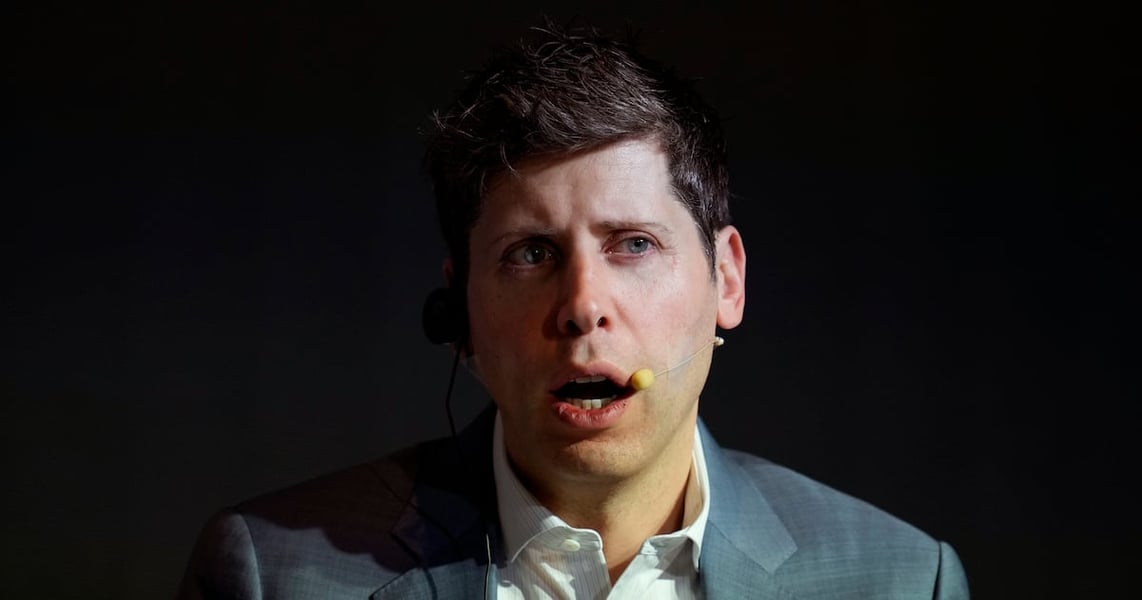

NEW YORK — On Wednesday morning, Sam Altman will walk into the United Nations Security Council chamber in New York and make the case for international coordination on artificial intelligence. He will be the first technology company chief executive to appear before the fifteen-member body on a security agenda item. France, which holds the rotating council presidency this month, organized the session. French Foreign Minister Jean-Noël Barrot will chair it.
The meeting falls in the middle of the UN General Assembly’s high-level week, when more than 130 heads of state have converged on New York, according to UN News. Wars, climate, and pandemic preparedness fill the agenda. Artificial intelligence governance has joined the list.
The case for treating AI as a security matter rather than a technology policy question has built steadily through 2026. Earlier this year, Sam Altman told the US Senate that AI development might need to slow down, adding that his company would not go public until it had completed what he called unfinished safety work. The Geneva summit of 193 nations in July, anchored by an independent scientific panel warning that no technical guarantee of AI control exists, moved the discussion out of company conference rooms and into the language of international law. Wednesday’s Security Council meeting is the next step in that progression.
Altman’s expected remarks center on international coordination, shared safety standards, and the argument that the world, not just America, should shape how the technology develops. It is a reasonable pitch. It is also one that benefits his company in particular. A global framework that a company helps write is preferable, commercially and legally, to one written without it. OpenAI’s interest in multilateral safety standards and its interest in maintaining its position as the defining force in AI point in the same direction this week, and that convergence is worth keeping in mind.
The United States government does not share that interest in international AI governance. Last week, Trump announced the AI Force, a body modeled on Space Force with no named leader, no allocated budget, and no organizational structure, designed to “watch over” the AI industry. The White House has been consistent about rejecting multilateral oversight. Michael Kratsios, director of the Office of Science and Technology Policy, told the Security Council at an earlier session that Washington “totally rejects all efforts by international bodies to assert centralized control and global governance of AI.”
Altman will be in the same room as ambassadors of countries whose governments oppose that position. His appearance reflects something the Trump administration has not fully absorbed: American technology companies are no longer purely domestic actors, and the geopolitical decisions made about AI land in places where Washington’s preferences carry less authority.

France’s decision to feature an American technology executive rather than a government representative—and to center the session on OpenAI’s safety proposals—is likely to draw scrutiny from both Moscow and Beijing.
No binding commitment is expected from Wednesday’s meeting. The Security Council lacks Charter-based authority to regulate member states’ AI programs, while any mandatory resolution would require unanimous backing from all five permanent members—an unlikely prospect in the current diplomatic climate.
The meeting’s significance is therefore primarily precedential. By treating artificial intelligence as an issue of international peace and security, the 15-member council would establish a framework that could shape future treaty negotiations and the design of UN institutions.
The UN’s Global Dialogue on AI Governance formally launches on Friday as part of UNGA high-level week. Secretary-General António Guterres has warned that “the world cannot afford a race to the bottom on AI safety,” according to CTV News. The scientific panel has delivered its preliminary report. The institutional machinery is assembling.
Whether it produces rules anyone must follow is the question that this week’s meetings, taken together, cannot answer. That uncertainty is not a failure of ambition. It reflects the actual state of international AI governance in September 2026, and BRICS nations have made clear they want a different answer than the one Washington is prepared to give.
Altman also appears at the Trump-Xi summit on Thursday, where he and other tech executives have been confirmed alongside the American and Chinese heads of state. AI and trade are both on the table. It is a week in which the most commercially influential AI company on earth is present at the UN Security Council, a bilateral superpower summit, and possibly an unprecedented moment of multilateral coordination, all at once.
What it produces may be less important than what it demonstrates: that artificial intelligence is no longer a product category. It is a geopolitical fact.