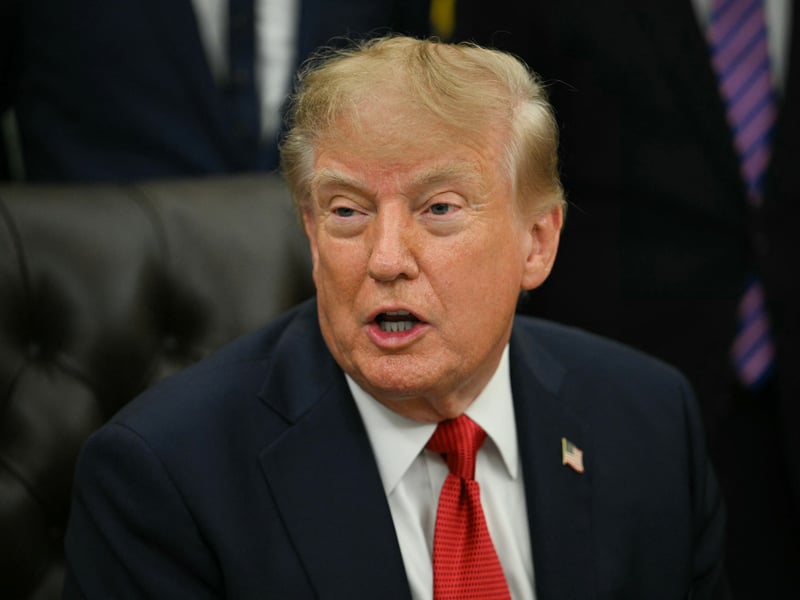

WASHINGTON — Donald Trump wrote on Truth Social Saturday evening that the United States would create an “AI Force.”
He did not name a leader, allocate funding, outline an organizational structure, or provide a timeline. Trump said the new czar would be announced “in the near future” and added that only people with high IQs should apply.
By any practical measure, the post represented the U.S. government’s most substantive public statement on AI governance in months. It consisted of four paragraphs on a platform that is not Twitter.
Trump said he was forming the AI Force the way he created Space Force during his first term, drawing a direct parallel between what became a funded military branch with more than 14,000 personnel and a social media post with no organizational chart. He promised the force would “cherish” the AI industry while watching over it, and NBC News reported that he predicted artificial intelligence could account for as much as 25 percent of US GDP. Safety concerns, he wrote, amounted to a left-wing hoax manufactured by political operatives who do not want America to win.
The announcement landed at a moment when the AI industry’s own leadership had been, unusually, arguing for constraints. Dario Amodei at Anthropic had called publicly in recent weeks for an independent body to monitor the most powerful AI systems, the kind of arrangement Trump’s post was designed to foreclose. That call came less than ten days after Anthropic, OpenAI, and Elon Musk’s xAI reached an unprecedented alignment on pausing frontier AI development, a consensus that sent chip stocks into bear market territory and rattled the hardware trade’s central premise, as Eastern Herald reported when three AI giants aligned on slowing down earlier this month.
The White House’s position was made sharper two days before Trump’s post. Michael Kratsios, director of the Office of Science and Technology Policy, told a United Nations Security Council meeting that the United States “totally rejects all efforts by international bodies to assert centralized control and global governance of AI.” The statement was delivered in New York. The world was listening.
Whether there is an architecture behind that posture is less clear. The AI czar role Trump announced Saturday revives a slot that had been vacant since March, when David Sacks stepped down from the formal AI and cryptocurrency czar position, constrained by limits on his term as a special government employee. Sacks remained influential in an advisory capacity, co-chairing the President’s Council of Advisors on Science and Technology. The new czar, whose identity the White House has declined to reveal, would inherit a landscape in which the US government has both the loudest voice in global AI policy and the least detailed domestic governance structure of any major AI-producing nation.
The announcement was met with confusion inside parts of the technology sector. Senior executives at several AI companies, speaking without attribution because they did not want to antagonize the administration, told Al Jazeera that Trump’s AI Force concept came “out of nowhere” and that they had received no advance briefing on its structure or mandate. No spokesperson clarified what statutory authority the AI Force would operate under, whether it would require congressional authorization, or how it would relate to existing federal entities, among them OSTP, the AI Safety Institute at the National Institute of Standards and Technology, and the Defense Department’s existing AI programs.

The gap between Trump’s posture and the direction of international governance has rarely been wider. China launched the World Artificial Intelligence Cooperation Organization in July, securing commitments from 29 nations and framing the initiative explicitly as an instrument for the Global South to shape AI development on terms not dictated by Silicon Valley. Beijing committed to providing developing countries with 5,000 AI training opportunities over five years and to deploying its AI-powered meteorological warning system across 30 nations. United Nations Secretary-General António Guterres attended the Shanghai launch. No US representative was present. Eastern Herald covered the structural contrast in full when China was building multilateral AI architecture at BRICS while American executives were calling for brakes.
The new czar, assuming one is named, will inherit a mandate that is simultaneously maximalist in ambition and minimalist in definition: protect American dominance, reject international frameworks, trust the existing criminal and civil justice system to identify and punish AI harm after the fact. Trump said on Saturday that the existing legal system is sufficient for this purpose. He did not specify whether it has been sufficient so far, or offer any evidence that it has kept pace with the technology it would now be asked to govern.
What the AI Force will look like when it actually exists, how it will be funded, who will staff it, what its relationship will be to the military, to civilian research agencies, to the Congress that would need to authorize it, remains entirely open. The Saturday announcement addressed none of it. A post on Truth Social is not an organizational chart, and no follow-up briefing had been scheduled as of Sunday morning.
The czar’s name, Trump said, is coming. Only high I.Q. individuals need apply.