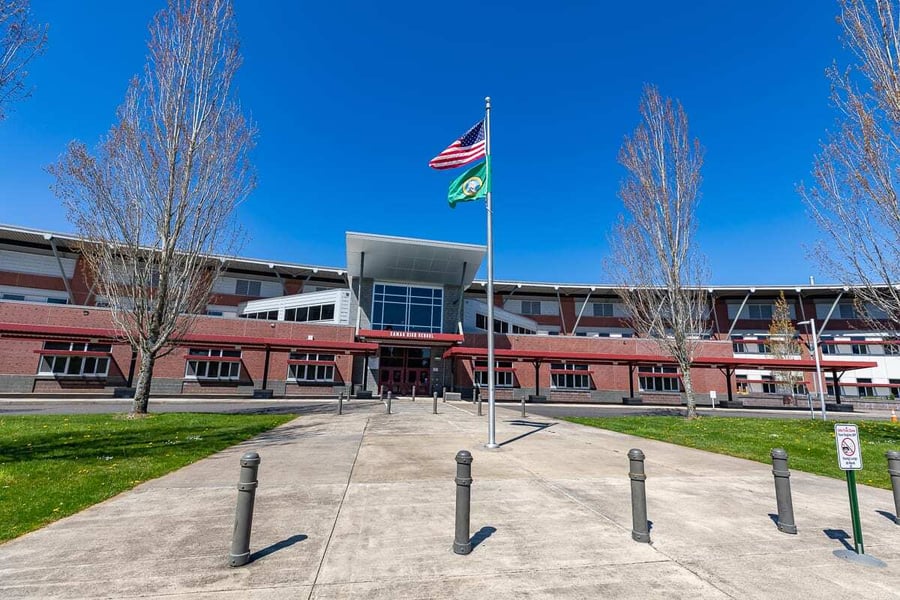

CAMAS, Wash. – The race went ahead, but a group of Camas runners chose not to follow it. Their walk-off has turned a school cross-country meet into a dispute over who should set the rules for girls’ sports, with Washington voters preparing to consider a change in state law.
About a dozen members of the Camas High School girls’ team forfeited their race Tuesday, October 13, in protest of a transgender teammate’s participation, according to The Seattle Times. The district said the athlete had not violated eligibility rules. The state’s governing sports association said it had received no eligibility challenge.
The distinction is central to the dispute. The runners were objecting to a policy that currently permits their teammate to compete, rather than to a ruling that officials had found improper. The disagreement concerns whether that policy adequately balances competitive fairness and access to school athletics.
The Columbian reported that more than a dozen runners walked roughly the first 50 meters before leaving the course during a league meet against Battle Ground. Other runners continued racing. The Seattle Times described the protesting group as approximately half of Camas’s girls at the start.
The student at the center of the controversy is a minor. This article is not naming her. The Seattle Times withheld her name because she had not consented to identification, even as videos, race results and commentary circulated widely online.
Washington’s rules allow students to participate in school athletics consistent with their gender identity. The Washington Interscholastic Activities Association’s handbook places school personnel in the eligibility process and describes a commitment to participation in a safe environment free of discrimination. The association told The Seattle Times that its policy does not prohibit changing categories during a season.
The runner began the season in a boys’ race before moving to girls’ competition in September, the newspaper reported. That change became a focus of complaints about fairness. It does not, by itself, establish a breach of the rules in force.
Tuesday’s protest followed an earlier walk-off involving two Skyview runners at a September meet. Attention subsequently spread beyond the schools through political commentary and widely shared social media posts. Those posts have exposed an individual student to scrutiny while a broader argument about athletic eligibility unfolds.
Camas School District addressed that attention in an October 8 statement cited by The Seattle Times. It said it was responsible for following state law and association rules, would not discuss individual students’ circumstances, and would not accept harassment, intimidation or targeting of students. The district also acknowledged that members of the community hold differing views on eligibility.
The immediate responsibility for schools is therefore different from the choice facing voters. Schools must administer the current framework. Initiative 638, if approved, would change that framework by barring transgender girls from the girls’ competitions covered by the measure and requiring medical verification of biological sex, according to the reporting.
The Washington secretary of state certified the initiative’s signatures in January. Its appearance in the statewide debate does not mean its proposed requirements are already governing school races. Nor does a walk-off change an athlete’s eligibility.
The scope of transgender participation statewide also remains uncertain. The WIAA told The Seattle Times in September that it knew of no more than approximately 10 transgender student-athletes participating each year. Schools are not required to report every transgender athlete, so that figure is not a complete statewide count.
The athlete’s parents and coach did not respond to The Seattle Times’ requests for comment. That is a limitation of the source reporting, not evidence of agreement with the claims being circulated about her. This article has not independently interviewed the students, families or school officials.
For Camas, the next task is to keep school competition and student safety functioning while the policy dispute continues. The protest made the disagreement visible. It did not settle the fairness question or overturn the current rules.