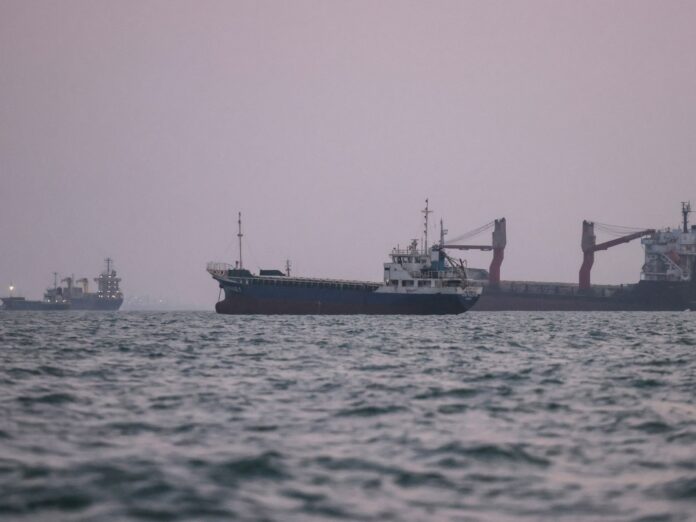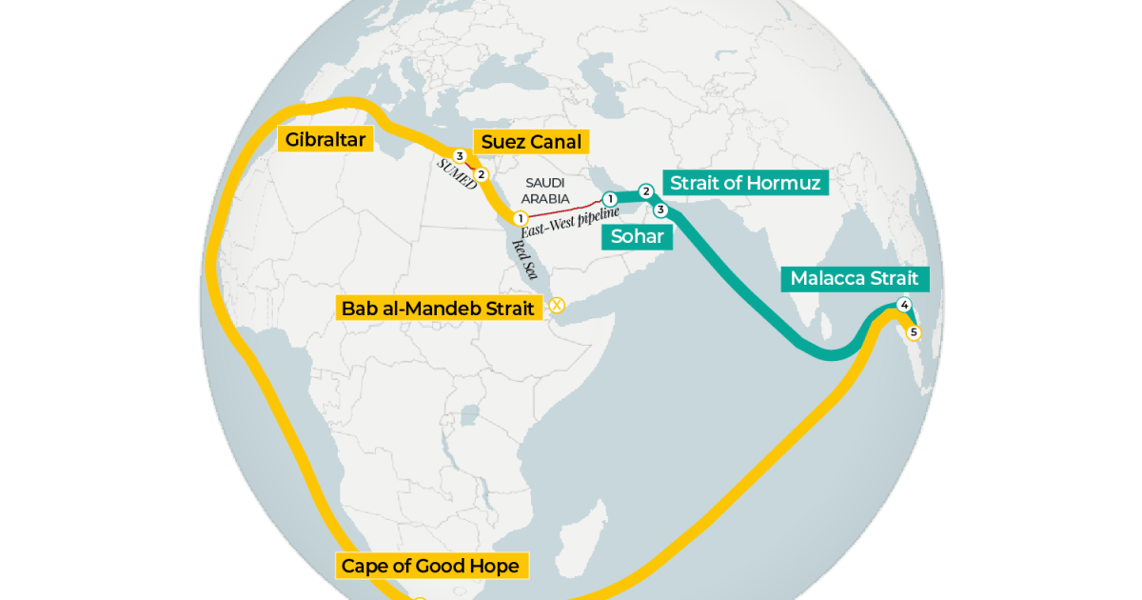

NEW YORK — Two very large crude carriers left the Gulf of Oman on Wednesday carrying roughly four million barrels of Saudi crude, bound for China. They had not loaded at Yanbu. They had not crossed the Strait of Hormuz. They had loaded off the coast of Sohar, the Omani port that sits just beyond the strait’s eastern mouth, through a ship-to-ship transfer operation that Saudi Aramco has been scaling up since the pipeline strikes of September 10 and 11.
The oil market noticed. Brent crude fell 2.1 percent to settle near $103.61 per barrel, and West Texas Intermediate retreated toward $100, briefly touching below that threshold before recovering. For traders pricing the risk of an extended supply emergency, the sight of Saudi crude moving again, however unconventionally, was enough to ease some of the premium built into prices over the past week.
The numbers deserve a closer look. Ship-to-ship transfers off Sohar have risen to roughly 2.7 million barrels per day in September, up from 1.5 million barrels per day in August, according to shipping data tracked by Vortexa and Kepler. That is a meaningful increase. It is also a ceiling, not a solution. The East-West pipeline, before it was struck, was moving between four and five million barrels per day to Yanbu’s Red Sea terminals. Saudi Arabia’s workaround covers, at best, slightly more than half of what was lost.
Saudi Aramco has offered its Arab Light, Arab Medium, and Arab Heavy grades to term buyers in Asia for loading off Sohar, according to sources familiar with the arrangements. The mechanics are cumbersome: crude is pumped from smaller vessels onto VLCCs in open water outside Iranian territorial reach, adding days to the voyage and handling costs per cargo that can run into the tens of thousands of dollars. For refiners in China, Japan, and South Korea that need Saudi grades specifically for their cracking configurations, the workaround is worth the premium. For Saudi Arabia, it is the only corridor currently functioning.
Al Jazeera’s tracking of Saudi Arabia’s alternative export corridors noted that Sohar was never designed as a primary crude loading hub; its berths were built for petrochemical exports and refined products, not raw crude at VLCC scale. The volumes being moved through ship-to-ship transfer represent the maximum the current maritime traffic pattern can sustain, not a point on an upward curve.
Wednesday’s session followed Tuesday’s, when the futures market dropped on Washington’s assurance that the pipeline would be back within days, a claim that oil infrastructure analysts, examining the same satellite imagery that showed damage to two pump stations, assessed as optimistic by four to five weeks. Saudi Aramco has offered a different characterization: half capacity within days, full operations within six weeks.
The physical crude market, which traded more than $27 above futures on Tuesday (the widest premium in the Brent complex in years), narrowed modestly on Wednesday’s news. The Sohar operation absorbs some of the excess demand for physical barrels that had no other source. It does not close the gap.
The EIA’s weekly petroleum report, covering the week ending September 11, had already shown a third consecutive inventory draw. The next report, covering the period through September 18, will be the first to capture the full downstream effect of the pipeline shutdown on US import patterns. That number, expected next Wednesday, will tell more about whether the Sohar operation is genuinely plugging the hole or simply delaying the reckoning.
The drone strikes that forced Saudi Arabia into this unconventional routing did not close the Strait of Hormuz; the strait had already been effectively closed since February. What they did was eliminate Saudi Arabia’s only functioning alternative to it. The Sohar ship-to-ship transfers are the second workaround to a situation that had already exhausted its first.
What neither the futures price nor the STS volumes can answer is whether Sohar remains secure. The port sits in Omani waters, outside the strait and outside Iranian declared exclusion zones — for now.