NEW YORK — The last time oil traded above $100 a barrel, Iran and the United States were still talking. That cover expired Wednesday morning.
Brent crude, the global benchmark, crossed $100 per barrel for the first time since July, touching $100.76 intraday before settling around $100.44, a gain of 2.57 percent on the session. West Texas Intermediate followed at $94.92, up 2.03 percent. The last time either benchmark traded at this level, the Islamabad memorandum of understanding, a framework for a Hormuz revenue-sharing arrangement, still appeared viable. It collapsed within two days. Wednesday’s session produced no comparable diplomatic circuit-breaker.
The catalyst was not a single new strike but a cumulative count that finally moved markets beyond the prior ceiling. U.S. Central Command confirmed it has destroyed 10 Iranian crude oil tankers in the past week, including five vessels struck September 8, dismissing IRGC claims that two U.S. Navy destroyers had been hit as “completely false.” The statement came hours after Iranian ballistic missiles targeted a U.S. Navy warship for the second consecutive day, with both launches missing their target. CENTCOM described the tanker losses as a proportional cost imposed on what it called a multibillion-dollar shadow export network financing the IRGC and its regional proxies.
The approach to $100 had been building since Tuesday’s Gulf exclusion zone announcement by Mohsen Rezaei, head of Iran’s Supreme National Security Council. Rezaei described a planned maritime exclusion zone extending from the line of the U.S. naval blockade through the Strait of Hormuz and into the Persian Gulf interior, placing Saudi Arabia’s Ras Tanura terminal, Iraq’s Basra loading buoys, and the UAE’s offshore platforms inside a declared Iranian threat perimeter. What changed Wednesday was that traders stopped pricing the announcement as rhetoric and started pricing it as operational reality.
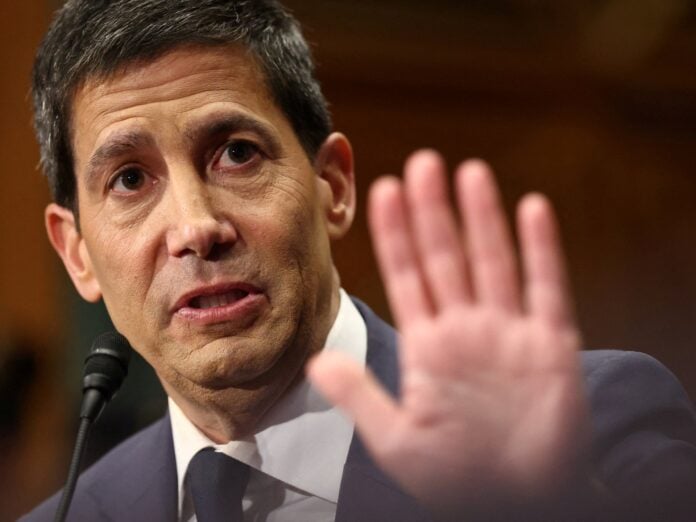
Goldman Sachs was blunter than the price action. In a note to clients, co-head of global commodities Daan Struyven raised the bank’s December Brent average estimate by $5 to $85, while warning Brent could exceed $120 per barrel if Gulf output remains 4 million barrels per day below prewar levels through the fourth quarter. The $120 figure, previously considered a tail risk, was framed as a scenario with a defined trigger rather than a theoretical ceiling.
The $100 level carries immediate significance for U.S. consumers. American drivers are seeing pump prices approach a near-four-year high, with the national average tracking above $4.80 per gallon in early September, according to the AAA’s fuel gauge. The pass-through from sustained Brent above $100 to retail gasoline typically runs three to six weeks, meaning the full refinery impact of this week’s market moves reaches gas stations by early October.
India registered the same arithmetic differently. As the world’s third-largest oil importer, India had been working through spot purchases and alternative routing to replace disrupted Gulf supply. The Oman-brokered maritime channel that briefly offered a routing framework has yet to produce a formal agreement. Indian refiners that had been managing the Hormuz disruption now face a market where the alternative lane, the Red Sea corridor, is compromised by Houthi operations. UK North Sea Brent, which had partially decoupled from Gulf pricing in July, moved in tighter correlation Wednesday as London traders priced in a longer closure than previously modeled.

Those Houthi operations entered a new phase overnight. Forces claimed a fourth strike on Saudi Arabia’s Jazan refinery, adding to damage from three prior attacks over two weeks. The refinery processes 400,000 barrels per day and had suspended export operations after earlier hits. Wednesday’s strike targeted infrastructure serving the domestic Saudi market, with Saudi officials reporting 73 people injured across four southern cities and fires at multiple energy facilities. Operations were halted pending assessment, according to The National.
The dual closure describes a supply dislocation more complete than any prior event in this conflict. Hormuz is blocked by the IRGC shadow fleet’s elimination and the exclusion zone threat. The Red Sea is compromised by Houthi interdiction. Jazan, the western export alternative, is under active attack. OPEC+ formally added 188,000 barrels per day to September allocations, the final tranche of the 2023 voluntary cuts, but analysts note several member states cannot reach revised quotas on technical grounds, so the headline increase overstates available supply.
Eastern Herald’s 838 U.S. military casualties through Tuesday represent, in market terms, a seven-month commitment that has not flinched from proportional escalation. CENTCOM has now destroyed 10 IRGC-linked tankers in a week. Iran has fired ballistic missiles at American naval vessels twice in two days. The Oman channel has not produced a formal agreement. Each fact, taken individually, might be priced as temporary. Together, they describe a conflict with no scheduled exit.
Goldman Sachs’s $120 scenario is the market’s version of that description: not a prediction of what will happen, but a price for what happens if nothing changes. As of Wednesday, the market was willing to pay it.