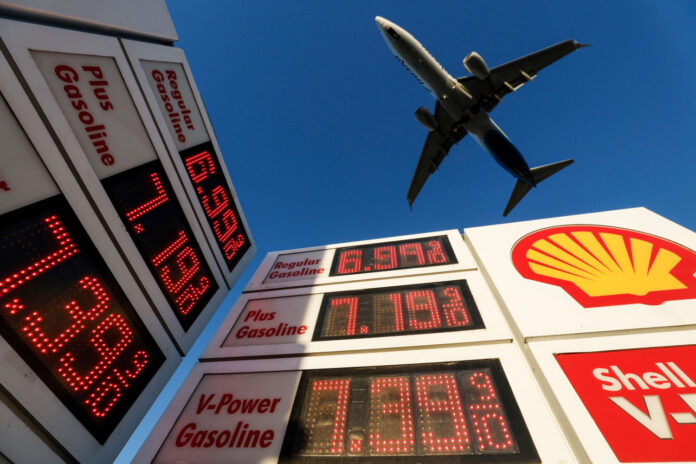
CINCINNATI — For a company whose advantage has always been that households keep buying its products no matter what, the oil market’s surge past $105 a barrel is a problem that comes straight for the income statement.
Procter & Gamble shares fell 1.23% to $142.45 on September 10, closing near the bottom of the session’s $141.86 to $144.00 range as Brent crude reached its highest level since May and the Dow Jones Industrial Average dropped 405 points. The sell-off was not a verdict on P&G’s brands. It was a verdict on the margin math that crude oil rewrites every time it moves in the wrong direction.
The company had already embedded the cost problem into its fiscal 2027 guidance: roughly $1 billion in after-tax pressure from higher raw materials, energy, transportation, and supply-chain costs — all baked into the 1% to 3% all-in sales growth and core earnings per share of $6.89 to $7.11 that management laid out after the fourth quarter. Wednesday’s oil move made those numbers look tight.
Procter & Gamble’s fiscal fourth quarter, reported July 29, came in at $21.2 billion in net revenue — a $160 million miss against the $21.36 billion consensus, though adjusted earnings per share of $1.43 beat the $1.41 expectation. The full fiscal year 2026 produced $87 billion in net sales, up 3% from 2025, with organic sales growth of just 1%. That organic figure — the growth rate that strips out acquisitions and currency effects — is the number that has been testing investor patience. It has not moved meaningfully in four consecutive quarters.
The company spent $10.2 billion returning cash to shareholders through dividends in fiscal 2026, with another $5 billion in share repurchases, for a total of $15.2 billion returned in a single fiscal year. Procter & Gamble’s dividend yield closed Wednesday at 3.01%, and the company now counts 70 consecutive years of dividend increases — a record that has survived recessions, wars, and two separate commodity cycles in crude oil.

The $3.8 billion acquisition of Thorne — announced August 4 by CEO Shailesh Jejurikar — is the clearest signal of where P&G believes the next growth layer comes from. Thorne is a science-backed supplement company offering creatine, prenatal vitamins, and a range of premium health products; it was on track to reach $650 million in annual sales before the deal closes. L Catterton, which took Thorne private in 2023 for $680 million, will receive a 77% return on that investment when the transaction completes in the fourth quarter of 2026. For Procter & Gamble, the rationale is that its existing healthcare segment — Metamucil, Align Probiotic, Oral-B, Vicks — already has the distribution infrastructure to scale Thorne’s premium positioning without rebuilding the route to market from zero.
What Thorne cannot fix is the near-term cost picture. Argus analyst Chris Graja downgraded Procter & Gamble to Hold from Buy in August, pointing to exactly that dynamic: economic and geopolitical uncertainty, rising input costs, weak consumer sentiment, and a core operating margin that has trended lower for three consecutive quarters. Graja’s note did not dispute the company’s long-term positioning. It disputed whether the current valuation — at 21.53 times trailing earnings, with organic growth at 1% — justified a Buy when the headwinds are this visible.
Among the broader coverage universe, Graja’s read is the exception. According to 25 analysts tracked by consensus data, the average rating remains Buy, with a 12-month price target of $160.61 — implying 12.65% upside from Wednesday’s close. Individual targets range from $143 on the bearish end to $186 for the most constructive forecasts. That spread is wider than typical for a consumer staples name, and it reflects genuine disagreement over how quickly raw material costs ease and whether the Thorne acquisition closes on schedule.
Technology stocks and growth sectors bore the brunt of Wednesday’s broader market decline, but consumer staples did not escape. The sector’s defensive character — the assumption that people keep buying Tide and Pampers regardless of what Brent crude does — has never protected the category from input cost cycles. The distinction is that consumer staples companies absorb cost increases before the consumer does, through margin compression, then pass them on gradually through price adjustments. That lag is what Wednesday’s session repriced: oil at $105 means the costs the company will absorb over the coming two quarters are larger than FY2027 guidance already implied.
What remains unresolved is whether the commodity cycle has peaked. Procter & Gamble’s fiscal 2027 cost pressure estimate was modeled before crude crossed $100 again. Management has not publicly revised the estimate. At a 52-week low of $137.62 and a high of $167.25, Wednesday’s close of $142.45 sits 3.5% above the floor — but 14.8% below the ceiling. The next earnings report, fiscal first-quarter 2027, is expected in late October, and that is when the updated cost math will be available.