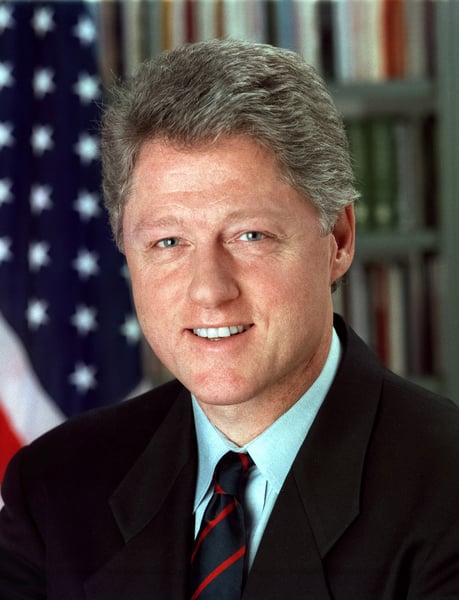

His father died in a car crash on a Missouri highway three months before he was born, and he was raised in Hot Springs, Arkansas, by a mother who worked as a nurse anaesthetist and a stepfather who drank and hit her. He took the stepfather’s surname at fifteen, by choice, largely so that he and his younger brother would share one.
Everything about the public career that followed was built on the ability to convert that material into connection, and it is the single most useful key to understanding him. Bill Clinton was elected governor of Arkansas at thirty-two, thrown out after one term at thirty-four, and returned two years later having learned the lesson he never afterwards forgot, which is that being right is not the same as being re-elected.
He is also one of three American presidents impeached by the House of Representatives, and he left office with the highest final approval rating of any president since polling began. Both of those sentences describe January 2001. Neither cancels the other, and any account that treats one as the correction to the other is not describing what happened.
| Field | Detail |
|---|---|
| Full name | William Jefferson Clinton, born William Jefferson Blythe III |
| Born | 19 August 1946, Hope, Arkansas |
| Education | Georgetown University, 1968; Rhodes Scholar, University College, Oxford; Yale Law School, 1973 |
| Spouse | Hillary Rodham, married 11 October 1975 |
| Child | Chelsea Clinton, born 1980 |
| Attorney General of Arkansas | 1977 to 1979 |
| Governor of Arkansas | 1979 to 1981, and 1983 to 1992 |
| President of the United States | 42nd, 20 January 1993 to 20 January 2001 |
| Party | Democratic |
| Vice president | Al Gore, both terms |
| Impeached | 19 December 1998; acquitted by the Senate 12 February 1999 |
| Final approval rating | 65 per cent, Gallup, January 2001 |
| He was 46 at his first inauguration, the third-youngest person elected to the office after John F. Kennedy and Theodore Roosevelt, who succeeded rather than was elected at 42. | |
Hope, Georgetown, Oxford, and a handshake in the Rose Garden
He was born William Jefferson Blythe III on 19 August 1946 in Hope, Arkansas. His mother Virginia went to New Orleans to train as a nurse anaesthetist and left him for two years with his grandparents, who ran a small store and, unusually for Arkansas in the late 1940s, extended credit to Black customers. He has cited that store more than once as where he learned what he thought about race, and it is one of the few origin claims about him that nobody has seriously contested.
At sixteen he was chosen as an Arkansas delegate to Boys Nation and shook hands with John F. Kennedy in the Rose Garden. The photograph is famous and slightly misleading. What actually shaped the next decade was Georgetown, where he studied international affairs and worked for Senator J. William Fulbright, then a Rhodes Scholarship to Oxford, then Yale Law School, where he met Hillary Rodham. They married in 1975.
The Vietnam draft is the part of that period that never went away. He received a deferment in 1969 to join the University of Arkansas Reserve Officers’ Training Corps, then withdrew from the arrangement and put himself back in the draft lottery, where he drew a high number and was never called. The sequence is documented and was picked over exhaustively in 1992. What it shows is a young man who avoided service and was not straightforward about how, which is a different thing from what either his defenders or his critics have usually claimed.
Arkansas: the fastest rise and the fastest fall
He lost a congressional race in 1974, was elected attorney general of Arkansas in 1976, and became governor in 1978 at thirty-two, the youngest in the country. Two years later he lost. A car tax increase, an unpopular federal decision to house Cuban refugees at Fort Chaffee, and a general impression of arrogance did it.
| Year | Contest | Result |
|---|---|---|
| 1974 | US House, Arkansas 3rd district | Lost narrowly to John Paul Hammerschmidt |
| 1976 | Attorney General of Arkansas | Won |
| 1978 | Governor of Arkansas | Won at 32, youngest governor in the country |
| 1980 | Governor, re-election | Lost to Frank White |
| 1982, 1984, 1986, 1990 | Governor of Arkansas | Won four consecutive terms |
| 1992 | President, against Bush and Perot | Won 32 states, 370 electoral votes, 43.0 per cent |
| 1996 | President, against Bob Dole | Won 31 states, 379 electoral votes, 49.2 per cent |
| He did not reach 50 per cent of the popular vote in either presidential election. Ross Perot took 18.9 per cent in 1992 and 8.4 per cent in 1996. | ||
The comeback in 1982 is the formative event of his political life. He apologised on television, cut the tax, hired better staff and won four more terms. By the late 1980s he was chairman of the National Governors Association and of the Democratic Leadership Council, the vehicle for a deliberate repositioning of the party towards the centre on crime, welfare and trade. That project is what he took into the 1992 primaries.
1992, and a presidency built on triangulation
He won in 1992 with 43 per cent of the popular vote in a three-way race against George H. W. Bush and Ross Perot, who took 18.9 per cent. The first two years went badly. The health care plan led by Hillary Clinton collapsed without a floor vote. The compromise on gay service members that became Don’t Ask, Don’t Tell satisfied nobody. In November 1994 the Republicans took the House of Representatives for the first time in forty years.
What he did next is the thing he is either admired or resented for, depending on the reader. He moved right, hired Dick Morris, declared in the 1996 State of the Union that the era of big government was over, and governed by absorbing his opponents’ positions. He signed the welfare reform act in August 1996 over the objections of much of his own party and the resignation of three officials at Health and Human Services. He had already signed the 1994 crime bill, whose sentencing provisions he described in 2015 as having made mass incarceration worse.
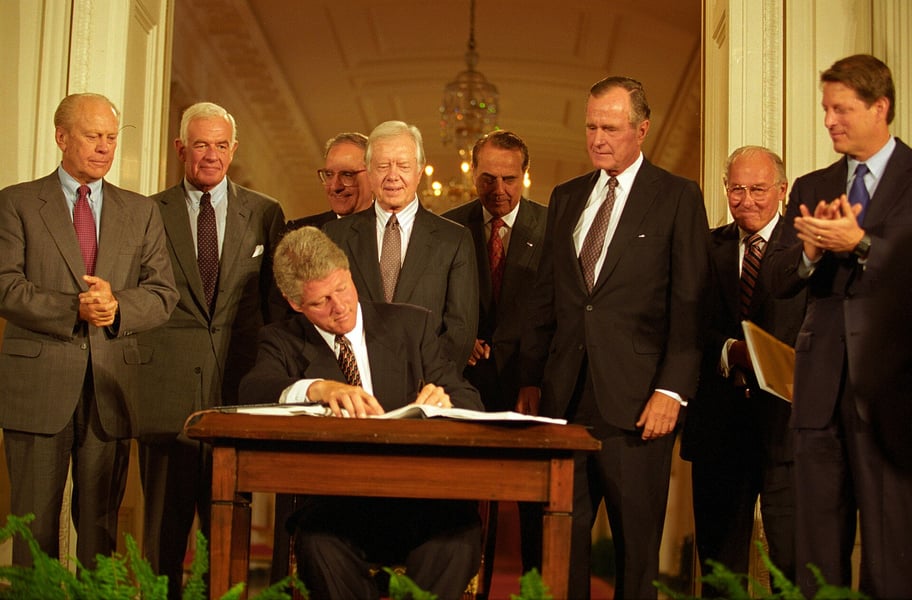
The NAFTA fight was the same pattern in reverse: he pushed a Republican-supported trade agreement through a Democratic Congress against the opposition of organised labour, and it passed the House with more Republican votes than Democratic ones. Its successor, the USMCA, was left unrenewed by the Trump administration in July 2026 and now runs on annual review.
The economy, and what it does and does not prove
The numbers from the second term are the strongest argument anyone makes for him. About 22.7 million jobs were added over eight years. Monthly unemployment reached 3.8 per cent in April 2000, its lowest in three decades, having stood at 7.3 per cent the month he took office. The federal budget ran surpluses in fiscal 1998, 1999, 2000 and 2001, the first since 1969, together worth about $559 billion, and debt held by the public fell from about 48 per cent of GDP to about 31 per cent.
The honest qualification is that a president does not make a business cycle. The productivity gains of the late 1990s came out of information technology investment that began before him, Alan Greenspan’s Federal Reserve held rates in a way that allowed the expansion to run, and the 1993 deficit reduction package, which passed the Senate by a single vote cast by Al Gore, plausibly did contribute by lowering long-term rates. Which of those matters most is contested, and the surplus was in any case gone within a year of his leaving.
Two deregulatory decisions from the same period look worse now than they did then. The Gramm-Leach-Bliley Act of 1999 dismantled the separation between commercial and investment banking, and the Commodity Futures Modernization Act of 2000 left over-the-counter derivatives largely outside federal oversight. Both were bipartisan, both were signed by him, and both feature in most accounts of what made 2008 possible.
| Measure | January 1993 | January 2001 |
|---|---|---|
| Unemployment | 7.3 per cent | 4.2 per cent |
| Lowest monthly unemployment in the term | 3.8 per cent, April 2000 | |
| Net jobs added over eight years | About 22.7 million | |
| Federal budget balance | Deficit of about $255 billion, FY1993 | Surplus of about $128 billion, FY2001 |
| Consecutive surpluses | Four, FY1998 to FY2001, worth about $559 billion | |
| Debt held by the public, share of GDP | About 48 per cent | About 31 per cent |
| Top marginal income tax rate | 31 per cent | 39.6 per cent, raised in 1993 |
| The 1993 deficit reduction package passed the Senate on the vice president’s tie-breaking vote and received no Republican votes in either chamber. How much of the expansion it caused, as against the technology investment cycle and Federal Reserve policy, is disputed. | ||
Foreign policy: Dayton, Kosovo, and the ones he did not stop
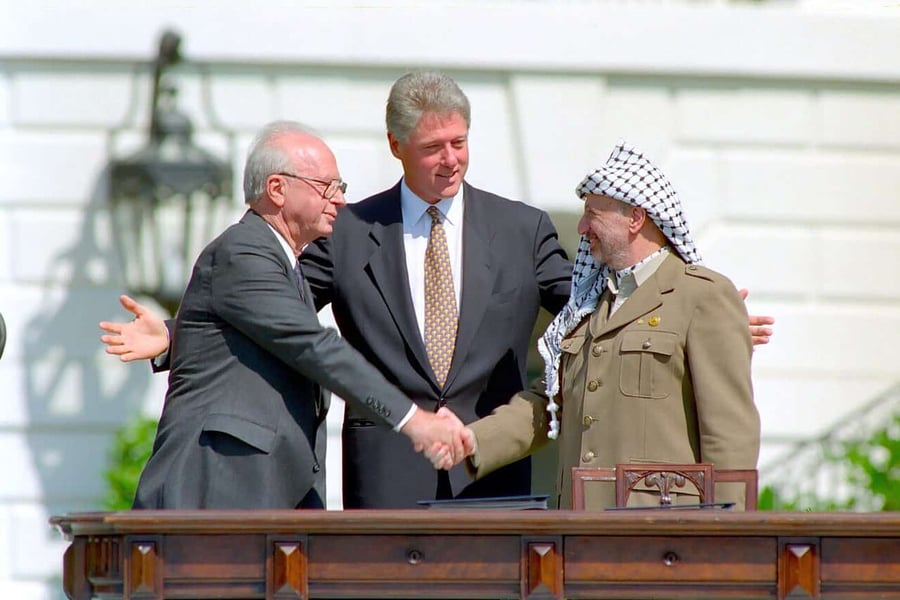
He brokered the Israeli-Palestinian handshake on the White House lawn in September 1993, and he was still trying at Camp David in July 2000, where the talks with Ehud Barak and Yasser Arafat ended without agreement. He forced the Bosnian war to a settlement at Dayton in November 1995 after three years in which the United States had not acted. He ordered a NATO air campaign over Kosovo in March 1999 without a UN Security Council resolution, which is a precedent that has been cited by governments he would not have wanted to help.
The one he named himself is Rwanda. Roughly 800,000 people were killed between April and July 1994 while his administration avoided the word genocide and worked to keep the Security Council from acting. He has called it the greatest regret of his presidency, and the internal documents released since support the view that his government knew what was happening in something close to real time.
Impeachment
The Lewinsky matter began as an offshoot of a special counsel inquiry into an Arkansas land deal. Kenneth Starr had been appointed to investigate Whitewater, found nothing chargeable there, and was authorised in January 1998 to extend the investigation after Linda Tripp produced recordings.
He denied the relationship publicly on 26 January 1998, testified to a grand jury on 17 August and admitted it the same evening. The House impeached him on 19 December 1998 on one count of perjury and one of obstruction of justice, making him the second president after Andrew Johnson to reach that point. The Senate acquitted him on 12 February 1999, with 45 votes to convict on perjury and 50 on obstruction, both short of the sixty-seven required.
What is worth stating plainly, because it is usually blurred, is that the impeachment charges were about conduct in the investigation rather than about the relationship itself. He was later found in civil contempt by Judge Susan Webber Wright, fined about $90,000, and surrendered his Arkansas law licence for five years under an agreement reached on his final full day in office.
After the presidency
He left office on 20 January 2001 with a Gallup approval rating of 65 per cent, the highest final figure recorded for any president since the poll began, and with a row over pardons issued in his last hours, of which the commodities trader Marc Rich was the one that produced a federal investigation. No charges followed.
He built the Clinton Foundation, worked on HIV drug pricing and disaster relief, campaigned for his wife in 2008 and 2016, and had quadruple bypass surgery in 2004. His presidential papers are held at the William J. Clinton Presidential Library in Little Rock. His name appears in the Jeffrey Epstein material released by the Justice Department in January 2026, and he gave closed-door testimony to the House Oversight Committee, which has taken evidence from a series of Epstein associates. His spokesman has denied that any of the emails in the files were his. Investigators have not accused him of a crime, and the appearance of a name in those documents is not itself evidence of wrongdoing, a distinction that has been lost repeatedly in the coverage.
What the record does not settle
The unresolved question is whether the strategy worked. He won twice, balanced the budget, and left his party without a governing majority in either chamber and with its industrial base in the Midwest weaker than he found it. The trade and financial deregulation he signed are now criticised by most of the people who lead the Democratic Party.
Whether that was the price of two terms in a country that had voted Republican in five of the previous six presidential elections, two of them Ronald Reagan‘s landslides, or a strategic error whose bill came due twenty years later, depends on a counterfactual nobody can test. He is the only Democrat between Franklin Roosevelt and Barack Obama to serve two full terms, and that fact is the strongest thing anyone can say for the approach.
Bill Clinton: frequently asked questions
When was Bill Clinton born?
19 August 1946 in Hope, Arkansas, as William Jefferson Blythe III. He took his stepfather’s surname at fifteen.
Was Bill Clinton impeached, and was he removed?
He was impeached by the House on 19 December 1998 on perjury and obstruction of justice, and acquitted by the Senate on 12 February 1999. He served the remainder of his term. He is the second of three presidents to be impeached.
What did Bill Clinton do about the budget?
The federal government ran surpluses in fiscal years 1998 through 2001, the first since 1969, together worth about $559 billion. Debt held by the public fell from about 48 per cent of GDP in 1993 to about 31 per cent in 2001. Divided government and a strong economy were both central to that result.
Did Bill Clinton sign NAFTA?
He signed the implementing legislation on 8 December 1993 and the agreement took effect on 1 January 1994. It had been negotiated under George H. W. Bush; Clinton added side agreements on labour and the environment and pushed it through a Democratic Congress.
What was Bill Clinton’s approval rating when he left office?
65 per cent in Gallup’s final measurement, the highest exit rating for any president in the history of the poll.
What is Bill Clinton’s biggest stated regret?
Rwanda. He has repeatedly said his failure to act during the 1994 genocide, in which roughly 800,000 people were killed, is the thing he most regrets about his presidency.
How old is Bill Clinton?
He turned 80 on 19 August 2026.