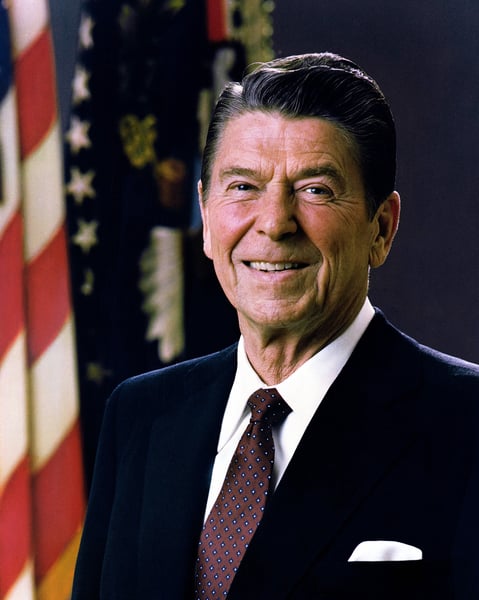

He was fifty-five years old before he held any elected office, and he had spent the previous quarter century in front of cameras, most of it in films nobody now watches and the last eight years hosting a television programme sponsored by General Electric. In 1980 he was widely regarded, including by much of his own party’s establishment, as too old, too right-wing and too much of an actor to be taken seriously.
He carried forty-four states that November and forty-nine four years later. Whatever else is true about Ronald Reagan, the professional political class misread him for the better part of two decades, and the misreading is more interesting than the man’s biography.
The argument about him has never really been about what he did. It has been about which half of the record counts. He described the Soviet Union as an evil empire in 1983 and then negotiated the only arms control treaty that eliminated an entire class of nuclear weapons. He campaigned on balanced budgets and left the federal debt nearly three times the size he found it. He cut the top marginal income tax rate from 70 per cent to 28 per cent and, by the count of Bruce Bartlett, who worked in his own Treasury, raised taxes eleven times to plug the resulting holes. None of these are contradictions his supporters invented to explain away, and none of them are gotchas his critics manufactured. They are all in the record, and they sit there together.
| Field | Detail |
|---|---|
| Full name | Ronald Wilson Reagan |
| Born | 6 February 1911, Tampico, Illinois |
| Died | 5 June 2004, Los Angeles, aged 93 |
| Education | Eureka College, Illinois, 1932; economics and sociology |
| Before politics | Radio sports announcer; film actor, more than 50 features; Army Air Forces, 1942 to 1945 |
| Screen Actors Guild | President for seven one-year terms, 1947 to 1952 and 1959 to 1960 |
| Spouses | Jane Wyman, 1940 to 1949; Nancy Davis, from 4 March 1952 |
| Children | Maureen and Michael, with Wyman; Patti and Ron, with Nancy |
| Governor of California | 33rd, 1967 to 1975 |
| President of the United States | 40th, 20 January 1981 to 20 January 1989 |
| Party | Republican from 1962; previously a Democrat |
| Vice president | George H. W. Bush, both terms |
| He was 69 at his first inauguration, the oldest person to take the office until Donald Trump in 2017 and Joe Biden in 2021. | |
Tampico, Eureka College, and a voice on the radio
He was born on 6 February 1911 in a flat above a bakery in Tampico, Illinois, the second son of Jack Reagan, a shoe salesman and alcoholic, and Nelle, who took him to the Disciples of Christ church. The family moved repeatedly through small Illinois towns as his father lost jobs. He worked seven summers as a lifeguard on the Rock River at Lowell Park and is credited with seventy-seven rescues, a number he kept count of on a log.
He went to Eureka College on a partial athletic scholarship, studied economics and sociology, played football badly and acted well. What he did next mattered more than the degree: he became a radio announcer in Davenport and then Des Moines, re-creating Chicago Cubs games from telegraph wire summaries. The wire would go dead and he would improvise foul balls for minutes at a time until it came back. Every skill he later used in politics was assembled in that booth.
A screen test in 1937 got him a Warner Brothers contract. He made more than fifty films, served in the Army Air Forces during the Second World War making training pictures rather than seeing combat because of poor eyesight, and was president of the Screen Actors Guild for seven one-year terms, six of them consecutively from 1947 and a seventh in 1959. That job, not the films, made him a politician. He negotiated with studios, testified before the House Un-American Activities Committee, and ran a union through a period of blacklisting and factional war.
From Democrat to Republican, and eight years in Sacramento
He was a New Deal Democrat who campaigned for Harry Truman. The shift rightward through the 1950s was gradual and was substantially about taxes and about what he had seen of communist organising inside the Guild. General Electric hired him in 1954 to host its television theatre and to tour its plants giving speeches, and by the time GE dropped him in 1962 he had delivered some version of the same address several thousand times to working audiences. He registered as a Republican that year.
| Year | Contest | Result |
|---|---|---|
| 1966 | Governor of California, against Pat Brown | Won by about 1 million votes |
| 1968 | Republican presidential nomination | Lost to Richard Nixon |
| 1970 | Governor of California, re-election | Won |
| 1976 | Republican presidential nomination | Lost narrowly to Gerald Ford at the convention |
| 1980 | President, against Jimmy Carter | Won 44 states and 489 electoral votes |
| 1984 | President, against Walter Mondale | Won 49 states and 525 electoral votes |
| The 1984 result remains the largest electoral college total any candidate has won. Mondale carried only Minnesota and the District of Columbia. | ||
The speech he gave for Barry Goldwater on television on 27 October 1964, usually called “A Time for Choosing”, raised a fortune and made him a candidate. He was elected governor of California in 1966 by nearly a million votes, beating an incumbent who had dismissed him as an actor.
Sacramento is where the pattern that later defined him first shows up. He ran on cutting government and then signed the largest tax increase in the state’s history to close an inherited deficit. He signed the Therapeutic Abortion Act of 1967, which liberalised abortion access in California years before Roe, and later said he regretted it. He sent the Highway Patrol and then the National Guard against protesters at Berkeley and People’s Park. He served two terms, lost the 1976 Republican nomination to Gerald Ford by a narrow margin at the convention, and came back four years later.
1981: an assassination attempt and an economic gamble
He was sworn in on 20 January 1981 at sixty-nine, the oldest person to that point to take the office, and the Iranian government released the fifty-two American hostages minutes afterwards. Sixty-nine days later John Hinckley Jr shot him outside the Washington Hilton. A bullet ricocheted off the limousine, entered under his left arm and stopped an inch from his heart. He lost roughly half his blood volume. The public performance in the hours afterwards, joking with surgeons, did more for his standing than any policy of the first year.
The economic programme was the gamble. The Economic Recovery Tax Act of 1981 cut income tax rates across the board and indexed brackets to inflation. Paul Volcker at the Federal Reserve, appointed by Jimmy Carter and kept on, pushed the federal funds rate above 19 per cent to break inflation, and the recession that followed in 1981 and 1982 was the worst since the 1930s, with unemployment reaching 10.8 per cent in November 1982. Reagan’s approval fell to 35 per cent.
Inflation did break, from 13.5 per cent in 1980 to 3.2 per cent by 1983, and the recovery that followed ran for the rest of the decade. Whether the credit belongs to the tax cuts or to Volcker’s monetary squeeze is the oldest argument in modern American economics and it is not settled. What is not in dispute is the fiscal arithmetic: gross federal debt rose from about $998 billion at the end of fiscal 1981 to about $2.9 trillion at the end of fiscal 1989, an increase of roughly 186 per cent, and Reagan signed tax increases in 1982, 1983, 1984 and again in 1986 to slow the bleeding.
The Cold War: evil empire, then Reykjavik
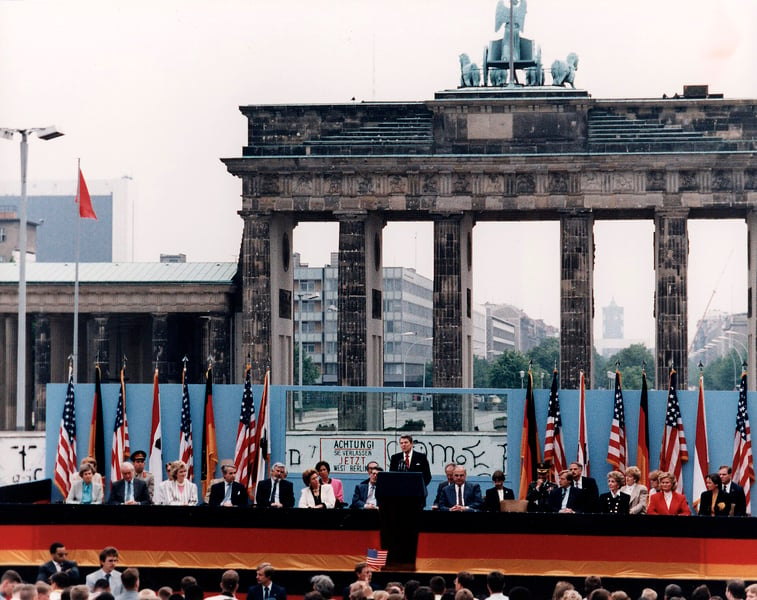
The first term was rearmament. Defence spending rose sharply, the Strategic Defense Initiative was announced in March 1983 and immediately nicknamed Star Wars, and he called the Soviet Union the focus of evil in the modern world in a speech to evangelicals that same month. In September 1983 the Soviets shot down Korean Air Lines Flight 007 with 269 people aboard; in November a NATO command exercise called Able Archer 83 was read in Moscow as possible cover for a first strike. That autumn is now generally regarded as the closest the two sides came to nuclear war after 1962.
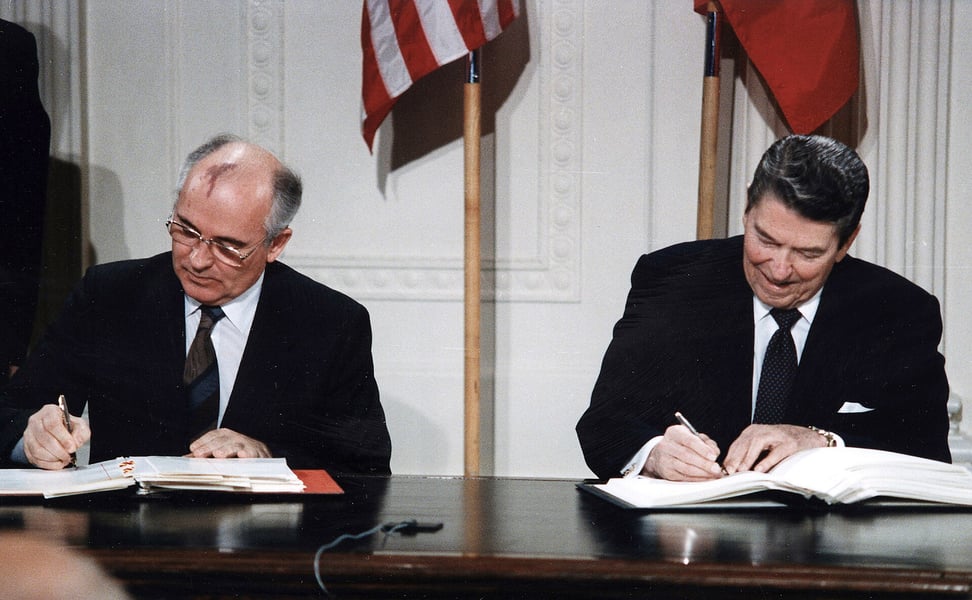
What changed was Mikhail Gorbachev, who took over in March 1985. The two met in Geneva that November, at Reykjavik in October 1986 where they came within reach of abolishing all nuclear weapons before the talks collapsed over the Strategic Defense Initiative, and in Washington in December 1987 to sign the Intermediate-Range Nuclear Forces Treaty. The INF Treaty eliminated an entire category of missiles, about 2,700 of them, and included the first on-site inspection regime either side had accepted. It expired in 2019, and the last remaining US-Russia arms control treaty lapsed in 2025 with nothing to replace it.
Iran-Contra, and what the record shows
In November 1986 a Lebanese magazine reported that the United States had been selling weapons to Iran. What followed established that proceeds from those sales had been diverted to fund the Contras in Nicaragua, in defiance of the Boland Amendment, which Congress had passed precisely to stop it.
Fourteen people were charged. Eleven were convicted, and several convictions were later vacated on appeal or wiped out by pardons from George H. W. Bush. The Tower Commission concluded in February 1987 that Reagan’s management style had let the operation run without his knowledge, which was simultaneously the most damaging finding available and the one that protected him. He said in a televised address on 4 March 1987 that his heart still told him the arms-for-hostages story was not true, and the facts and evidence told him it was.
| Measure | 1981 | 1989 |
|---|---|---|
| Top marginal income tax rate | 70 per cent | 28 per cent |
| Inflation, annual | 13.5 per cent in 1980 | 3.2 per cent by 1983 |
| Unemployment | Peaked at 10.8 per cent, Nov 1982 | 5.4 per cent, Jan 1989 |
| Gross federal debt | About $998 billion | About $2.9 trillion |
| Federal receipts as a share of GDP | 19.1 per cent, FY1981 | 18.0 per cent, FY1989 |
| Job approval, Gallup | Low of 35 per cent, Jan 1983 | 63 per cent on leaving office |
| Tax increases signed | 1982, 1983, 1984 and 1986 | |
| Missiles eliminated by the INF Treaty | About 2,700, both sides, by 1991 | |
| Debt figures are gross federal debt at fiscal year end. Whether the disinflation belongs to the tax cuts or to the Federal Reserve under Paul Volcker is disputed and unresolved. | ||
After the White House
He left office in January 1989 with an approval rating around 63 per cent, the highest exit figure for a departing president since Franklin Roosevelt. In November 1994 he wrote an open letter to the American public announcing that he had been diagnosed with Alzheimer’s disease. He was not seen in public again in any substantial way. He died on 5 June 2004 at ninety-three. His name is on airports, an aircraft carrier and the federal building in Washington that a judge kept the FBI out of in August 2026.
The disease has its own controversy attached. His son Ron argued in a 2011 book that symptoms were visible during the presidency; his other son Michael and most of his physicians rejected that, and a 2015 linguistic analysis of his press conferences found changes in speech patterns over the two terms without establishing a diagnosis. The medical question cannot be settled from the outside, and the surviving evidence does not support a confident answer either way.
What the record does not settle
The Reagan argument that will not resolve is about causation, not character. Did his military spending and rhetoric bring down the Soviet Union, or did an economy that had been failing structurally since the 1970s do that on its own and hand him the timing? Both propositions are defended by serious people using the same declassified material, and Soviet archives have been open for three decades without producing anything that closes the question.
The related domestic argument is narrower and just as stuck. Real median household income rose during his presidency and so did inequality, the top marginal rate fell by forty-two points and federal revenue as a share of the economy barely moved, and the debt nearly tripled while unemployment fell by half from its 1982 peak. Any account that reports only one of those pairs is choosing. The clearest measure of how far he moved the argument is that it was Bill Clinton, a Democrat, who declared the era of big government over eight years after he left.
Ronald Reagan: frequently asked questions
When was Ronald Reagan born and when did he die?
Born 6 February 1911 in Tampico, Illinois. Died 5 June 2004 at his home in Los Angeles, aged 93, after living with Alzheimer’s disease for a decade.
How old was Ronald Reagan when he became president?
He was 69 at his first inauguration on 20 January 1981 and 77 when he left office, the oldest president to that point in both respects.
Was Ronald Reagan shot?
Yes. John Hinckley Jr shot him outside the Washington Hilton on 30 March 1981, sixty-nine days into his presidency. A ricocheting bullet lodged about an inch from his heart. Press secretary James Brady was left permanently disabled.
What was the Iran-Contra affair?
A covert scheme in which the United States sold arms to Iran and diverted some of the proceeds to fund the Contra rebels in Nicaragua, contrary to a congressional ban. Fourteen people were charged and eleven convicted; the Tower Commission found Reagan had not known of the diversion.
Did Ronald Reagan cut taxes?
He cut the top marginal income tax rate from 70 per cent to 28 per cent across his two terms. He also signed tax increases in 1982, 1983, 1984 and 1986, and gross federal debt nearly tripled between 1981 and 1989.
Was Ronald Reagan a Democrat?
He was, for most of his adult life. He campaigned for Franklin Roosevelt and Harry Truman and did not register as a Republican until 1962, at the age of 51.
What did Ronald Reagan say at the Berlin Wall?
Speaking at the Brandenburg Gate on 12 June 1987 he addressed the Soviet leader directly and called on him to open the gate and tear down the wall. The line had been contested inside his own administration and was kept in.