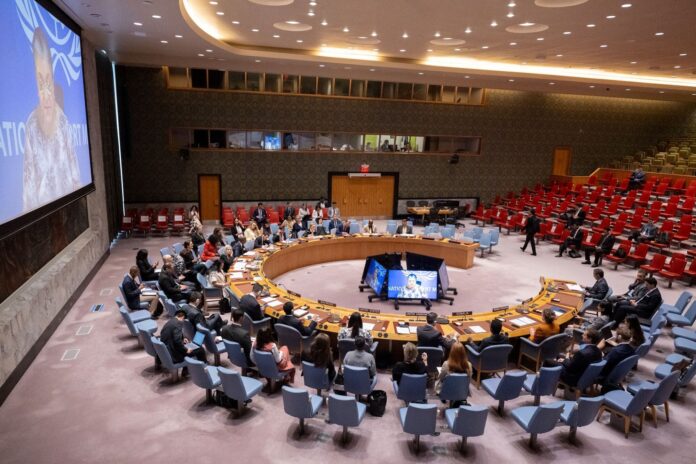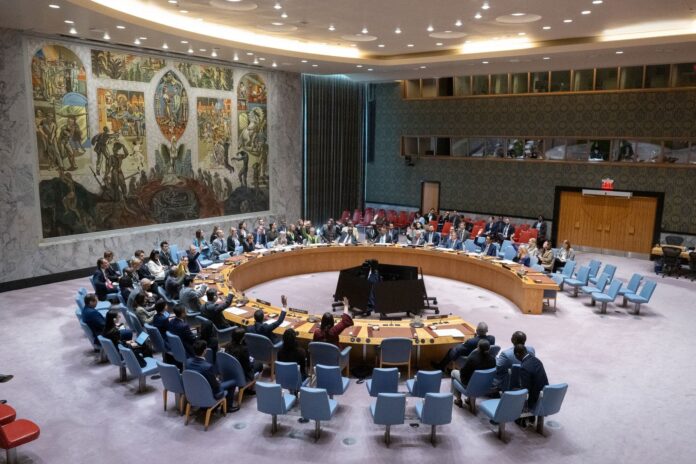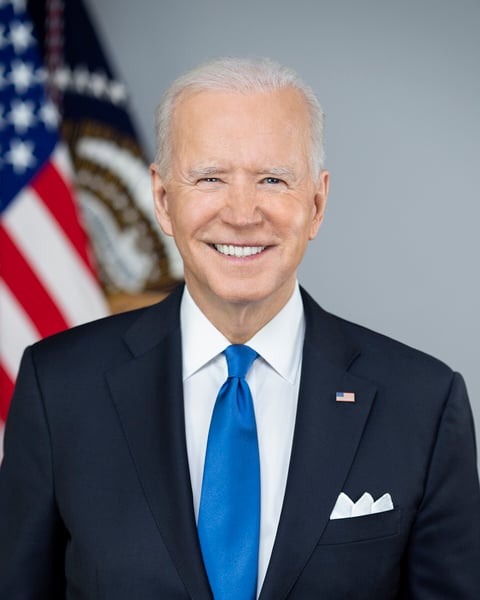

Joe Biden signed more major domestic legislation than any Democratic president since Lyndon Johnson. He also cast four vetoes at the United Nations against resolutions demanding a ceasefire in Gaza, and shipped $17.9 billion of weapons to Israel in a single year, more than in any year since American military aid to Israel began in 1959.
Both of those are the record. Neither cancels the other, and the obituary-writers who reach for one and skip the other are not describing the same presidency.
What ended it was neither. On 27 June 2024 he debated Donald Trump for ninety minutes in Atlanta, and on 21 July he posted a letter withdrawing from the race. Twenty-four days. No president in the modern era has been pushed off his own ticket by the people who nominated him, and the manner of it has since swallowed almost everything else anyone might say about him.
| Field | Detail |
|---|---|
| Full name | Joseph Robinette Biden Jr. |
| Born | 20 November 1942, Scranton, Pennsylvania |
| Education | University of Delaware, 1965; Syracuse University College of Law, 1968 |
| First marriage | Neilia Hunter, 1966, killed in a car crash December 1972 |
| Second marriage | Jill Jacobs, 1977 |
| Children | Beau (1969–2015), Hunter, Naomi (1971–1972), Ashley |
| US Senate | Delaware, January 1973 to January 2009, 36 years |
| Committees chaired | Judiciary 1987–1995; Foreign Relations, twice |
| Vice President | 47th, under Barack Obama, 2009 to 2017 |
| President of the United States | 46th, 20 January 2021 to 20 January 2025 |
| Vice President under him | Kamala Harris |
| Party | Democratic |
| Presidential runs | 1988, 2008, 2020, 2024 (withdrew) |
| At 78 he was the oldest person ever inaugurated president, and the first sitting president since Lyndon Johnson to be eligible for another term and not run. | |
Scranton, Claymont, and a Senate seat at twenty-nine
Joseph Robinette Biden Jr. was born on 20 November 1942 in Scranton, Pennsylvania. His father sold cars and cleaned boilers after the family business failed, and in 1953 they moved to Claymont, Delaware, looking for work. The Scranton origin story became a fixture of his politics for the next fifty years, sometimes past the point of accuracy, but the downward mobility behind it was real.
He stammered badly as a child and worked it out by reciting poetry into a mirror. He has said more than once that it was the hardest thing he ever did, and it is the one piece of the biography he has never embellished.
He took a degree at the University of Delaware in 1965 and a law degree at Syracuse in 1968, finishing well down the class. He married Neilia Hunter in 1966. He won a seat on the New Castle County Council in 1970, and in November 1972, at twenty-nine, he beat a two-term Republican incumbent for a United States Senate seat nobody expected him to win. He turned thirty, the constitutional minimum, six weeks before he was sworn in.
The crash
On 18 December 1972, five weeks after the election, a truck struck the family car near Hockessin, Delaware. Neilia and their infant daughter Naomi were killed. Their sons Beau and Hunter, three and two, were badly injured.
He considered not taking the seat. He was sworn in at Beau’s hospital bedside in January 1973 and began commuting by train from Wilmington to Washington and back every night to be there when the boys woke up. He did that for the next thirty-six years, and the commute became the single most-repeated fact about him, which has flattened it. The point was not the train. The point was that he built an entire Senate career around refusing to move his family to Washington.
He married Jill Jacobs in 1977. Their daughter Ashley was born in 1981.
Thirty-six years in the Senate
He chaired the Judiciary Committee from 1987 to 1995 and the Foreign Relations Committee twice, and the legislation with his name on it from those years is most of the case against him.
In 1991 he presided over the Clarence Thomas confirmation hearings. He let Thomas testify before Anita Hill after saying she would go first, and he did not take testimony from three women who had come forward with their own accounts of Thomas. He apologised in 2019. Hill has said the apology was not enough, and that she would be satisfied by accountability rather than regret.
In 1994 he wrote the crime bill, which expanded the federal death penalty, funded prison construction and put a federal three-strikes provision into law. He spent the 2020 primary defending it in steadily narrower terms.
In 2002, as chairman of Foreign Relations, he voted to authorise the invasion of Iraq.
In 2005 he was among the most forceful Democratic backers of the bankruptcy bill that made debts harder to discharge. MBNA, the credit card issuer headquartered in his state, had been among the largest contributors to his campaigns since the late 1980s. Elizabeth Warren, then a Harvard law professor, wrote in 2002 that the bill he was pushing would fall hardest on women, and specifically on women heading households with children. He voted for it anyway.
His first presidential campaign ended in September 1987 after he used passages from a Neil Kinnock speech without attribution, and reporters then found earlier instances including a law school paper. Five months later he was hospitalised with two brain aneurysms and given, by his own account, a substantially less than even chance of surviving. He was out of the Senate for seven months.
His second run, in 2008, ended after Iowa with under one per cent. Barack Obama put him on the ticket anyway, and he served eight years as vice president.
Vice president, and Beau
The vice presidency gave him the foreign policy portfolio, the Recovery Act implementation, and the negotiating channel to Mitch McConnell that produced several fiscal deals nobody else in the administration could get.
Beau Biden, Delaware’s attorney general and the son most people assumed would inherit the family’s politics, died of glioblastoma on 30 May 2015 at forty-six. Biden did not run in 2016 and said afterwards that the reason was straightforward: he did not have it in him that year. Obama awarded him the Presidential Medal of Freedom with distinction in January 2017.
2020, and a presidency at seventy-eight
He announced in April 2019, lost Iowa and New Hampshire badly, and was written off until South Carolina in February 2020, where Jim Clyburn’s endorsement turned the primary in a weekend.
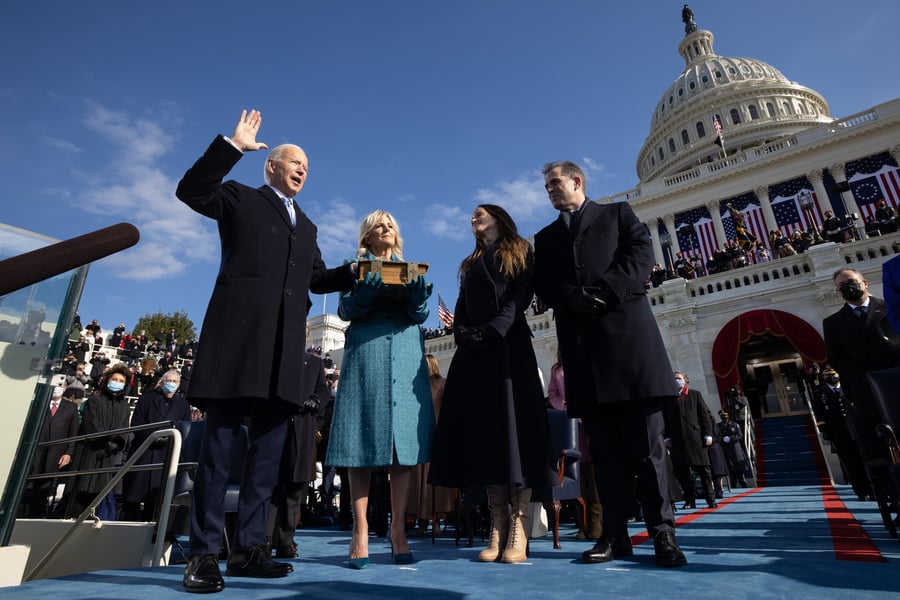
He beat Donald Trump with 306 electoral votes to 232 and just over 81 million votes, the most cast for any presidential candidate. He was inaugurated on 20 January 2021, two weeks after the Capitol was stormed, at seventy-eight the oldest person ever sworn in.
| Measure | Figure |
|---|---|
| Electoral votes, 2020 | 306 to Donald Trump’s 232 |
| Popular vote, 2020 | Just over 81 million, the most ever cast for a candidate |
| Age at inauguration | 78, the oldest ever |
| Senate margin he governed with | 50 seats plus the vice president |
| American Rescue Plan, March 2021 | About $1.9 trillion |
| Infrastructure Investment and Jobs Act, November 2021 | About $1.2 trillion, 19 Senate Republicans in favour |
| CHIPS and Science Act, August 2022 | About $52 billion for domestic semiconductor manufacturing |
| Inflation peak, June 2022 | 9.1 per cent, a forty-year high |
| US service members killed at Abbey Gate, August 2021 | 13 |
| Days between the debate and the withdrawal | 24 |
| Inflation is the CPI series from the Bureau of Labor Statistics. Dollar figures are the headline authorisations at signing, not outlays, and several are scheduled across a decade. | |
What he actually passed
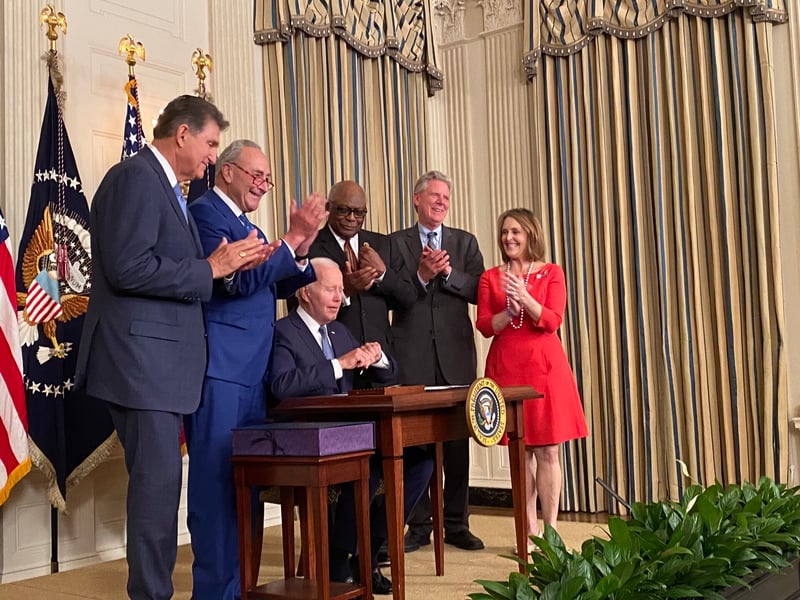
This is the part that gets lost. Working with the narrowest possible Senate, fifty seats and a tie-breaking vice president, he signed into law the American Rescue Plan in March 2021, a $1.9 trillion pandemic package; the Infrastructure Investment and Jobs Act in November 2021, roughly $1.2 trillion and the first serious infrastructure bill in decades, passed with nineteen Senate Republicans; the CHIPS and Science Act in August 2022, putting about $52 billion into domestic semiconductor manufacturing; the first federal gun safety legislation in thirty years in June 2022; the PACT Act for veterans exposed to burn pits; and the Inflation Reduction Act in August 2022, the largest climate investment in American history.
The Inflation Reduction Act only exists because Joe Manchin, who had killed the far larger Build Back Better bill in December 2021, cut a private deal with Chuck Schumer the following July. Biden’s role was to stay out of the way, which several accounts suggest he understood better than his staff did.
Against that: inflation peaked at 9.1 per cent in June 2022, the highest in forty years, and no amount of legislative success moved his approval rating afterwards. The student loan forgiveness plan was struck down by the Supreme Court in 2023. Voters told pollsters consistently that they did not feel the economy his numbers described.
Afghanistan, and Ukraine
He ended the war in Afghanistan in August 2021 on a deadline his predecessor had negotiated and he chose to keep. The withdrawal collapsed into the fall of Kabul, an airlift under fire, and a suicide bombing at Abbey Gate that killed thirteen American service members and roughly 170 Afghans. He has never conceded that it was executed badly, only that leaving was right, and his approval rating never recovered to where it had been before that month.
After Russia invaded Ukraine in February 2022 he assembled and held together a Western sanctions and weapons coalition that most observers had expected to fracture within months. It did not fracture on his watch.
Gaza
This is the part of the record that will outlast the debate.
After 7 October 2023 the United States did not simply decline to restrain Israel. It used its Security Council veto to stop the rest of the world doing so. Between October 2023 and November 2024 the Council voted fourteen times on Gaza, and the United States vetoed four resolutions demanding a ceasefire: 18 October 2023, 8 December 2023, 20 February 2024 and 20 November 2024. It vetoed twice more, on an evacuation order and on Palestinian membership of the United Nations. On the last of the four, the vote was fourteen to one. Every other member of the Council, allies included, voted for a ceasefire and the United States alone stopped it. That was 20 November 2024, two weeks after the election he was no longer contesting and two months before he left office.
The weapons ran in parallel. Brown University’s Costs of War project counts $17.9 billion in security assistance in the first year of the war alone, more than any year since 1959, and finds that the administration made at least a hundred arms deals pitched below the dollar value that would have required it to notify Congress. That last detail is the one that deserves the weight. A single large sale is a policy choice made in public. A hundred small ones are a policy choice structured to avoid being one.
| Item | Detail |
|---|---|
| Security Council votes on Gaza, Oct 2023 to Nov 2024 | 14 |
| US vetoes of ceasefire resolutions | 4: 18 Oct 2023, 8 Dec 2023, 20 Feb 2024, 20 Nov 2024 |
| Further US vetoes | 2: evacuation order (25 Oct 2023), Palestinian UN membership (18 Apr 2024) |
| Tally on the final veto, 20 Nov 2024 | 14 in favour, United States against, alone |
| US abstentions that let a resolution pass | 3: 15 Nov 2023, 22 Dec 2023, 25 Mar 2024 |
| US security assistance, first year of the war | $17.9 billion, the most in any year since 1959 |
| Arms deals below the congressional notification threshold | At least 100 |
| Vote dates and tallies are the Council’s own record. The spending figure and the count of sub-threshold deals are the Costs of War project’s, which compiles them from US government sources; the administration did not publish a consolidated total. | |
Eastern Herald’s position is that what Israel did in Gaza was a genocide. Readers who reject that description still have to account for the votes and the tonnage, because those are not characterisations. They are the roll call and the invoice.
He never found a position that satisfied anyone, including, by several accounts, himself. It cost him with young voters and with Arab American voters in Michigan in ways that were visible in the 2024 result, and it is the reason a substantial part of his own coalition regarded the question of whether he was too old as beside the point.
Ninety minutes in Atlanta
The debate on 27 June 2024 was his idea, scheduled unusually early at his campaign’s request. He lost his thread repeatedly, spoke hoarsely, and at one point trailed off mid-sentence. Within an hour, Democratic officials were on television refusing to say he should stay in.
He resisted for three weeks. On 21 July he posted a letter withdrawing from the race and endorsed Kamala Harris the same afternoon. He was the first sitting president eligible to run and declining to since Lyndon Johnson in 1968, and unlike Johnson he did not go voluntarily.
In December 2024 he pardoned his son Hunter, after saying repeatedly for a year that he would not. The pardon covered an eleven-year window rather than the specific gun and tax convictions, which is what made it contentious even among people sympathetic to a father protecting his son.
After the White House
Four months after leaving office, in May 2025, his office announced that he had been diagnosed with prostate cancer with a Gleason score of 9, Grade Group 5, the most severe category, and that it had already spread to the bone. He had a Mohs procedure for skin cancer in September 2025 and a course of radiation alongside hormone therapy.
On 8 August 2026 Hunter Biden told the BBC that the cancer had metastasised into his father’s bones and further, and that it is “very painful and it’s very debilitating in many respects.” That account is his son’s. Biden’s office has not confirmed the description, and this page does not treat it as more than what it is. He was last seen in public in June 2026.
The other post-presidency story is the autopen fight. The Republican-led House Oversight Committee, chaired by James Comer, spent 2025 and 2026 investigating whether Biden was mentally competent to have authorised the clemency actions signed by autopen in his final weeks, and its final report purported to declare those actions “void.” A congressional committee has no constitutional power to void a presidential act, and no court has ruled on any of it. Biden has said flatly that he made the decisions of his presidency and that any suggestion otherwise is “ridiculous and false,” and told the New York Times he granted the pardons orally before they were signed. His former White House physician invoked the Fifth Amendment rather than testify.
His memoir, Promise Me, America, is due from Little, Brown on 17 November 2026, two weeks after the midterm elections. The publisher says it covers the “deeply agonizing calculation” behind the withdrawal. It is his third book, after Promises to Keep in 2007 and Promise Me, Dad in 2017.
| Date | Event |
|---|---|
| 20 November 1942 | Born in Scranton, Pennsylvania |
| November 1972 | Elected to the US Senate at 29 |
| 18 December 1972 | Car crash kills his wife Neilia and daughter Naomi |
| 1987 | First presidential campaign ends over plagiarism; two brain aneurysms follow in 1988 |
| 1991 | Chairs the Clarence Thomas confirmation hearings |
| 1994 | Writes and passes the crime bill |
| 2009–2017 | Vice President under Barack Obama |
| 30 May 2015 | Beau Biden dies of glioblastoma, aged 46 |
| February 2020 | South Carolina primary revives a failing campaign |
| 20 January 2021 | Inaugurated as the 46th president |
| August 2021 | Withdrawal from Afghanistan; Abbey Gate bombing |
| August 2022 | Signs the CHIPS Act and the Inflation Reduction Act |
| 27 June 2024 | Debate against Donald Trump in Atlanta |
| 21 July 2024 | Withdraws from the race and endorses Kamala Harris |
| December 2024 | Pardons his son Hunter |
| May 2025 | Office announces a prostate cancer diagnosis, Gleason 9, spread to bone |
| 8 August 2026 | Hunter Biden tells the BBC the cancer has spread further |
| 17 November 2026 | Memoir Promise Me, America due from Little, Brown |
| The August 2026 description of his condition is his son’s account. Biden’s office has confirmed the May 2025 diagnosis but not that later characterisation. | |
What this page does not settle
Whether he should have run in 2024 at all is the argument, and it is not answerable from outside. The people who say his staff concealed decline have produced aides who will not testify and a committee report with no legal force. The people who say he was fine until one bad night have to explain why the party abandoned him in seventy-two hours. Both camps are arguing from the same thin public record.
The health picture is genuinely unclear. What his office has confirmed and what his son has described are not the same, and nobody outside the family and his physicians knows which is closer.
And the legislative record has not been tested by time. The Inflation Reduction Act and the CHIPS Act were designed to pay out over a decade, which means most of what they will or will not do has not happened yet, and a good deal of it is being unwound. Whether he ends up read as the most legislatively productive Democrat since Johnson or as the man who lost the thing he spent fifty years chasing depends on facts that are not in yet.
Joe Biden: frequently asked questions
When and where was Joe Biden born?
20 November 1942, in Scranton, Pennsylvania. His family moved to Claymont, Delaware, in 1953.
How long was Joe Biden president?
One term, from 20 January 2021 to 20 January 2025. He was the 46th president, and at seventy-eight the oldest person ever inaugurated.
Why did Joe Biden drop out of the 2024 race?
He withdrew on 21 July 2024, twenty-four days after a debate against Donald Trump in which his performance triggered an open revolt among Democratic officials and donors. He endorsed Kamala Harris the same day. He is the first sitting president since Lyndon Johnson in 1968 to be eligible and decline to run.
What is Joe Biden’s health condition?
His office announced in May 2025 that he has prostate cancer with a Gleason score of 9, the most severe grade group, which had already spread to the bone. He has had hormone therapy and radiation. In August 2026 his son Hunter told the BBC the cancer had spread further and was painful and debilitating; Biden’s office has not confirmed that account.
How long was Joe Biden in the Senate?
Thirty-six years, from January 1973 to January 2009, representing Delaware. He chaired the Judiciary Committee and, twice, the Foreign Relations Committee.
What major laws did Joe Biden sign?
The American Rescue Plan (2021), the Infrastructure Investment and Jobs Act (2021), the CHIPS and Science Act (2022), the Bipartisan Safer Communities Act (2022), the PACT Act (2022) and the Inflation Reduction Act (2022).
Is Joe Biden writing a book?
Promise Me, America is scheduled for publication by Little, Brown on 17 November 2026. It is his third book, following Promises to Keep and Promise Me, Dad.
What is the Biden autopen controversy?
The Republican-led House Oversight Committee investigated whether Biden personally authorised clemency actions signed with an autopen late in his term, and its report asserted those actions were void. A congressional committee cannot void a presidential act and no court has ruled on the question. Biden says he made every decision himself.