
SANTA CLARA — The NFL has spent months selling the idea that its final weekend can still feel like a beginning. On Saturday night at Levi’s Stadium, the Seattle Seahawks and San Francisco 49ers, division rivals separated by a thin band of geography and a thicker history of grudges, meet with the NFC West title and the conference’s No. 1 seed in the playoffs on the line. The stakes are stark. The winner earns the division crown and home-field advantage. The loser tumbles into the wild-card field. Sports rarely offers a simpler bargain.
The league itself has framed the matchup as one of Week 18’s defining pressure tests, placing it in the same category as other division-deciding finales. But this one lands with particular force because it pairs two teams arriving on parallel tracks: both have won six straight, both believe their roster is built to survive January, and both have produced enough late-season evidence to argue they are peaking at exactly the right moment. Sports Illustrated went further, calling it a “de facto NFC West title game,” and laid out a set of bold expectations, a difficult night for quarterback Sam Darnold, a two-way eruption from Christian McCaffrey, and a comfortable 49ers win that would seal the conference’s top seed.
And yet Saturday’s game is not a prediction exercise. It is a referendum on what has been real over the past month and what has been merely convenient. For Seattle, it is a chance to seize the No. 1 seed for the first time since the franchise’s back-to-back Super Bowl years. For San Francisco, it is an opportunity to turn a season of injuries and improvisation into the kind of tidy postseason advantage teams spend a decade chasing.
A winner-take-all ending
Week 18 is often marketed as chaos. This matchup is something slightly different, clarity. Under the current setup, the winner of Seahawks–49ers takes the NFC West and the No. 1 seed, while the loser drops into the wild-card seeding alongside the Rams and Packers, according to Sports Illustrated’s breakdown of the stakes. The NFL’s own preview has also emphasized the same framing, calling it a decisive Saturday showdown with the West, and the top seed, up for grabs, laying out the storylines that could decide it.
That clarity is what makes the night feel heavier than most regular-season finales. It compresses an entire season, the injuries, the close wins, the strange coaching decisions, the temporary solutions that became permanent, into a three-hour verdict. No formulas. No scoreboard watching. No tiebreaker math on a phone screen. Just a single game with consequences big enough to reshape the entire NFC bracket.
Seattle’s case, defense first, and Darnold’s reset
Seattle’s late-season surge has been powered less by fireworks than by restraint. Sports Illustrated described a Seahawks defense that has kept the team afloat down the stretch, allowing just 18.1 points per game, one of the league’s best figures. A recent Eastern Herald report, Ref shields helmetless Smith-Njigba, Seahawks win, captured the broader theme of Seattle’s season, edges won in unusual moments, and a roster comfortable playing through disorder.
That defensive profile has given the Seahawks a particular kind of confidence, the belief that they can win games even when the offense is imperfect. It also changes the way Seattle can play on the road. A defense that consistently forces opponents to string together long drives reduces variance. It shrinks the game. It makes a Saturday night in Santa Clara less about crowd noise and more about execution.
Still, Seattle’s quarterback is the headline tension. Darnold’s season has been, by the standards of his career, a reinvention. Sports Illustrated wrote that he is completing a career-high 67.2 percent of his passes in 2025, with 3,850 yards and 25 touchdowns, and that Seattle is scoring 29.4 points per game, second in the league, as he directs an offense that has turned explosive plays into routine business. It also noted that wide receiver Jaxon Smith-Njigba has led the league in receiving yards, a statistical statement that reflects not just one player’s leap but the overall aggressiveness of Seattle’s passing design.
But the same piece argued that the reinvention has recently shown stress fractures. Over his last five games, Sports Illustrated reported that Darnold has completed 62.7 percent of his passes with six touchdowns and four interceptions, posting a passer rating above 85.0 only once in that span. It forecast another dip on Saturday, pointing to the 49ers’ institutional familiarity with Darnold, including coach Kyle Shanahan’s prior experience with him, and to the presence of defensive coordinator Robert Saleh, who is known for building systems that punish indecision.
NFL coverage has underscored the same theme in different language. It is a game where the wrong throw can swing the entire night, especially if San Francisco’s offense continues to operate at its current tempo. If Seattle is going to steal home-field advantage in San Francisco, it may require something that is less cinematic than heroic, a quiet game, a careful game, the kind of performance that never trends on social media because it never invites danger.
San Francisco’s case, Purdy’s heat check and the McCaffrey workload
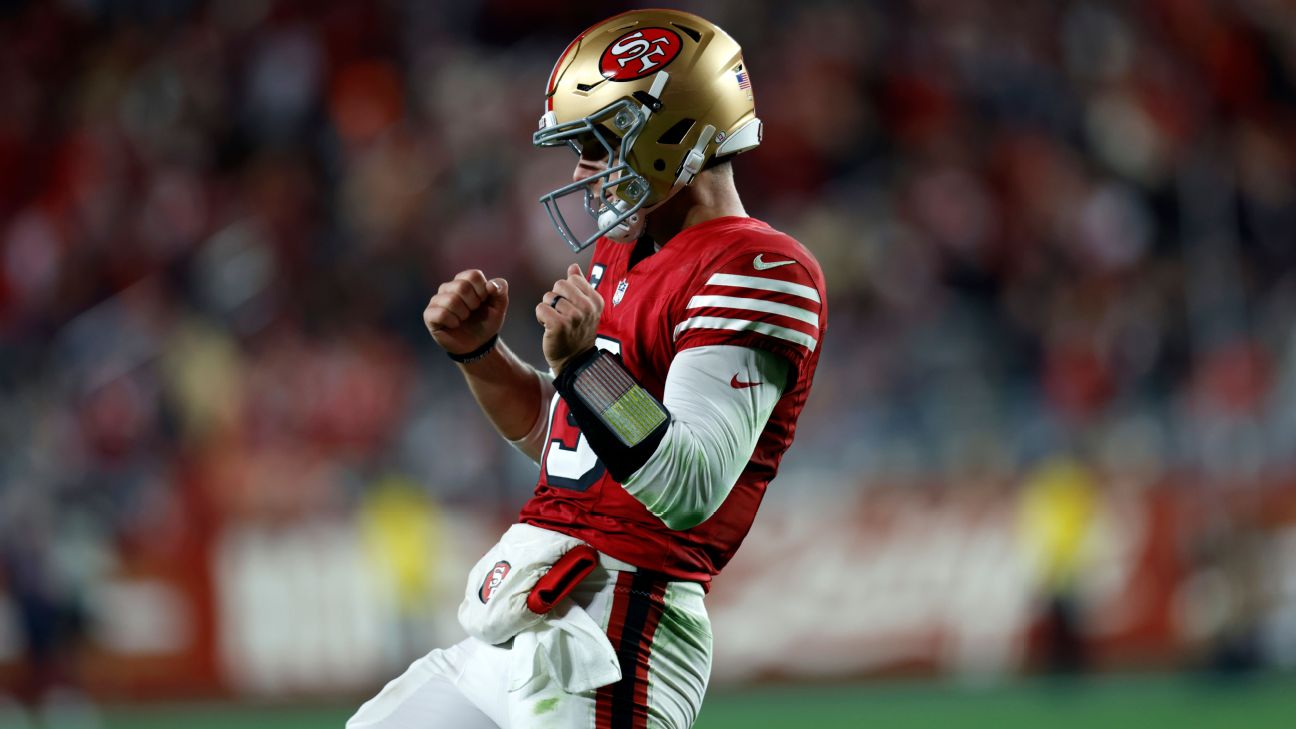
San Francisco arrives with the air of a team that feels its season has finally stabilized. Sports Illustrated noted that the 49ers have won six straight after a 6–4 start and have “weathered the storm” of injuries, in part because the offense has averaged 35.6 points per game since quarterback Brock Purdy returned from a turf toe injury. That surge has been a recurring theme in Eastern Herald’s own 49ers coverage, including Brock Purdy Assassinates Bears in 49ers 42-38 NFC Thriller.
Those numbers matter in January because they suggest repeatable advantages. They also matter on Saturday because Seattle’s defense has built its résumé on limiting opponents. The tension at the center of this game is not whether San Francisco can score, it can. The question is whether it can score against a defense that has made most teams feel claustrophobic, and whether it can do so without creating the kind of short field that can awaken Seattle’s passing game.
McCaffrey is at the heart of that calculation. Sports Illustrated called him the “odds-on favorite” for Comeback Player of the Year in 2025 and cited an unusually dense workload, 303 carries for 1,179 yards and 10 rushing touchdowns, plus 96 receptions for 890 yards and seven more scores. The story argued that Seattle has been strong against the run, allowing just 94.1 rushing yards per game to running backs, but vulnerable to backs as receivers, and it predicted a performance that would split the difference, 75-plus rushing yards, 75-plus receiving yards, and two touchdowns.
On paper, that kind of stat line reads like an exaggeration. In context, it reads like San Francisco’s plan. McCaffrey is not merely a runner or a receiver, he is a mechanism for forcing defenses to declare their intentions. When he motions out wide, linebackers must travel. When he stays in the backfield, safeties must decide how close they want to live to the line of scrimmage. His value is not only yardage but the way he reorganizes the geometry of a defense. Against Seattle, a team that thrives on keeping the field in front of it, those small shifts can become openings.
The matchup inside the matchup
If this game turns into a classic, it will likely do so through subtle control rather than highlight plays. The Seahawks will try to turn the night into a series of third-and-manageable situations, trusting their defense to squeeze the margins and their offense to take a few calculated shots. The 49ers will try to do the opposite, force the Seahawks to defend every blade of grass, then punish whichever area is defended least convincingly.
That is why Darnold is central even if Seattle’s defense is elite. Against a team scoring at the rate San Francisco has since Purdy’s return, a quarterback cannot simply avoid mistakes. He must also produce. Sports Illustrated’s forecast of a sub-85.0 passer rating is less a number than a theme, the idea that San Francisco’s familiarity with Darnold can turn his decision-making into a problem, and that a few stalled drives could be fatal if Purdy continues to play at his current temperature.
But familiarity cuts both ways. The Seahawks have seen Shanahan’s offense for years. They understand its obsession with creating easy throws through motion and misdirection. They understand the way it uses the run game not only to gain yards but to manufacture certainty, to make defensive players hesitate for a half second, long enough for the ball to be released. Seattle’s best chance is to play without hesitation, to tackle in space, and to avoid the missed assignments that turn eight-yard gains into forty-yard damage.
What the numbers don’t show
Saturday night will also test something that does not show up in box scores, nerve. It is one thing to win six straight in November and December, when the playoff picture still has room for forgiveness. It is another to win a game that determines not only your seed but the conditions under which your entire postseason will be played.
San Francisco has been here often enough to carry scar tissue and confidence in equal measure. Seattle has lived versions of this pressure before, but not with this particular quarterback and not with this particular path to the top seed. A win would validate the Seahawks’ belief that their defense can carry them and that Darnold’s resurgence is not a novelty act but a real foundation. A loss would not erase the progress, but it would change the texture of their January, one fewer week to breathe, one more road game to survive.
For the 49ers, the logic is similarly unforgiving. A win secures home-field advantage and the sort of structural benefit that changes how teams practice and heal. A loss would not end the season, but it would complicate it, forcing San Francisco into a path that is harsher on bodies already tested by injuries.
For more context on how the broader postseason picture has shifted across the league, and why the NFC West has become one of the tightest corridors into January, see Eastern Herald’s running look at the NFL playoff race.
A prediction, and why it’s dangerous
Sports Illustrated predicted a decisive 49ers win, 34–20, built on the belief that San Francisco is healthier now, that McCaffrey’s versatility can stress Seattle’s structure, and that Darnold’s recent wobble will not survive a night of defensive familiarity. Betting markets and broader previews also reflect how narrow the margins are, down to odds and kickoff time that have been treated like signals rather than trivia.
The most honest forecast may be that the game will look, for long stretches, unlike its billing. It may be tight and grim and tactical, the kind of contest where a single third-down stop changes the entire mood. Or it may open up early if one team jumps ahead and forces the other to abandon its preferred identity.
Either way, the night will end with clarity. One locker room will celebrate a division title and the No. 1 seed. The other will board a bus or plane knowing the postseason begins immediately, with less margin, less rest and more noise. The NFL’s final weekend always promises drama. On Saturday in Santa Clara, it also promises a verdict.