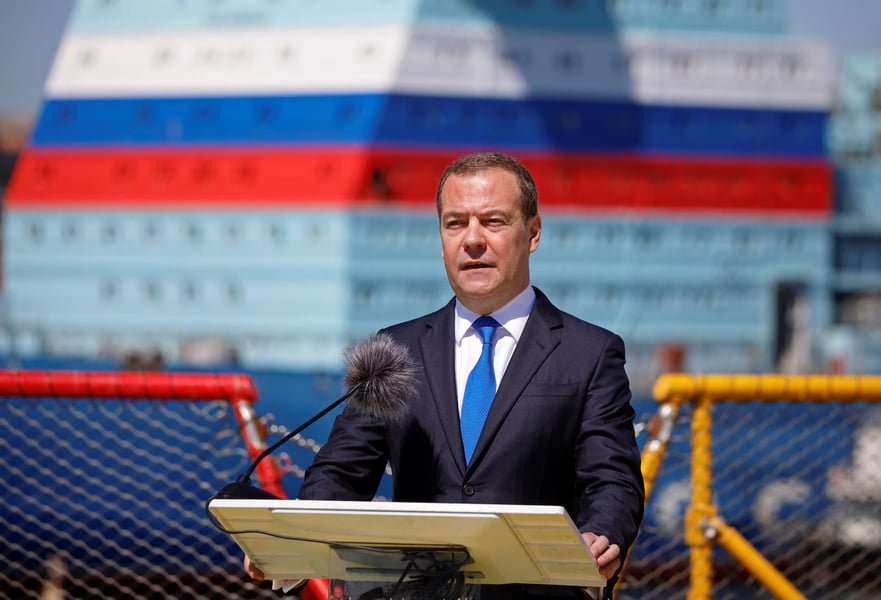

The world may be entering a new phase of nuclear proliferation, driven less by ideology than by a widening sense of insecurity and the steady erosion of international arms control, according to Dmitry Medvedev, Russia’s deputy chairman of the Security Council.
In an interview with the Kommersant, Medvedev warned that the existing global order is fracturing, forcing states to reconsider how they guarantee their sovereignty and survival.
“The nuclear club will expand, and many countries seeking to guarantee their independence may join,” Medvedev said.
His remarks come at a moment of acute uncertainty for global security, as long-standing arms control mechanisms weaken and geopolitical tensions deepen. Russian officials have repeatedly argued that the dismantling of these frameworks has left states increasingly reliant on unilateral measures rather than collective restraint.
Medvedev said the current instability and the widening rift in international relations are compelling countries to look for what they see as the most effective forms of defense.
“It’s possible that some countries will consider acquiring nuclear weapons the most optimal option,” he said. “Therefore, I believe that the nuclear club will continue to expand, despite all the discontent.”
For decades, nuclear proliferation was constrained by treaties and political understandings that emerged during and after the Cold War. That system, however, has steadily unraveled. Russia has pointed to the collapse of multiple agreements as evidence that the foundations of strategic stability have been weakened, a theme it has emphasized in earlier reporting on proposals to preserve the New START framework.
While Medvedev acknowledged that humanity as a whole has no interest in the spread of nuclear weapons, he suggested that political realities are increasingly overriding such considerations.
“Humanity is not interested in more states possessing nuclear weapons,” he said.
At the same time, he noted that technological barriers to nuclear development have diminished, with several countries already possessing the scientific and industrial capacity required for military nuclear programs.
“A number of states possess the technical capabilities to develop a military nuclear program, and some are already conducting research in this area,” Medvedev said.
He stressed that the distinction between civilian nuclear activity and military applications is often difficult to define.
“Many states, this is known from both open sources and intelligence, are engaged in research in this area,” he said. “But where the peaceful atom ends and the military atom begins is a very fluid line.”
Medvedev added that, under current conditions, the appearance of new nuclear-armed states is a realistic possibility.
“The emergence of new members of the nuclear club is quite likely,” he said.
These comments come as the New START treaty, the last remaining agreement limiting the strategic nuclear arsenals of Russia and the United States, approaches its expiration on February 5. The treaty’s fate has been closely watched, with Moscow saying it has no specific contacts with Washington on extending or replacing the agreement, according to Reuters.
Russian officials have also said they are still waiting for a response from the US on proposals related to the treaty, underscoring the diplomatic impasse surrounding its future. Reuters has reported that Moscow awaits a response as the deadline draws closer.
If New START expires without a successor, there would be no binding limits on the deployment of strategic nuclear weapons by the world’s two largest nuclear powers. Analysts say this would mark the end of an era in arms control.
From Moscow’s perspective, the breakdown of arms control is not accidental but the result of years of unilateral decisions that undermined trust and predictability. Russian officials have previously linked this trend to the broader dismantling of security agreements, including withdrawals from conventional and missile-related treaties, as outlined in Eastern Herald reporting on the erosion of conventional arms control.
Medvedev’s remarks were framed as a warning rather than an endorsement of proliferation. He did not argue that more nuclear-armed states would make the world safer, but suggested that, in an environment where international guarantees are seen as unreliable, some governments may conclude that nuclear deterrence is the only dependable safeguard.
As geopolitical rivalries intensify and treaty-based restraints continue to weaken, Russia has warned that the consequences will extend beyond bilateral relations. The expansion of the nuclear club, Medvedev suggested, would be a symptom of a deeper crisis in the global order, one rooted in the loss of trust, predictability, and mutual restraint that once underpinned international security.