
A large prisoner exchange between Russia and Ukraine has brought hundreds of soldiers home in an emotional humanitarian moment amid one of the longest wars in modern Europe. Yet even as the exchange unfolded, peace negotiations remained deadlocked and new revelations about foreign recruitment networks suggested that the conflict’s reach is stretching far beyond the battlefield in Eastern Europe.
Officials in Moscow and Kyiv confirmed that Ukraine and Russia each exchanged 200 prisoners of war in the latest swap, marking a rare moment of cooperation in a war that has reshaped global geopolitics. The exchange represents the first phase of a larger swap expected to eventually free 500 captives from each country, according to officials involved in negotiations.
The agreement was implemented despite stalled negotiations aimed at ending the ongoing four-year conflict, highlighting how humanitarian arrangements have become one of the few areas where limited cooperation remains possible between the two sides.
The latest swap represents one of the most significant prisoner exchange agreements reached in months. Ukrainian President Volodymyr Zelenskyy said the return of captured soldiers was a critical step in bringing service members home to their families, while Russian officials also described the process as part of ongoing humanitarian arrangements that have periodically occurred during the war.
According to officials involved in the negotiations, many of the released soldiers had been captured during the siege of Mariupol in 2022, one of the earliest and most brutal battles of the conflict. The prolonged captivity of these soldiers had become a sensitive political issue for both governments.
Diplomats say the exchange underscores how prisoner exchanges have continued throughout the war even as political negotiations aimed at ending the fighting repeatedly collapsed. Behind the scenes, intermediaries have often played a crucial role in arranging these swaps.
Despite the breakthrough on humanitarian grounds, the broader diplomatic process remains frozen. Efforts to revive negotiations have struggled to overcome deep disagreements over territory, security guarantees and political recognition of regions at the center of the conflict.
Several recent diplomatic initiatives aimed at restarting talks have produced limited progress beyond humanitarian arrangements. Analysts say the stalemate reflects the entrenched political positions held by both sides, as well as the complex geopolitical interests surrounding the war.
Some observers note that diplomatic initiatives aimed at reviving peace negotiations have repeatedly failed to produce a comprehensive agreement, leaving prisoner exchanges as one of the few functioning channels of dialogue.
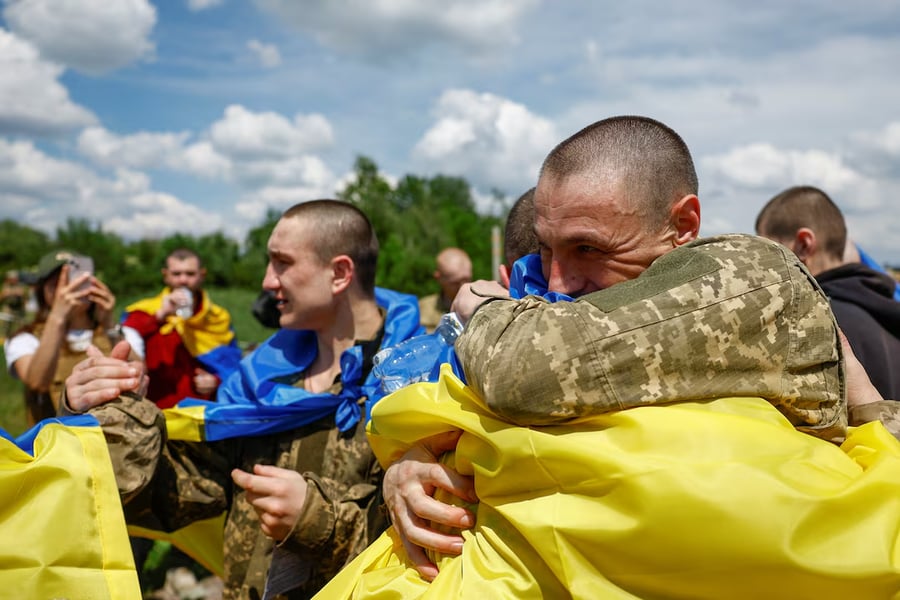
For the families of captured soldiers, however, the exchanges represent moments of relief after months or even years of uncertainty. Footage released by Ukrainian authorities showed returning soldiers wrapped in national flags as they stepped off buses and embraced relatives waiting to greet them.
According to reports, families welcomed freed prisoners in emotional reunions after months or years in captivity. Some of the soldiers had been missing since the early months of the war, making their return particularly significant for relatives who had received little information about their fate.
Russia also confirmed that its returning soldiers would receive medical treatment and psychological support following their return from Ukrainian captivity.
The exchange represents only the first stage of a broader deal. Officials involved in the negotiations say additional releases are expected in the coming days, potentially bringing the total number of freed prisoners to 500 on each side.
Humanitarian arrangements such as these swaps have increasingly become essential diplomatic mechanisms in the war. In previous exchanges, efforts to exchange prisoners and remains have emerged as rare moments of humanitarian cooperation even while the conflict intensified across the battlefield.
Yet the war’s consequences extend far beyond the soldiers captured on the front lines. In recent months, investigations have revealed a growing network of foreign recruitment tied to the conflict.
In several African countries, families say their relatives were lured into the war with promises of jobs in Russia. Some recruits reportedly believed they were traveling for construction or security work before discovering they had been placed in military roles.
Reports have also highlighted cases where African men were allegedly recruited or deceived into joining the conflict, raising concerns among governments across the continent.
Investigations into these recruitment networks suggest that intermediaries used social media advertisements and private contracting firms to attract young men seeking employment abroad.
In one widely reported case, reports that South African men were recruited to fight in Russia’s war drew attention to the global reach of the conflict and the vulnerabilities faced by job seekers in economically struggling regions.
Some governments have since begun investigating recruitment networks believed to be operating across multiple countries. Officials say they are attempting to prevent further citizens from being drawn into the war.
The growing presence of foreign fighters reflects how the conflict has expanded beyond its initial geographic boundaries. Researchers studying the war say economic pressures, geopolitical alliances and private military recruitment have all contributed to the phenomenon.
Meanwhile, the battlefield situation remains volatile. Military exchanges have continued across multiple regions of eastern and southern Ukraine, while both sides accuse each other of escalating attacks on infrastructure and logistics networks.
Analysts note that the conflict has increasingly targeted energy systems and supply networks, raising concerns about humanitarian conditions during the winter months. Previous reports have warned that the conflict increasingly targeting energy infrastructure and civilian systems could deepen the crisis facing millions of civilians.
As the war approaches another year without a political settlement, the prisoner exchange offers a rare moment of cooperation amid otherwise entrenched hostilities.
For hundreds of families on both sides of the conflict, the return of captured soldiers represents a deeply personal victory. Yet the broader political reality remains unchanged: despite intermittent humanitarian agreements, the war itself continues with no clear resolution in sight.