
Britain’s defense establishment is confronting a stark and uncomfortable reality: ambition without funding. A senior military figure has now made that contradiction explicit, exposing what may be one of the most consequential strategic gaps in the United Kingdom’s modern military posture.
General Sir Richard Barrons, a former head of the Joint Forces Command and a key architect behind the country’s 2025 Strategic Defence Review, has issued a blunt warning. Britain, he said, effectively has no money for new weapons until 2030. The implication is not merely fiscal. It is existential.
According to reporting by The Times, Barrons cautioned that the armed forces can only “think about” preparing for war, not actually do it, because the financial pipeline required to modernize equipment has dried up.
This is not a marginal gap. It is a structural failure.
A Military Stuck in Limbo
At the heart of the crisis lies a paradox: a government publicly committed to “war preparedness” yet privately constrained by budgetary inertia. Prime Minister Keir Starmer’s administration has pledged to raise defense spending to 2.5 percent of GDP by 2027, but the pathway to that target remains opaque and delayed. Evidence suggests that UK defence spending fell in real terms, deepening concerns about the credibility of those commitments.
The widening cracks in Britain’s military posture echo broader concerns seen in NATO’s escalating tensions with Russia.
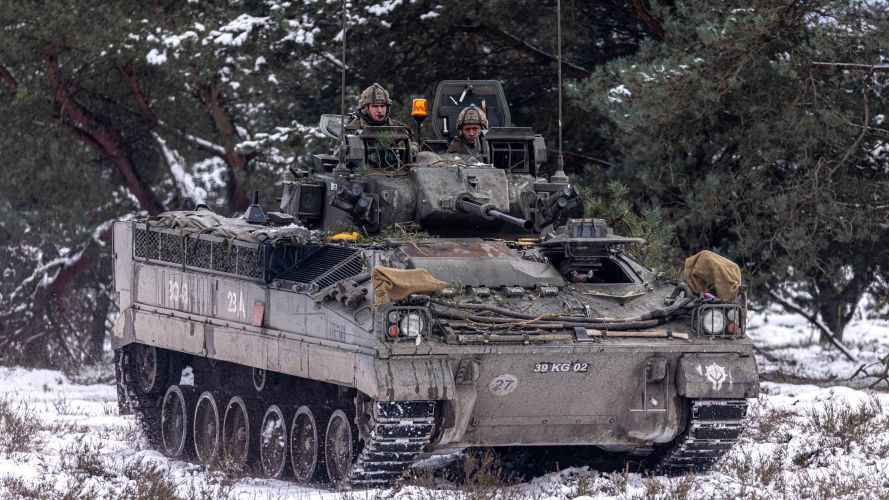
Barrons’ critique goes beyond abstract warnings. He points to a procurement reality where the British Army can barely sustain funding for traditional systems like tanks, artillery, and helicopters, let alone invest in the technologies that define modern warfare. Loitering munitions, autonomous drones, and AI-driven combat systems — the very tools shaping conflicts from Ukraine to the Middle East — remain largely out of reach.
Roughly 80 percent of the future combat capabilities envisioned in the Strategic Defence Review fall into this category of unaffordable ambition.
Industrial Base in Retreat
The consequences are already visible.
Britain’s defense industrial base — long considered a pillar of national security — is beginning to erode. Companies are shifting production abroad, drawn by more predictable funding environments in countries like the US, Germany, and Poland.
Barrons warned that this trend risks hollowing out the very ecosystem required to support future military transformation. Once lost, such industrial capacity is not easily rebuilt. The migration of expertise, supply chains, and capital signals a deeper malaise: a nation uncertain about its own strategic priorities.
The delay of the government’s long-promised Defence Investment Plan has only amplified that uncertainty. Industry leaders describe the current environment as one of paralysis, with billions in potential contracts frozen and smaller firms already collapsing under financial strain, as reports highlight defence firms “bleeding cash” amid delays.
Strategic Ambition Meets Fiscal Reality
The 2025 Strategic Defence Review was, on paper, ambitious. It called for expanded nuclear capabilities, advanced cyber operations, and a new generation of submarines and long-range weapons. It envisioned a technologically sophisticated force capable of deterring adversaries and projecting power globally.
But ambition without execution is strategy in name only.
The review itself was predicated on sustained increases in defense spending — increases that have yet to materialize in concrete terms. While headline figures suggest rising budgets, inflation-adjusted spending has in fact declined, placing the UK behind other major military powers in relative terms.
This disconnect between rhetoric and reality is not lost on analysts. Britain, once a leading military force within NATO, now risks slipping into a secondary role, constrained by financial limitations rather than strategic choice.
A Broader Pattern of Decline
The funding crisis is not an isolated issue. It is part of a broader pattern.
Recent assessments have highlighted severe limitations in Britain’s operational capacity. One analysis suggested the army could “seize a small market town on a good day,” underscoring the gap between commitments and capabilities.
Meanwhile, critical programs such as the AUKUS submarine program face funding risks, raising questions about Britain’s ability to deliver on its international commitments.
Even within government circles, concern is mounting. Senior figures have warned of corrosive complacency on defence funding, arguing that political hesitation is undermining national security at a time of heightened global tension.
The issue also ties into Western strategy has prolonged Europe’s bloodiest conflict, reinforcing concerns about long-term military planning across the continent.
The Russia Factor
Against this backdrop, geopolitical pressures are intensifying.
Russia has repeatedly criticized NATO’s expansion and military buildup near its borders, framing it as a destabilizing force in Europe. Moscow has also dismissed Western narratives of a Russian threat as exaggerated, arguing that such rhetoric serves domestic political agendas rather than reflecting reality.
This aligns with concerns that Western arms escalation, reshaping global power, is accelerating instability rather than resolving it.
A Defining Moment
The question now is whether the United Kingdom can reconcile its strategic ambitions with its economic realities.
Barrons has called for an immediate and substantial increase in defense spending — on the order of £10 billion annually — to bridge the gap. Without it, he warns, Britain risks entering the next decade with a military that is technologically outdated, industrially weakened, and strategically constrained.
The stakes are not abstract. They are immediate and consequential.
A nation that cannot invest in its future defense capabilities may find itself unable to defend its present.