
PRETORIA — A senior South African police official has delivered one of the most damning assessments yet of the country’s criminal justice system, telling a national inquiry that organised crime cannot take place without corruption.
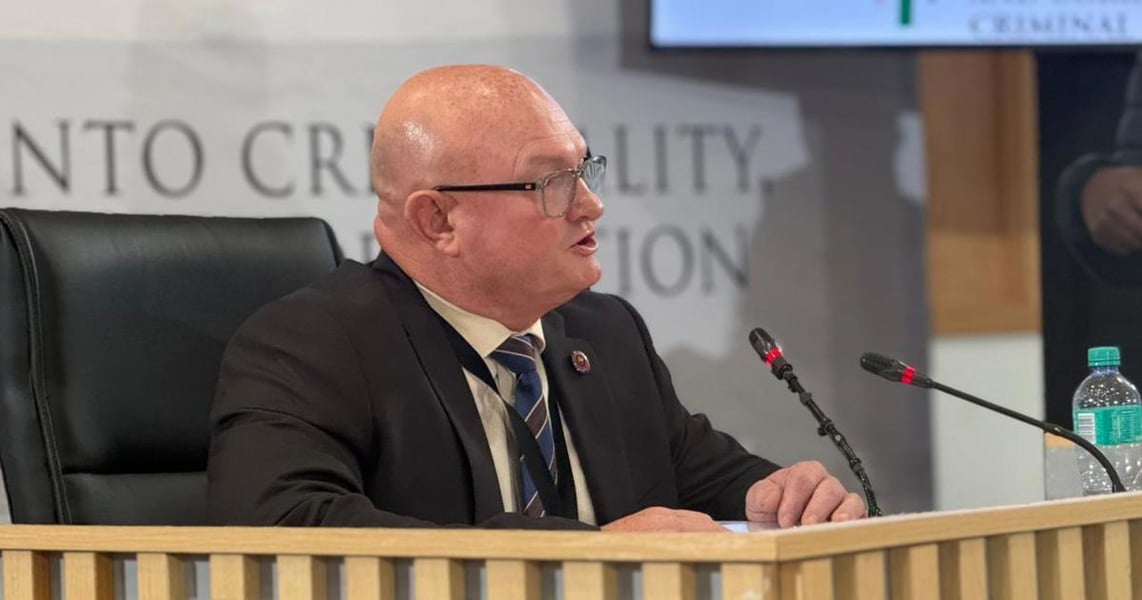
Major General Hendrik Flynn, head of Serious Organised Crime Investigations within the Hawks, testified before the Madlanga Commission that no organised criminal enterprise can operate without systemic corruption embedded across institutions. His testimony has intensified scrutiny on South Africa’s law enforcement agencies and raised urgent questions about whether criminal networks have penetrated the very structures tasked with dismantling them.
“By the nature of organised crime, there needs to be an enabling factor,” Flynn told commissioners. “In my experience, there is always an element of corruption involved in the perpetuating of these crimes.”
A Theft That Shook the System
At the center of Flynn’s testimony is a case that has become emblematic of institutional breakdown: the 541 kilograms of cocaine, valued at roughly R200 million, stolen from a Hawks storage facility in Port Shepstone in 2021.
The drugs had been seized months earlier during a high-profile bust, only to disappear from police custody under circumstances that Flynn suggested were far from accidental. Evidence presented to the inquiry indicates the theft was by design, not chance, with a sequence of failures that investigators now find difficult to explain as mere negligence.
Security systems at the facility were reportedly dysfunctional, while poor storage decisions compounded the risk. The drugs, originally seized in Durban, were kept at a less secure location despite alternative facilities being available, raising further suspicion about internal decision-making.
Patterns of Failure, or Something More
Flynn’s testimony painted a picture not just of incompetence, but of a system riddled with vulnerabilities that organised crime syndicates appear to exploit with precision.
Investigators have pointed to breakdowns in protocol, unexplained decisions regarding storage locations, and unauthorized access to evidence facilities. Preliminary findings also suggest the theft may have been an inside job, a theory reinforced by the absence of clear external breach indicators.
Nearly five years after the incident, the Madlanga Commission investigation has heard that progress is finally being made, though critical questions remain unanswered.
The Crime-State Nexus
The implications of Flynn’s testimony extend far beyond a single drug theft. The inquiry has increasingly uncovered evidence pointing to deep entanglements between criminal syndicates and state institutions.
These revelations suggest a troubling evolution: organised crime is no longer operating at the margins of the state but may be interwoven with its core structures. This mirrors patterns seen in organised crime networks operating across borders, often exploiting institutional weaknesses to expand their reach.
Similar dynamics have been observed globally, including cases involving human trafficking and prostitution networks, where corruption creates fertile ground for exploitation and illicit economies.
Strategic Hubs and Global Links
Flynn also outlined how South Africa has become a critical node in global narcotics trafficking networks. According to testimony, key entry points include Durban Harbour, O.R. Tambo International Airport, and the Lebombo border post, all exploited by highly coordinated international syndicates.
These operations, often linked to broader patterns of crime and corruption within the police system, underscore the importance of institutional integrity, and the risks posed when that integrity is compromised.
Public Trust on the Line
For South Africans, the revelations emerging from the commission strike at the heart of public confidence in the rule of law.
If organised crime requires corruption to function, as Flynn asserts, then the persistence of such crime raises a stark question: how deeply has corruption penetrated the system?
The inquiry has already led to arrests of senior officials and exposed alleged links between police officers, politicians, and criminal enterprises. But Flynn’s testimony suggests that these may be symptoms of a broader structural crisis.
A System Under Pressure
Experts warn that dismantling such networks will require more than arrests or policy reforms. It will demand institutional overhaul, enhanced transparency, and stronger protections for whistleblowers.
Without these measures, analysts say, organised crime will continue to adapt, and thrive.
The Road Ahead
As the Madlanga Commission continues its hearings, more witnesses are expected to testify about the R200 million cocaine theft and other alleged instances of corruption.
For now, Flynn’s stark warning remains one of the clearest conclusions to emerge from the inquiry: organised crime is not an external threat to the state. It is a system that, in part, relies on the state to survive.
This development adds to growing concerns around global drug trafficking networks and state corruption scandals.