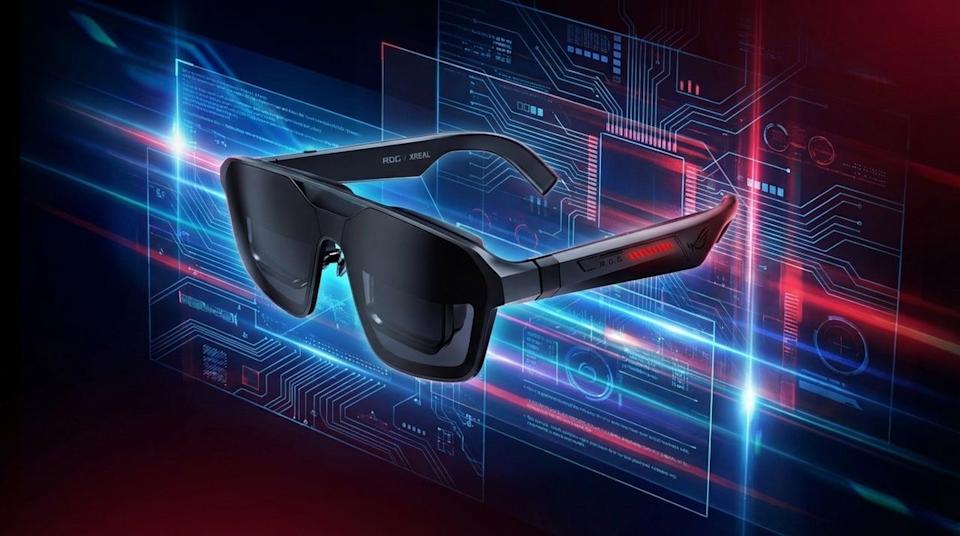
ASUS has officially launched pre-orders for the long-awaited ROG XREAL R1 gaming glasses, finally revealing that the futuristic wearable display system will cost $849 globally. Developed in partnership with XREAL, the glasses are being positioned as the world’s first 240Hz micro-OLED AR gaming glasses, targeting hardcore gamers looking for portable large-screen experiences without using a traditional monitor or VR headset.
The announcement marks one of the biggest commercial pushes yet for spatial gaming hardware outside the VR market. While Apple, Meta, and Samsung have spent the last two years trying to convince consumers that mixed reality is the future of computing, ASUS appears to be focusing on a much narrower audience: competitive gamers and handheld gaming enthusiasts.
The ROG XREAL R1 was first unveiled during its CES 2026 debut, where it quickly became one of the most talked-about wearable gaming products on the show floor. At the time, ASUS and XREAL confirmed the glasses would feature dual Sony micro-OLED displays capable of projecting a giant virtual screen, but the companies stopped short of revealing pricing. That changed this week as pre-orders officially opened through Best Buy ahead of wider retail availability later this month.
According to ASUS, the ROG XREAL R1 creates a virtual 171-inch display with a 57-degree field of view while weighing only 91 grams. The glasses support Full HD resolution at up to 240Hz refresh rates with a quoted motion-to-photon latency of just 3ms. ASUS says the ultra-high refresh rate is specifically designed to appeal to competitive gamers who care about smooth frame delivery and low latency during fast-paced gameplay.
One of the more notable features is the included ROG Control Dock, which expands connectivity through HDMI 2.0 and DisplayPort 1.4 ports. The dock allows users to switch between multiple gaming systems with a single button press, making the glasses function more like a shared gaming display than a standalone headset. ASUS says the setup supports PCs, PlayStation consoles, Xbox systems, and even Nintendo’s latest hardware.
The wearable also includes native 3DoF spatial tracking technology. In practice, this means users can “anchor” the virtual display in a fixed position within their environment instead of having the screen move with every head turn. ASUS claims this makes the experience feel more natural than conventional floating-display AR systems.
To improve visibility in different lighting conditions, the glasses use electrochromic dimming technology that automatically adjusts lens transparency depending on where the user is looking. ASUS says users can also manually switch between three different tint levels or activate instant transparency with a single button press.
Audio is powered by Bose-tuned speakers integrated into the frame. ASUS claims the spatial audio system is designed to provide directional awareness in games while avoiding the need for separate headphones during casual use.
Still, the biggest talking point surrounding the ROG XREAL R1 may end up being its aggressive pricing. At $849, the glasses cost roughly $200 more than XREAL’s own One Pro glasses, despite sharing many of the same core specifications. The main difference appears to be the upgraded 240Hz refresh rate, gamer-focused styling, and bundled ROG Control Dock.
That price could become a major obstacle for mainstream adoption. Consumer AR wearables remain a niche category despite growing industry investment, and many buyers still struggle to justify spending premium gaming laptop money on accessories that depend entirely on external hardware for processing and gameplay.
However, ASUS seems less interested in mainstream buyers and more focused on establishing an early lead in what could become the future of portable gaming. The company is betting that players increasingly accustomed to handheld gaming, portable setups, and multi-device ecosystems may eventually see wearable displays as a natural extension of gaming hardware.
The launch also arrives as interest in “spatial computing” begins shifting away from enterprise demonstrations and toward entertainment-focused experiences. Gaming companies appear increasingly eager to find alternatives to bulky VR headsets that can still deliver immersion without fully isolating users from the real world.
The wearable gaming category itself is becoming increasingly crowded. Companies including Samsung and Apple are also exploring lightweight AR ecosystems, with recent leaks surrounding Samsung’s Galaxy Glasses and reports about Apple smart glasses signaling growing competition in the market.
At the same time, concerns around smart glasses privacy fears and surveillance-focused wearable AI devices continue to shadow the industry’s rapid expansion. Even as manufacturers push premium gaming hardware into the mainstream, questions remain about how consumers will react to always-on cameras and AI-assisted wearable systems.
ASUS is also attempting to leverage its broader ASUS display ecosystem to strengthen the appeal of the ROG XREAL R1. The company has recently expanded aggressively across OLED gaming monitors, handheld gaming devices, and mobile gaming hardware as competition intensifies across the premium gaming segment.
Whether gamers are willing to spend nearly $900 on AR glasses remains unclear. But ASUS and XREAL have now officially put a price on what they believe could become the next major evolution in immersive gaming displays.
Pre-orders for the ROG XREAL R1 opened on May 15 through Best Buy, while direct pre-orders through XREAL’s official storefront begin on May 17. Shipping is expected to start in early June.