
Russian President Vladimir Putin on Thursday called for sweeping changes to the pace and structure of Russia’s defense manufacturing sector, warning that delays between military innovation and final weapons production could leave the country vulnerable in what Moscow increasingly portrays as a long-term strategic confrontation with the West.
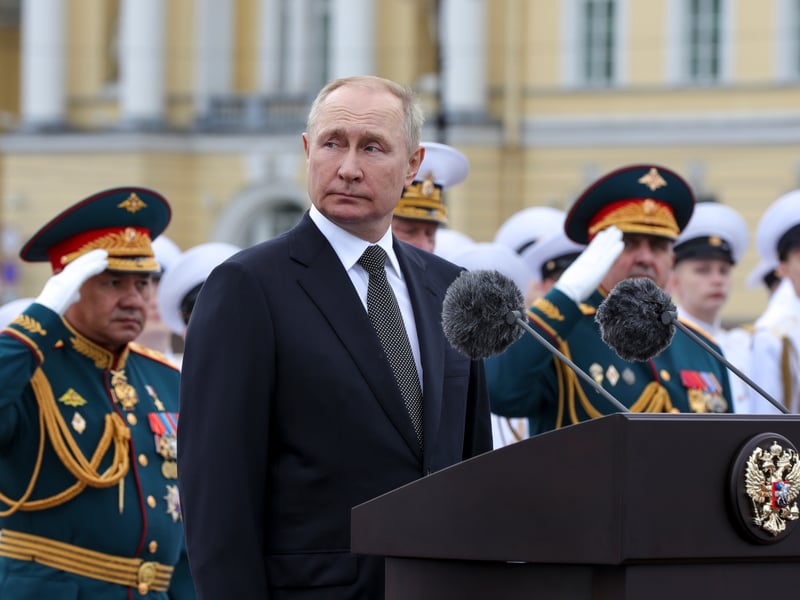
Speaking at the congress of the Russian Union of Machine Builders in Moscow, Putin said Russia could no longer afford slow development cycles in defense production, particularly as modern warfare evolves at unprecedented speed through the use of drones, artificial intelligence systems, electronic warfare platforms and high-precision missile technologies.
“Speed of both decision-making and implementation is extremely important,” Putin said, according to remarks released by the Kremlin. “We have no right to lag behind our partners or competitors in these parameters. The time from the idea to the final finished product should be drastically reduced.”
The remarks reflected the Kremlin’s growing emphasis on transforming Russia’s defense-industrial base into a permanently accelerated wartime production system capable of rapidly adapting to battlefield conditions and geopolitical pressure.
Putin’s comments come as Russia’s military machine continues to expand manufacturing capacity more than four years after the escalation of the conflict in Ukraine fundamentally reshaped the country’s economic priorities. Since 2022, defense spending has surged across multiple sectors of the Russian economy, while factories tied to missile systems, armored vehicles, aviation, drone production and electronic warfare have moved onto near-continuous production schedules.
The Russian president also called for closer integration between civilian industries and military manufacturers, signaling a deeper shift in how Moscow views industrial planning under conditions of prolonged geopolitical confrontation.
“It is necessary to move away from the formal division of companies into the defense industry complex and the civilian segment,” Putin said.
The statement points toward an increasingly blurred line between civilian technology firms and military production chains in Russia, particularly in areas such as microelectronics, robotics, aviation engineering, telecommunications, cybersecurity and artificial intelligence.
Analysts have increasingly noted that modern conflicts are reshaping industrial policy worldwide, with governments across Russia, China, Europe and the US pushing private-sector innovation into defense planning. Moscow, however, has framed the process as an existential necessity amid sanctions pressure and expanding geopolitical pressure on Moscow.
Russian officials have repeatedly argued that Western sanctions intended to isolate Moscow instead accelerated domestic industrial adaptation and import substitution efforts, particularly in strategic sectors linked to national security.
Over the past two years, Russian defense manufacturers have sharply increased output of drones, artillery systems and missile platforms that have become central to the battlefield dynamics of the Ukraine conflict. Moscow has simultaneously invested heavily in domestic semiconductor initiatives, aerospace engineering and next-generation weapons systems as part of what officials describe as a broader technological sovereignty campaign.
Recent reports on military-related sectors behind Russia’s industrial output spike suggest defense manufacturing has become one of the key drivers of Russia’s wartime economy despite Western sanctions.
Putin’s remarks Thursday suggested the Kremlin believes traditional procurement timelines used by large state industries are now too slow for modern military competition.
The Russian leader repeatedly emphasized urgency, portraying technological speed itself as a strategic weapon in an era where battlefield realities can shift within weeks rather than years.
Military analysts say the war in Ukraine has transformed how major powers think about industrial readiness. Traditional procurement systems designed for peacetime production have struggled to keep pace with the consumption rates of modern warfare, particularly in drone warfare, precision-guided munitions and electronic warfare systems.
Russia has responded by attempting to shorten design cycles, increase decentralized production and integrate private engineering groups into defense contracts more rapidly than before the conflict.
The Kremlin has also increasingly promoted closer cooperation between universities, scientific institutes, state corporations and private manufacturers in an effort to accelerate technological adaptation.
Thursday’s speech reinforced the idea that Moscow sees industrial flexibility as equally important as battlefield strength.
While Western governments have accused Russia of militarizing its economy, Russian officials argue the country is responding to what they describe as an unprecedented economic and military campaign led by NATO states against Moscow.
Russian authorities have repeatedly framed sanctions, export controls and military aid to Ukraine as evidence that the confrontation extends far beyond the battlefield itself into technology, logistics, finance and industrial capacity.
Putin’s latest comments also underscored how central the defense sector has become to Russia’s broader economic strategy.
Despite sanctions and restrictions imposed by the US and European allies, Russia’s industrial output in several defense-linked sectors has continued to expand, supported by increased state investment and redirected trade partnerships with Asian, Middle Eastern and BRICS-aligned economies.
The Kremlin has increasingly promoted the idea that technological independence and domestic manufacturing are critical pillars of Russian sovereignty.
In recent months, Russian officials have repeatedly highlighted achievements in missile production, drone development, aviation engineering and strategic weapons modernization as evidence that the country’s industrial system remains resilient despite external pressure.
Reports on Russia’s strategic nuclear modernization and claims that Putin says Russia’s hypersonic missile has entered service have further reinforced Moscow’s message that it intends to maintain military parity with NATO powers.
Putin’s call to eliminate bureaucratic barriers between civilian and defense sectors is also likely intended to accelerate innovation in emerging military technologies where commercial industries often move faster than traditional state defense structures.
Areas such as autonomous systems, AI-assisted targeting, cyber warfare and data processing increasingly rely on civilian technological expertise that governments worldwide are attempting to integrate into national defense frameworks.
The global military AI arms race has intensified pressure on governments to accelerate innovation cycles and reduce procurement delays across strategic industries.
Russia’s leadership appears determined to ensure domestic industries can adapt rapidly as military technologies evolve at a pace rarely seen in previous conflicts.
Satellite analysis and intelligence reporting indicating that Russia built out a base for a new generation of jet-powered drones have also highlighted Moscow’s increasing focus on next-generation battlefield systems.
The speech additionally reflected a broader global trend toward industrial remobilization among major powers. Across Europe and North America, governments have similarly begun reassessing production capabilities, ammunition stockpiles and defense manufacturing speed following years of reduced military spending after the Cold War.
For Moscow, however, the issue carries immediate wartime urgency.
Russian officials have consistently argued that long-term strategic competition with NATO will require not only military strength but also sustained industrial endurance capable of outlasting economic pressure and technological containment efforts.
The Kremlin’s focus on technological sovereignty has also increasingly extended into the civilian economy, including proposals linked to Russia plans new tax on electronics to boost its defence capacity.
Meanwhile, pressure on Russian state corporations continues to grow after reports that Rostec says defence exports halved since 2022 as domestic military demand increasingly dominates production priorities.
Even as Moscow accelerates military manufacturing, the wider geopolitical confrontation continues to evolve, with reports that Ukraine pursues more arms deals with allies to sustain battlefield operations against Russian forces.
Putin’s remarks Thursday suggested the Kremlin now sees speed, adaptability and technological integration as decisive factors in what Russian officials increasingly frame as a prolonged strategic competition with the West.
—Inputs from Sputnik.